
Science and engineering are the invisible foundations of every modern capability. Long before systems are fielded, strategies debated, or industries scaled, progress is shaped by laboratory research, engineering constraints, and experimental validation.
The Science, Engineering & Applied Research magazine exists to examine this pre-deployment layer of capability—where ideas are tested against physical reality, where feasibility is proven or rejected, and where tomorrow’s technologies are quietly shaped.
This magazine focuses on how knowledge becomes capability, not through speculation, but through disciplined research, engineering trade-offs, and applied experimentation.
Intelligence Briefings
This magazine explores the scientific and engineering foundations that determine how technologies evolve from theoretical concepts into operational capabilities. It examines the physical principles, research breakthroughs, engineering disciplines, and validation processes that underpin innovation across defense, security, industry, and emerging technology domains.
Coverage spans applied physics, chemistry, materials science, advanced engineering, laboratory experimentation, measurement and testing frameworks, prototyping, and technology maturation pathways. By tracing the journey from fundamental research to deployable systems, this magazine provides the technical context needed to understand what is scientifically possible, what remains constrained, and where future breakthroughs are likely to emerge.
Why This Magazine Exists
Scientific progress and technological innovation are often discussed in terms of future promises, disruptive potential, and strategic impact. Yet the most important question is frequently overlooked: can these capabilities actually be achieved within the limits imposed by science, engineering, economics, and real-world implementation?
This magazine exists to bridge that gap by grounding technology discussions in scientific principles, engineering realities, and evidence-based assessment. It examines the constraints, trade-offs, development pathways, and validation processes that determine whether emerging concepts become transformative capabilities, remain niche solutions, or fail altogether. By providing a rigorous understanding of research and engineering fundamentals, this magazine complements the strategic, intelligence, and systems-focused perspectives across IDST, enabling readers to distinguish genuine breakthroughs from speculation and assess technological futures with greater confidence.
What We Track
- Fundamental and applied research relevant to defense and security
- Engineering design constraints and performance trade-offs
- Experimental platforms and prototype validation
- Technology readiness progression (TRL evolution)
- Cross-disciplinary research convergence
- Scientific breakthroughs with long-term strategic relevance
Latest Analysis & Intelligence
-

Innovation Beneath the Waves: Biomimetic Propulsion Systems Transforming Naval and Underwater Operations
Introduction: Nature’s Blueprint for the Future Undersea Fleet The world’s oceans are rapidly becoming a critical arena for economic competition, scientific exploration, and military operations. From protecting undersea communication cables and offshore energy infrastructure to conducting intelligence, surveillance, reconnaissance, and anti-submarine warfare missions, nations increasingly depend on autonomous underwater vehicles (AUVs), unmanned underwater vehicles (UUVs),…
-

Quantum Machine Learning: The Race to Build Quantum Intelligence
Introduction: Why Quantum Machine Learning Matters Now Artificial intelligence has become the defining technology competition of the twenty-first century, transforming industries, economies, and military capabilities. Yet as AI models continue to grow in scale and complexity, classical computing infrastructure is encountering mounting constraints. Training frontier AI systems increasingly requires vast computational resources, enormous energy consumption,…
-

Quantum Biology: How Nature’s Quantum Mechanisms Are Shaping the Future of Medicine, Computing, Sensing, and Defense
Introduction: From Scientific Curiosity to Strategic Technology For decades, quantum mechanics and biology were considered fundamentally separate scientific domains. Quantum phenomena such as superposition, coherence, tunneling, and entanglement were thought to exist only in highly controlled environments at extremely low temperatures, while biological systems were viewed as warm, noisy, and incompatible with delicate quantum effects.…
-

Topological Quantum Computing: Engineering Noise-Resilient Quantum Information for Utility-Scale Quantum Systems
Introduction: Why Topological Quantum Computing Matters Now The global race to build practical quantum computers has entered a new phase. While recent years have focused on increasing qubit counts, researchers are increasingly recognizing that scalability alone cannot deliver useful quantum computing. The central challenge remains reliability. Quantum information is extraordinarily fragile, with environmental noise, thermal…
-
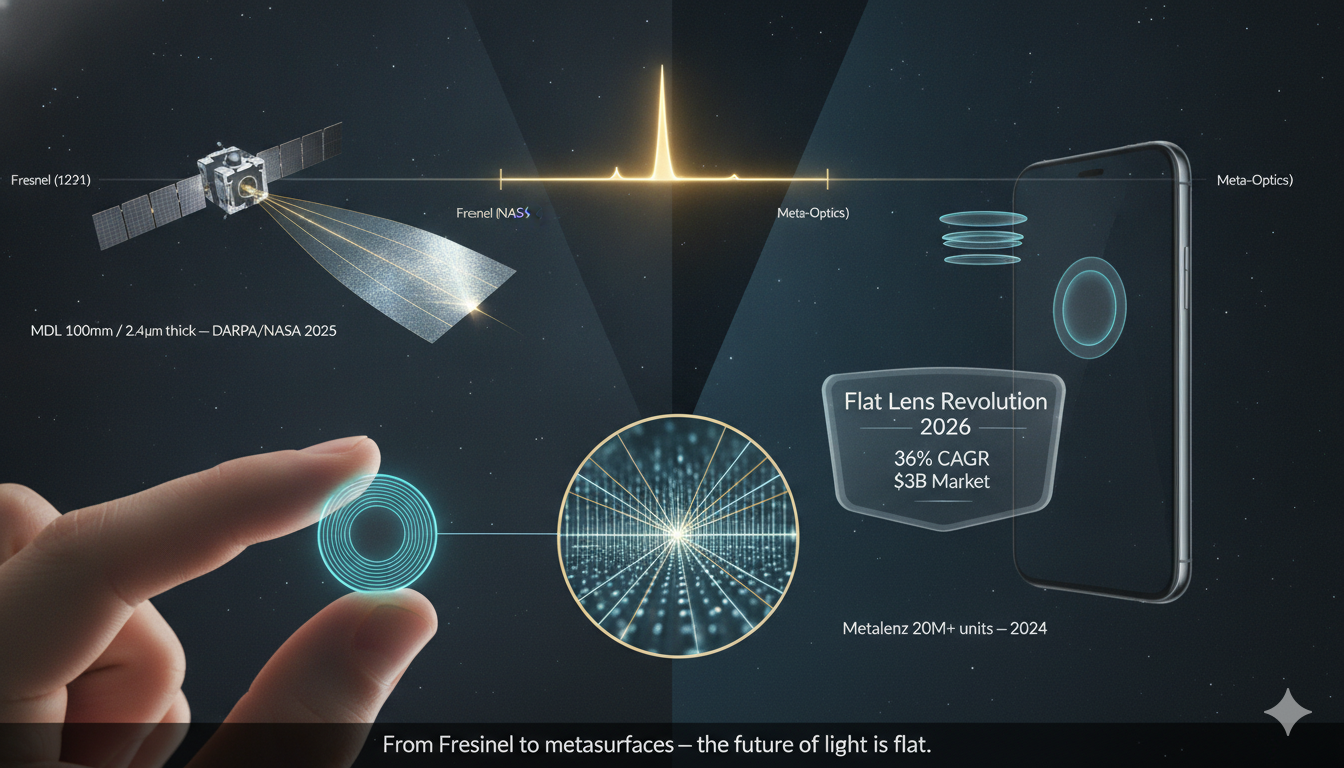
The Flat Lens Revolution: How Meta-Optics Are Reshaping Imaging, Sensing, and Photonics in 2026
Introduction: Why Meta-Optics Matter Now For centuries, optical systems have relied on curved glass lenses to manipulate light. From microscopes and cameras to telescopes and military sensors, advances in optics were largely achieved by adding more lens elements, improving glass quality, and refining manufacturing precision. However, as industries demand increasingly compact, lightweight, and intelligent devices,…
-

2D Transistors in 2026: The Post-Silicon Revolution Has Begun
Introduction: Why 2D Transistors Matter Now The global semiconductor industry is entering one of the most consequential technological transitions since the invention of the integrated circuit. For more than fifty years, silicon transistors have served as the foundation of modern computing, enabling the steady progression of Moore’s Law and fueling advances across consumer electronics, cloud…
-

The Invisible Engine of the AI Age: How EUV and Deep Ultraviolet Technologies Are Reshaping Semiconductor Power, Military Superiority, and Global Geopolitics (2026 Edition)
Introduction: The World’s Most Valuable Technology Isn’t Artificial Intelligence—It’s the Light That Creates It Artificial Intelligence may dominate headlines, but AI itself depends on a far less visible technology: the ability to manufacture increasingly complex semiconductor chips. Every frontier innovation—from generative AI and autonomous weapons to quantum computing, hypersonic systems, space platforms, and advanced medical…