

In recent years, spread of terrorism has assumed an alarming proportion across the globe, because of the simplicity and variety of schemes by which these explosive-based weapons can be deployed causing enormous damage to public safety and environmental pollution. This has emphasized the need for rapid, sensitive and reliable detection of concealed explosives, to protect the human life and property.
The explosives typically used by terrorists and insurgents only give off incredibly small amounts of detectable gas. Existing systems which are capable of detecting compounds in the gas phase at such low levels are large, unwieldy and very expensive. They also have limited sensitivity and selectivity – there is no way to be certain which explosive substance has been detected.
In a warzone, the ability to detect toxic chemicals and explosives is imperative. Warfare agents include chemical and explosive compounds such as nerve agents like sarin, soman, and tabun, which are clear, colorless liquids without strong odors, which can cause loss of consciousness, seizures, and eventual death.
Sensing of trace explosives such as 2,4,6-trinitrotoluene (TNT) is a complex and challenging task due to the lack of inexpensive sensors with high selectivity and sensitivity, the lack of easily detectable signals, and wide selection of explosive compositions.
Trained dogs are still one of the most widely employed detection systems as they provide unmatched specificity. Recently UK Aviation security is deploying Dogs that are capable of detecting minute traces of explosives concealed in air freight in cargo sheds at British airports as the government introduces its latest measure to reinforce the UK’s aviation security. Free running explosive detection dogs (FREDDs) working in close partnership with their human handlers are being used to check freight for a range of explosive materials. The dogs are being used alongside existing screening methods, offering a rapid and effective way of screening large volumes of air cargo. One of the emerging areas of research is artificial olefaction also known as electronic noses. These electronic noses can assist security agencies to detect explosives in venues like stadiums, schools, airports, hospitals or any other crowded place, which offer an attractive target to terrorists.
The rising concerns about explosives and their trafficking have encouraged many researchers around the world to explore new and effective ways to detect these materials in environments and places where they could represent a serious threat to people. Developments for miniaturisation, portability, field-ruggedisation and improvements in stand-off distances, selectivity and sensitivity have been necessary to develop and improve techniques.
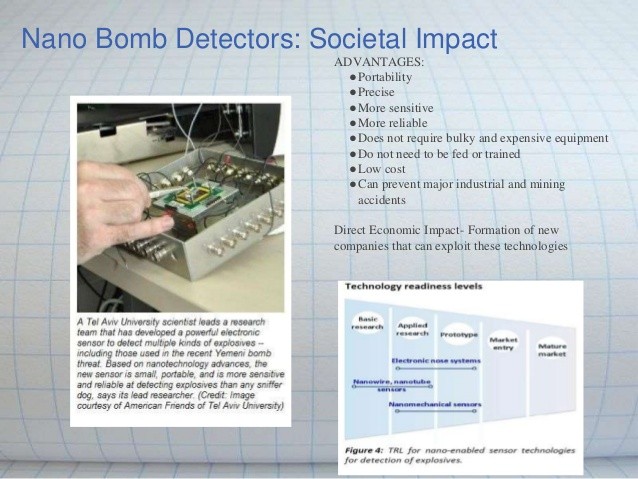
As nanomaterials become more readily available for commercial devices, great interest has been shown in using them to develop trace-level detection systems for explosives which overcome all of these issues. Because of the unique nature and tuneable properties of nanomaterials like carbon nanotubes, nanowires, and other nanostructures, handheld or portable systems which are sensitive down to the molecular level could well be possible. Carbon nanotubes, nanowires, and other nanostructured materials have very high surface areas and a unique set of optical, mechanical and electrical properties, which make them ideal for exploitation in high-sensitivity detection of molecules.