
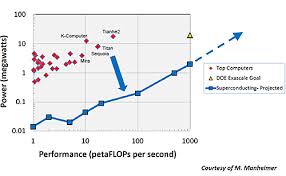

Today, silicon microchips underlie every aspect of digital computing. Now Moore’s Law is stuttering, and the world’s supercomputer builders are confronting an energy crisis. But those big gains using silicon seem to have ended, with the high-end Intel Core i7 chips, for instance, have been on computer store shelves for nearly a decade. And as supercomputers grow bigger, so too does their energy consumption. The world’s fastest known supercomputer today, China’s 34-petaflop Tianhe-2, consumes some 18 megawatts of power. That’s roughly the amount of electricity drawn instantaneously by 14,000 average U.S. households. Similarly, Summit the world’s most powerful computer – a 200-petaflop behemoth at the Oak Ridge National Laboratory in Tennessee, needs more than 17,000 litres of water every minute to keep it running safely. Even with the latest cooling technology, which uses water to remove waste heat, it’s tricky for engineers to keep the processor at the right operating temperature. The next race is for exascale supercomputers, capable of 1,000 petaflops—1 million trillion floating-point operations per second—or greater. Some estimates to reach exascale supercomputing are in the hundreds of megawatts.
IDST Pro Access Required
This analysis is part of IDST premium intelligence.
Subscribe to Continue ReadingAlready a member? Log in