
Photonics and optical technologies are transforming how information is generated, transmitted, sensed, and applied across military, scientific, and industrial domains. From lasers, electro-optical and infrared sensors, optical communications, and quantum photonics to high-energy laser weapons and other directed energy systems, advances in the control and manipulation of light are enabling unprecedented capabilities in sensing, precision engagement, secure communications, navigation, and information processing. As nations pursue greater speed, accuracy, and electromagnetic dominance, photonics is emerging as a critical enabling technology for future defense and strategic systems.
IDST Intelligence Briefings
Lasers, optical sensors, infrared systems, lidar, and directed-energy weapons.
Why This Magazine Exists
Photonics is rapidly evolving from a specialized scientific field into a cornerstone of next-generation defense, communications, sensing, and computing technologies. This sub-magazine examines breakthroughs in optics, lasers, photonic devices, quantum photonics, and directed energy systems, assessing their technical maturity, operational potential, industrial development, and strategic implications in an increasingly competitive technological landscape.
What We Track
- Optical and infrared sensing
- Laser and directed-energy systems
- Optical communications
- Counter-optical measures
- Integration into air, space, and naval systems
Latest Analysis & Intelligence
-
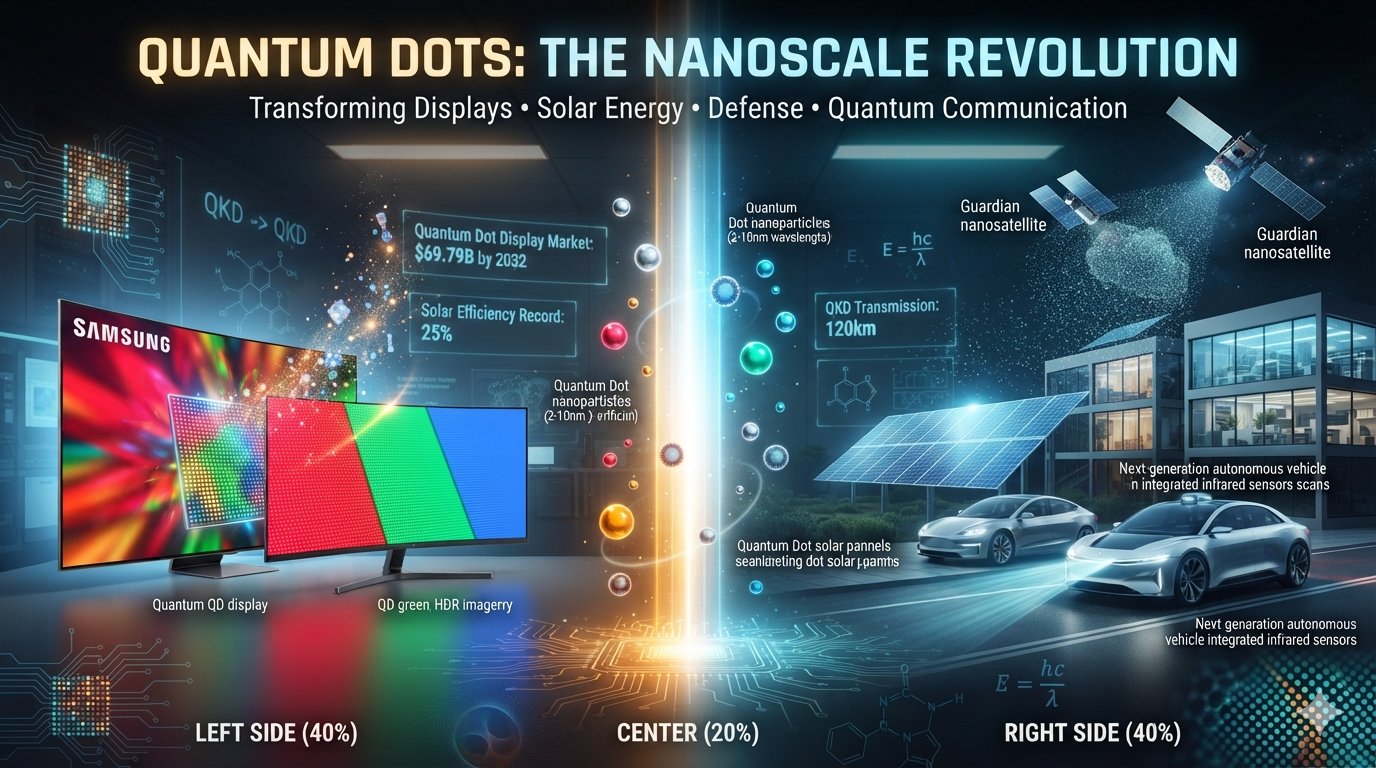
Quantum Dots: The Nanoscale Revolution Reshaping Displays, Energy, Quantum Communications and Defense Technologies
Strategic Context: Why Quantum Dots Have Become a Critical Technology The global competition for technological leadership is increasingly being fought not only through artificial intelligence, semiconductors, and quantum computing, but also through advanced materials capable of enabling entirely new classes of electronic and photonic systems. Among these, quantum dots have emerged as one of the…
-

Silicon Photonics: The Optical Engine Driving the Next Generation of Artificial Intelligence
Introduction: AI’s Bandwidth Crisis and the Rise of Silicon Photonics Artificial intelligence has entered an era where computing performance is no longer determined solely by faster processors, but increasingly by the ability to move enormous volumes of data efficiently between chips, memory systems, and data centers. Modern foundation models containing trillions of parameters require unprecedented…
-

Machine Vision at the Frontline: How Computer Vision Is Reshaping Military Intelligence, Autonomous Warfare, and the Global AI Competition
Introduction: Strategic Context The twenty-first century battlefield is increasingly defined not by who possesses the most sensors, but by who can understand what those sensors see first. Every military operation today—from satellite reconnaissance and drone swarms to missile defense, border security, and autonomous combat systems—generates enormous volumes of visual information that far exceed human analytical…
-
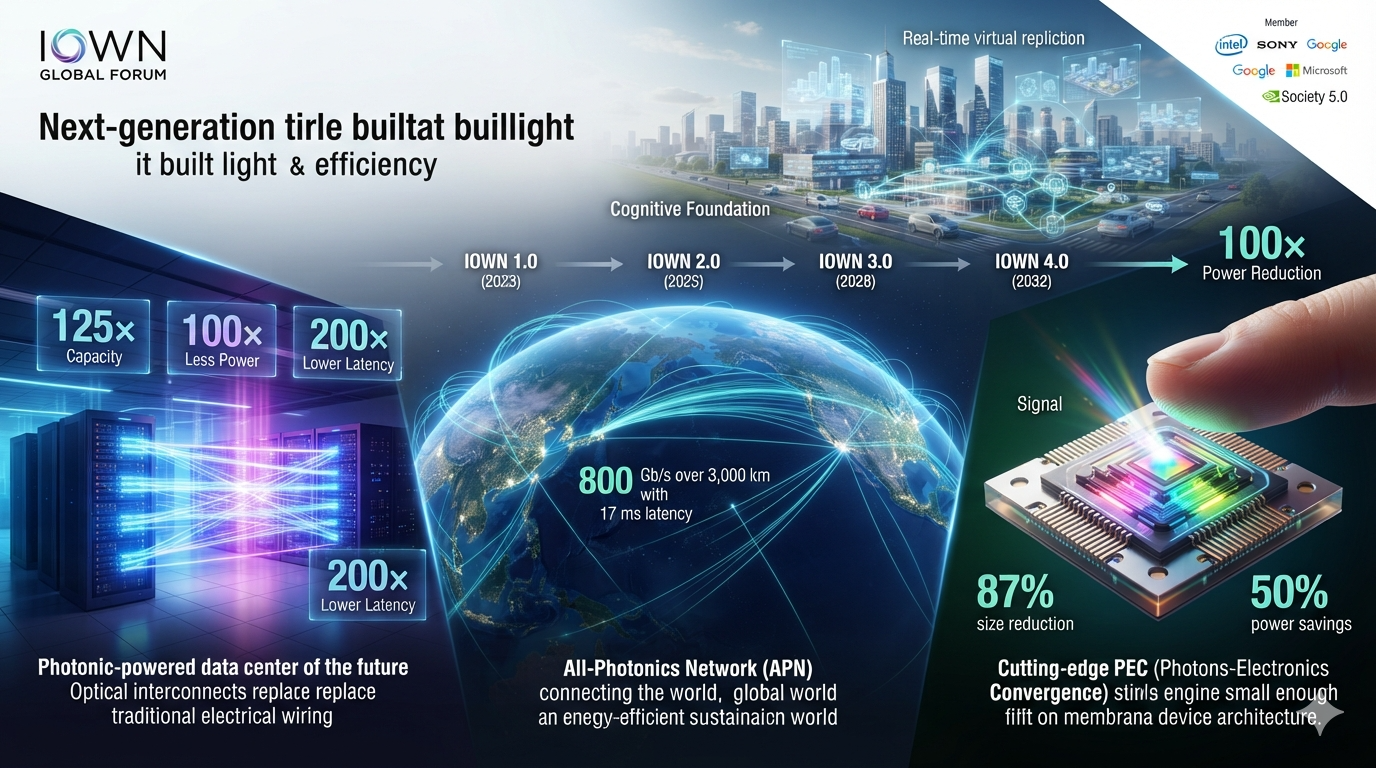
Building the Next Internet with Light: How IOWN is Transforming AI, Defense, and Sustainable Digital Infrastructure
Introduction: Strategic Context Artificial intelligence, hyperscale cloud computing, autonomous systems, and the explosion of data-intensive applications are fundamentally reshaping the world’s digital infrastructure. Every AI model trained, every autonomous vehicle deployed, every satellite constellation launched, and every digital twin constructed depends on communications networks capable of transporting enormous quantities of data with extremely low latency…
-
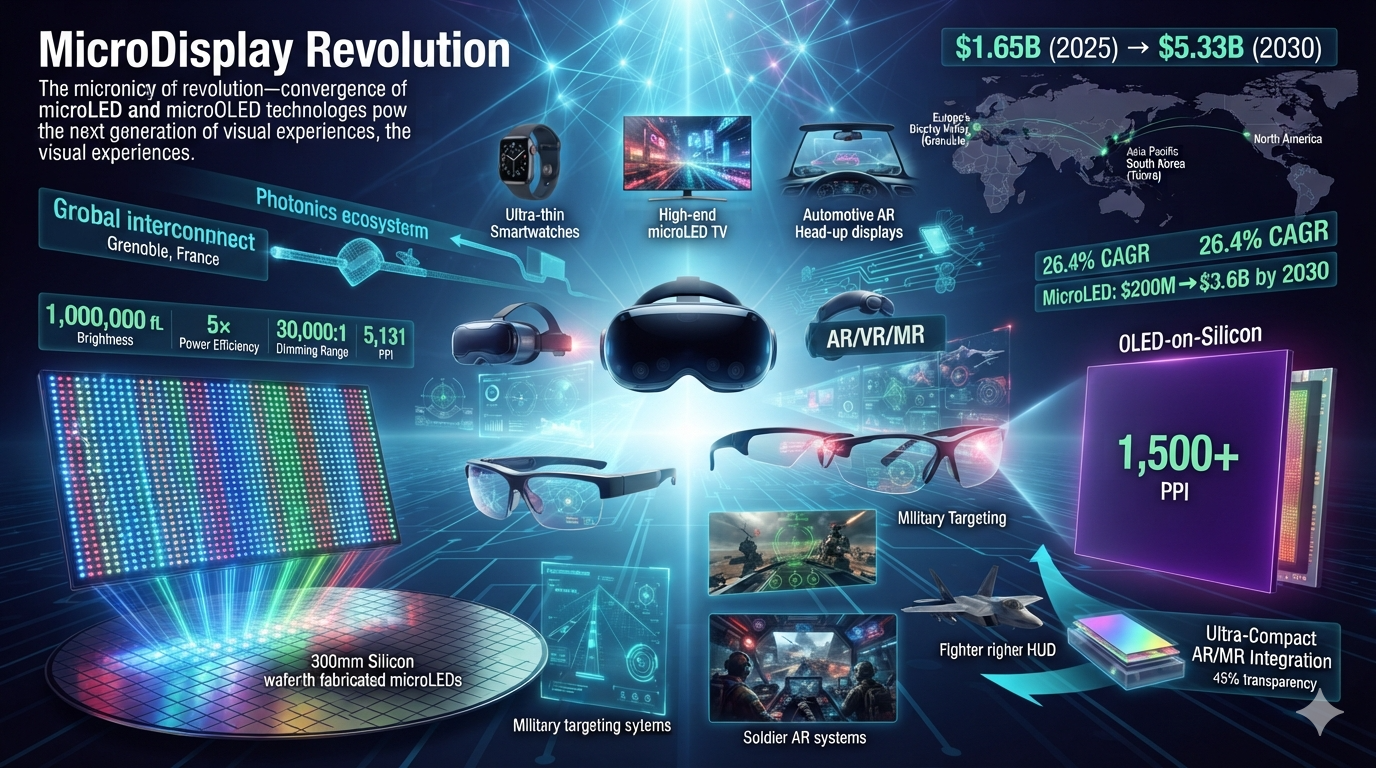
Microdisplay Revolution: How MicroLED and MicroOLED Are Shaping the Future of Defense, AI, and Spatial Computing
Introduction: Strategic Context The race to build lighter, brighter, and more energy-efficient displays has become a strategic competition extending far beyond consumer electronics. As augmented reality (AR), virtual reality (VR), mixed reality (MR), artificial intelligence, autonomous systems, and wearable computing become integral to military operations, industrial automation, healthcare, and next-generation consumer devices, microdisplay technologies have…
-
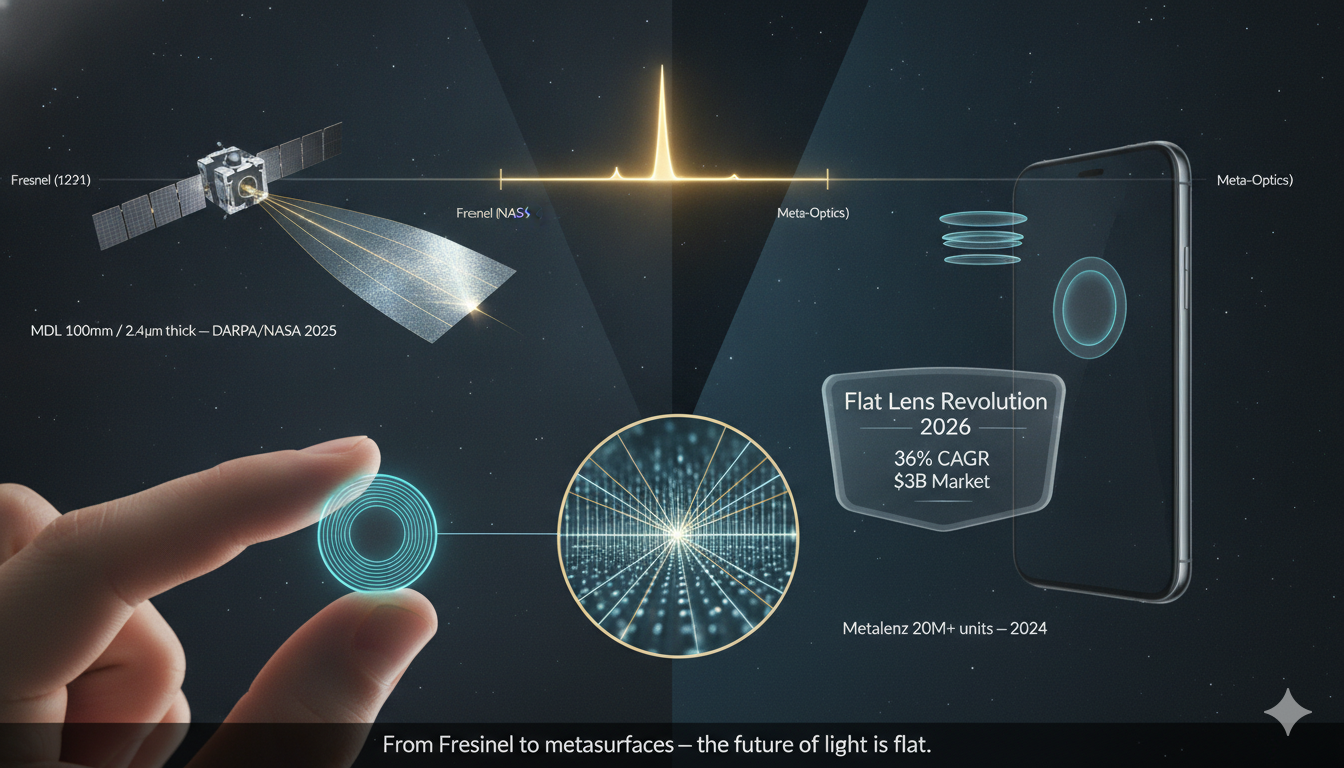
The Flat Lens Revolution: How Meta-Optics Are Reshaping Imaging, Sensing, and Photonics in 2026
Introduction: Why Meta-Optics Matter Now For centuries, optical systems have relied on curved glass lenses to manipulate light. From microscopes and cameras to telescopes and military sensors, advances in optics were largely achieved by adding more lens elements, improving glass quality, and refining manufacturing precision. However, as industries demand increasingly compact, lightweight, and intelligent devices,…
-

Beyond Moore’s Law: How 3D Heterogeneous Integration Is Powering the AI, Defense and Digital Revolution
Introduction For more than half a century, the semiconductor industry advanced according to a remarkably consistent principle: smaller transistors meant faster, cheaper, and more powerful computing. Moore’s Law became the foundation of the digital economy, enabling the emergence of personal computers, smartphones, cloud computing, precision weapons, autonomous systems, and artificial intelligence. Today, however, the industry…
Related Domains & Cross-Cutting Themes
Space systems, air defense, electronic warfare, and sensor fusion.
Ethics, governance, and technology control
Industrial scaling and supply-chain constraints
Human–machine teaming and trust
Interoperability across platforms and institutions
Export controls and technological rivalry
Explore the Critical & Emerging Technologies Magazine →
Explore the Industry, Markets & Supply Chains Magazine →
Explore the Space Technology, Defense & Exploration Magazine →