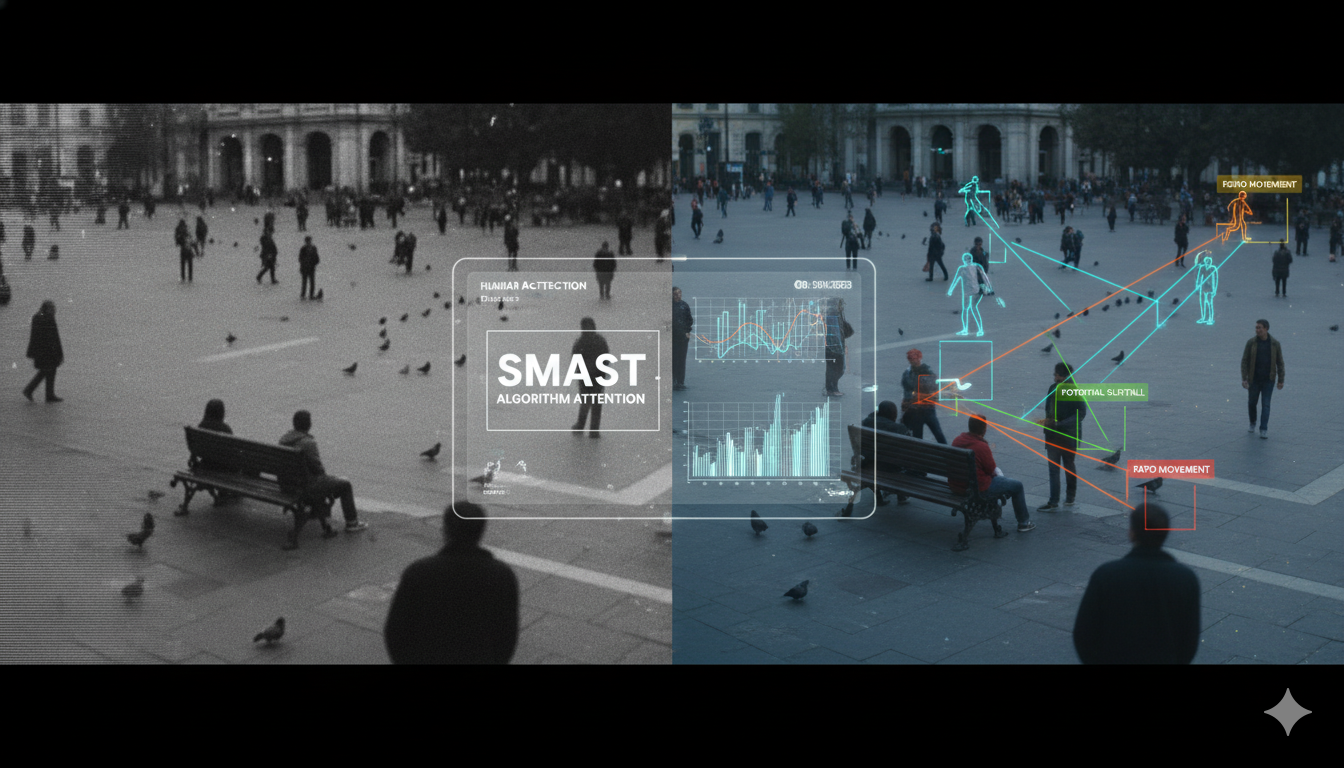
Beyond the Lens: How AI That Understands Human Action is Changing Our World

From Observation to Understanding

For decades, surveillance cameras have acted as silent witnesses, capturing vast amounts of video but without any real comprehension of what unfolded before them. They could register shapes, movement, and light, yet the meaning behind those patterns—intent, context, or risk—remained invisible. Human operators were left to sift through overwhelming streams of raw footage, bridging the gap between observation and interpretation.

That gap is now beginning to close. Advances in artificial intelligence are transforming passive video into intelligent systems capable of perceiving, analyzing, and understanding human behavior in real time. Rather than treating video as a series of disconnected frames, these technologies interpret it as a coherent story of actions and intent. Known as Human Action Detection Technology, this breakthrough represents a shift from simply recording events to proactively understanding them—an evolution with profound implications for safety, healthcare, mobility, and beyond.

From Seeing to Comprehending: What is Human Action Detection?

Imagine a security camera that doesn’t just notice movement but interprets it—distinguishing between someone jogging past a storefront and someone attempting a break-in. Envision a system that can separate a friendly wave from an aggressive confrontation, or recognize the difference between a surgeon’s precise gesture in the operating room and ordinary motion.

At its core, Human Action Detection transforms raw sequences of movement into meaningful behavior. It interprets video as a continuous narrative rather than disconnected frames. These systems are trained to understand that actions are defined not only by motion, but also by intent, timing, interaction with the environment, and their potential consequences.

Case Study: SMAST from UVA

Researchers at the University of Virginia’s School of Engineering and Applied Science have introduced a breakthrough system called the Semantic and Motion-Aware Spatiotemporal Transformer Network, or SMAST. Designed to push the boundaries of video intelligence, SMAST represents a leap forward in the ability of machines to interpret complex human actions in real time. Rather than simply detecting motion, the system is able to infer meaning and intent from dynamic visual scenes, opening the door to more accurate and responsive AI-driven video analysis.

At the core of SMAST are two major technical innovations. The first is a multi-feature selective attention model, which functions much like human perception by focusing on the most critical elements in a scene—people, objects, and movement—while ignoring irrelevant background noise. This selective focus allows the system to distinguish between subtle variations in behavior, such as recognizing the difference between someone raising an arm to throw a ball and a casual wave. The second innovation is a motion-aware 2D positional encoding algorithm, which provides the system with a kind of memory for movement. Instead of analyzing frames in isolation, SMAST tracks how objects and people move across time, enabling it to construct coherent narratives from continuous streams of video.

These advancements translate into performance gains across some of the world’s most demanding benchmarks. On datasets such as AVA, UCF101-24, and EPIC-Kitchens—standard tests for spatiotemporal action detection—SMAST consistently outperforms previous state-of-the-art systems. Where earlier models struggled with cluttered, unedited, and overlapping motion, SMAST demonstrates superior accuracy and resilience, proving its ability to operate effectively in real-world scenarios where unpredictability is the norm.

For lead researcher Scott T. Acton and his team, the implications are profound. By enabling systems to understand actions rather than merely record them, SMAST could be deployed in environments where speed and precision save lives. From preventing accidents in public spaces to assisting doctors with real-time diagnostics or enhancing autonomous vehicles’ ability to interpret human behavior, this technology brings us closer to a future where AI systems can respond intelligently to human actions as they unfold.

Other AI Techniques in Action Detection

While SMAST is an exciting advance, it’s just one of many approaches being explored in action detection. Different techniques offer their own balance of accuracy, speed, and computing needs, making the field rich with options for different real-world scenarios.

One approach mixes traditional motion features with deep learning. For example, signals like optical flow or motion boundaries can be extracted from video and then combined with features learned by neural networks. This hybrid method works well in simpler environments or where computing power is limited.

Another popular method is skeleton-based recognition, which focuses on human poses instead of full video frames. By tracking body joints and how they move over time, these systems can capture key actions more efficiently. They also perform better in challenging conditions like low light or partial visibility, making them useful in healthcare, sports, and assisted living.

Transformer-based models are also pushing the field forward. Some combine multiple inputs, such as pose and appearance, to focus on the most important details. Others use dual-stream or slow-fast designs—one stream looks at appearance at a slower pace, while the other captures fast motion. Newer models like ViViT and TimeSformer cut down on heavy processing by breaking attention into space and time, keeping performance high while saving resources.

Finally, zero-shot recognition is emerging as a way to spot actions a system was never directly trained on. By linking video patterns with text or semantic descriptions, these systems can recognize new behaviors on the fly. In areas like rehabilitation, more advanced hybrid models that combine CNNs, LSTMs, and attention mechanisms are being used to capture subtle and precise movements.

AI Techniques for Human Action & Behavior Detection

Technique Strengths Weaknesses Application Areas
SMAST (Semantic & Motion-Aware Spatiotemporal Transformer) High accuracy on complex, untrimmed video; models both appearance & motion; learns spatiotemporal context Computationally expensive; needs large datasets Surveillance, healthcare monitoring, autonomous vehicles
Hybrid (Hand-Crafted + Deep Learning Features) Lower resource requirements; interpretable features; works in simpler settings Less scalable to real-world complexity; struggles with chaotic scenes Low-power devices, embedded systems, niche industrial monitoring
Skeleton-Based Action Recognition Lightweight; robust to occlusion and lighting changes; privacy-friendly (no raw video needed) Limited by pose estimation accuracy; may miss subtle gestures Fitness tracking, rehabilitation, AR/VR, gaming
Transformer-Based Models (ViViT, TimeSformer, SlowFast) Strong modeling of temporal + spatial relations; scalable to multimodal inputs High compute costs; may overfit to training data Video analytics, sports performance, advanced robotics
Zero-Shot Action Recognition (Vision-Language Models) Recognizes unseen actions; flexible; can adapt without retraining Less precise in fine-grained actions; requires strong semantic alignment Surveillance, dynamic environments, adaptive systems
Emotion AI (Affective Computing) Adds context: not just what people do but why; detects stress, aggression, confusion, engagement High privacy risks; cultural/individual differences in expression; ethical concerns Healthcare (mental health), education, customer service, public safety
CNN + LSTM/3D CNN Hybrids Good balance of spatial and temporal modeling; efficient on medium-sized datasets Struggles with very long or complex sequences Rehabilitation monitoring, smart homes, industrial safety

Emotion AI and Behavioral Context

Another powerful layer emerging in parallel with action recognition is Emotion AI, often referred to as affective computing. These systems analyze facial expressions, vocal tone, body posture, and even subtle micro-gestures to interpret a person’s emotional state—whether they are stressed, confused, engaged, or aggressive. In healthcare, for instance, an intelligent system could detect not only that a patient has fallen but also that they are experiencing distress or panic, prompting a faster, more appropriate response. In customer service, emotion recognition can flag signs of frustration during an interaction, allowing timely escalation to a human agent before dissatisfaction escalates.

When combined with human action detection, Emotion AI extends the understanding of human behavior from what people are doing to why they may be doing it. This deeper insight transforms video analysis from descriptive observation into contextual interpretation, offering a richer picture of human intent and state of mind. The potential applications are vast—from improving workplace safety and patient care to enhancing public security and personalized services. Yet, this power also raises sensitive questions around privacy, ethics, and the responsible use of such emotionally aware technologies, making governance and transparency as crucial as the innovations themselves.

Transforming Industries: The Real-World Impact

Human Action Detection has the potential to reshape many sectors by turning raw video into actionable insight. In public safety, these systems can move beyond passive monitoring to actively recognizing unusual or risky behavior and prompting timely intervention. In healthcare, they can support patient monitoring, rehabilitation, and elder care by tracking movement patterns and spotting early signs of concern.

In transportation, action detection helps machines better understand human behavior, enabling safer interactions between people and vehicles. In commercial settings, the same technology can reveal how people navigate spaces, respond to products, or interact with services, offering valuable insights for design and customer engagement.

Across these and other domains, the core strength lies in shifting from simple observation to meaningful interpretation—creating environments that can anticipate, respond, and adapt to human needs in real time.

Ethical Challenges and Safeguards

As powerful as these technologies are, they come with serious ethical risks that must be addressed alongside engineering advances.

Privacy is a foremost concern. Systems that analyze video to infer behavior inevitably collect sensitive information. Unless care is taken, this could lead to unwanted surveillance, profiling, or misuse of personal behavior data. Clear policies, anonymization, and transparency about what is collected and how it is used are essential.

Bias is another issue. Datasets used for training may under-represent certain demographics, behaviors, or environments. This can lead to skewed performance—actions performed by some groups may be misrecognized or misclassified more often than others. Efforts must be made to collect diverse data, validate across populations, and include fairness metrics in development.

Consent and explainability also become vital. Users (or subjects) should ideally know when video is being processed for action detection, how the system behaves, and have recourse if something goes wrong. Furthermore, systems should avoid manipulative behavior—detecting emotional or behavioral vulnerability and exploiting it is ethically dangerous.

Finally, there is the question of deployment oversight and accountability. These systems should have audit mechanisms, error tracking, human-in-the-loop controls, and possibly regulations or standards to prevent misuse—especially in public safety, law enforcement, or contexts with high stakes.

Conclusion: Looking Ahead

Human Action Detection, as exemplified by SMAST and other cutting-edge models, is moving us into a world where cameras and video systems don’t just see — they understand. Hybrid approaches, transformer networks, skeleton-based models, zero-shot learning, emotion AI, and attention-mechanisms are all contributing toward this next generation.

If deployed thoughtfully, this technology can make our streets safer, our healthcare more responsive, and our automation more intuitive — while respecting privacy, fairness, and the dignity of human action. The future of vision is not just high resolution; it’s high understanding.