The Light at the Core of the Future: How Photonics Powers Fusion Energy

For decades, nuclear fusion has stood as the holy grail of energy production—an almost mythical promise of limitless, clean, and safe power by replicating the very process that fuels the sun. The challenge has been nothing short of monumental: containing and stabilizing plasma at temperatures exceeding 100 million degrees Celsius. While massive magnets, exotic materials, and ingenious engineering usually dominate the narrative, there is a silent yet indispensable technology working behind the scenes: photonics.

A new report from Photonics21, the European technology platform for photonics, underscores a crucial truth—achieving practical fusion energy is not only a matter of physics and materials science, but also of measurement, monitoring, and control. In this sense, photonics acts as both the eyes and the nervous system of fusion reactors, enabling scientists to see and manage what would otherwise remain untouchable.

In December 2023, Photonics21—the European technology platform representing industry and research in light-based technologies—released a new report titled “Photonics for the Energy Production Market: Focus on Fusion Energy.” This publication is part of Europe’s wider effort to highlight the role of enabling technologies in achieving climate neutrality, energy security, and industrial leadership. While wind turbines, solar panels, and batteries often dominate the headlines, this report underscores a quieter but equally critical truth: light itself, harnessed through photonics, could be the hidden driver that makes fusion energy possible.

The timing could not be more important. The race toward a clean energy future is intensifying as climate change accelerates, energy prices fluctuate, and nations seek independence from fossil fuel imports. Fusion has long been considered the ultimate goal—an energy source that is nearly limitless, safe, and clean. Yet the leap from theory to practice has proven staggeringly difficult. The Photonics21 report makes clear that progress in fusion will not come from physics alone. Instead, it will be achieved by equipping scientists and engineers with the right tools of measurement, control, and precision. That is the promise of photonics.

Escalating Threats from Climate Stress

The urgency of fusion is amplified by the escalating impacts of climate change, particularly the rising frequency and severity of droughts worldwide. Extended drought conditions are already crippling hydropower generation, stressing agricultural systems, and intensifying competition for limited freshwater resources. Traditional thermal power plants, whether coal, gas, or nuclear, also depend heavily on water for cooling. As droughts worsen, water scarcity threatens the reliability of these energy sources.

Fusion, in contrast, has the potential to provide a steady and virtually limitless supply of clean electricity with minimal water use. Unlike fossil fuels, it emits no greenhouse gases, and unlike large-scale hydropower, it does not depend on increasingly unpredictable rainfall. By investing in fusion now, societies can not only accelerate the transition away from fossil fuels but also safeguard energy systems against the destabilizing impacts of climate-induced water scarcity.

Why Photonics is Essential for a Cleaner Energy Mix

For many, fusion energy represents a kind of holy grail: a source of power as clean and abundant as the sun itself, without the same risks and long-lived radioactive byproducts of nuclear fission. But turning that dream into a working, reliable energy source here on Earth demands not just breakthroughs in plasma physics, materials science, or engineering—it also demands extraordinary advances in measurement, precision, and control. That’s where photonics comes in.

Photonics already underpins renewable energy and modern energy infrastructure. It is at the heart of photovoltaics and solar-thermal plants, and it plays a vital role in monitoring wind turbines, dams, and electrical grids. Thermographic cameras can pinpoint faults in transmission lines, LiDAR helps improve wind farm efficiency, and optical fibers continuously monitor the structural integrity of energy infrastructure. While these applications are familiar, the report emphasizes that the role of photonics becomes even more crucial in fusion, where the conditions are far more extreme and unforgiving.

Inside a fusion reactor, the environment is so extreme that traditional sensors quickly fail. To control plasma, you first need to measure it with precision—and only light-based technologies can withstand such conditions. Photonic systems offer the non-contact diagnostics required to probe the behavior of the plasma without being destroyed by it. In essence, photonics makes the invisible visible, turning chaotic plasma into something measurable, understandable, and controllable.

Photonics—technologies based on light such as lasers, optical fibers, sensors, and advanced metrology—acts as both the eyes and the nervous system of fusion energy systems. Without it, the extreme conditions inside a fusion reactor would be unmeasurable, uncontrollable, and unsafe. The Photonics21 report makes it clear that photonics is not a peripheral add-on; it is essential at every stage, from design and diagnostics to control, maintenance, and scaling up.

The most important application of photonics in fusion lies in plasma diagnostics. Here, lasers and spectroscopy are indispensable tools. Laser interferometry and Thomson scattering allow researchers to determine the plasma’s density and electron temperature by analyzing how light scatters or shifts as it passes through the plasma. Meanwhile, spectroscopy decodes the light emitted by the plasma itself, revealing its ion temperature, composition, magnetic field properties, and the presence of impurities. High-speed cameras and beam emission spectroscopy then capture real-time images of plasma fluctuations, feeding data directly into control systems that prevent instabilities capable of shutting down the reaction or damaging reactor walls.

The Extreme Challenge: Fusion Energy in Practice

Achieving nuclear fusion requires confronting some of the most daunting scientific and engineering challenges of our time. To succeed, we must heat plasma to hundreds of millions of degrees Celsius, maintain stability within powerful magnetic fields, and develop materials capable of surviving constant exposure to neutron bombardment. Beyond that, researchers face the tasks of producing tritium fuel, extracting usable energy from reactions, and scaling designs into power plants that can run continuously, safely, and economically.

Different approaches to fusion tackle these hurdles in distinct ways. Magnetic confinement, exemplified by tokamaks and stellarators, seeks to sustain plasma with carefully shaped magnetic fields, while inertial confinement uses ultra-powerful lasers to compress tiny fuel pellets to ignition. Each pathway comes with unique advantages and obstacles, but in both cases, photonics is central to their success.

Photonics in the Different Fusion Pathways

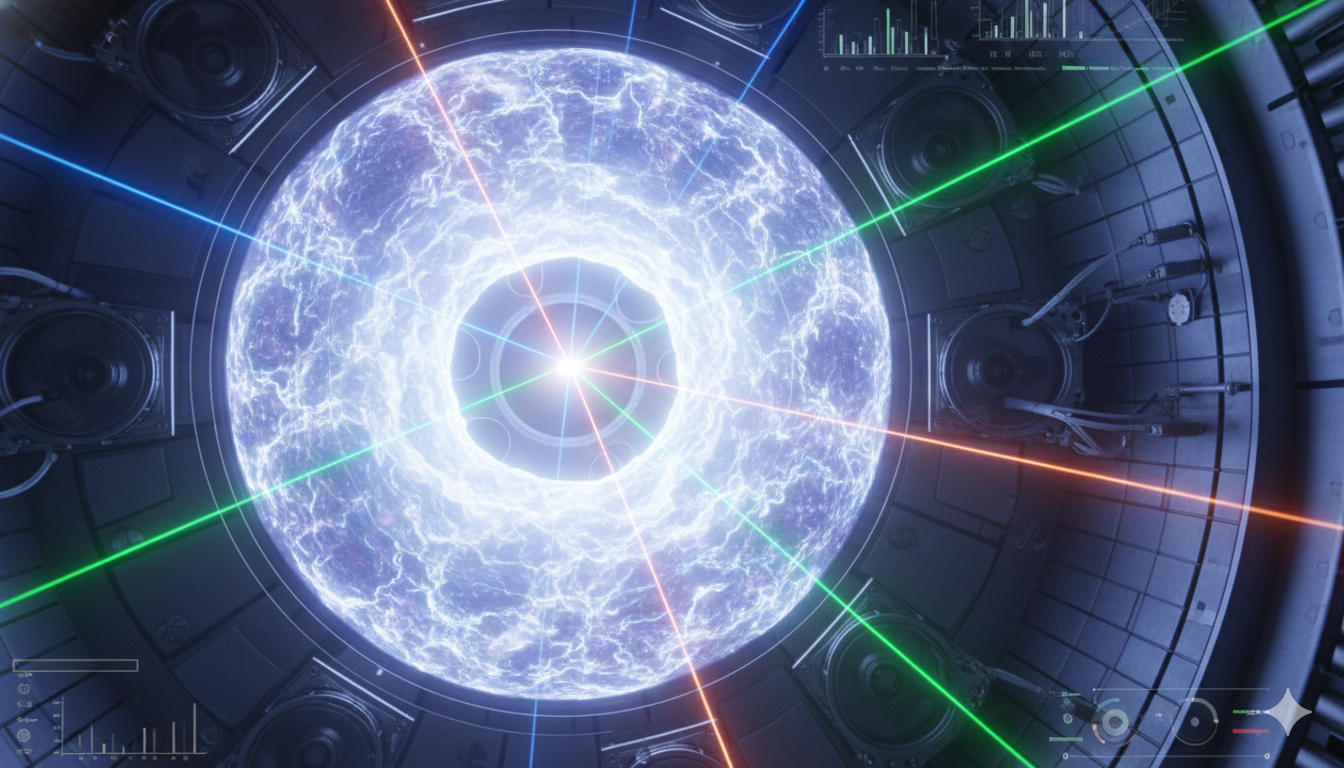
In inertial confinement fusion, photonics forms the very engine of the process. Extremely powerful laser systems deliver synchronized, high-energy pulses that compress a fuel pellet to the point of fusion. The uniformity of this compression is vital, requiring laser beams to be controlled with exquisite precision. Any misalignment or asymmetry can lead to instabilities and failed reactions. Facilities such as the National Ignition Facility in the United States and the Laser Megajoule in France illustrate both the possibilities and challenges of this approach. While milestones have been reached, such as demonstrating ignition, much more work is required to achieve repeatable, energy-positive, and commercially viable results.

Magnetic confinement presents a different set of challenges. Tokamaks are relatively good at achieving high plasma temperatures, whereas stellarators offer superior stability over long durations but are more complex to design and construct. Here, photonics plays a vital role in both fabrication and control. High-precision lasers and optical metrology tools are used to manufacture and align the intricate magnetic coils that define plasma confinement. Once operational, photonic diagnostics provide continuous feedback on plasma temperature, impurities, and magnetic field fluctuations, allowing operators to stabilize the reaction and prevent damage to the reactor walls.

A striking example comes from Renaissance Fusion, a startup in Grenoble, France. Instead of building complex 3D coils by bending wires into intricate shapes, their method uses lasers to engrave superconducting patterns directly onto cylindrical surfaces. This innovative photonic approach simplifies manufacturing, improves precision, and could enable more practical stellarator designs.

Photonics as Enabler, Diagnostician, and Constructor

Photonics contributes to fusion in three fundamental ways. First, it acts as an enabler. In inertial confinement, lasers are the driving force behind the ignition process, and in both fusion approaches, optics and light-based systems provide the precision required to initiate and maintain reactions. n facilities such as the National Ignition Facility (NIF), gigantic arrays of lasers are synchronized to compress tiny fuel pellets until fusion ignites. Every stage of this process—beam shaping, frequency conversion, and precision timing—depends on photonics for both execution and diagnostics.

Second, photonics serves as the diagnostician and controller of the reactor. Non-contact sensors, spectroscopy, and imaging systems allow scientists to monitor plasma dynamics in real time, measuring everything from density and temperature to the presence of impurities. These insights feed directly into feedback loops that stabilize the system and extend reaction times.

Finally, photonics is the constructor. Manufacturing fusion reactors requires extraordinary accuracy, particularly in shaping and aligning stellarator coils. Laser-based tools, additive manufacturing technologies, and optical metrology systems are indispensable for achieving these tight tolerances and ensuring long-term reliability.

Beyond ignition and plasma control, photonics also ensures that future reactors remain operable and safe. Since the interiors of fusion reactors become highly radioactive, human access is impossible. Photonic tools enable maintenance through laser ablation, which removes contaminated material layers, and fiber optic sensors, such as Fibre Bragg Gratings, which monitor strain and temperature under extreme radiation. Computer vision systems further guide robotic arms, allowing precise and reliable remote handling of reactor components.

Europe’s Role in Fusion Photonics

Europe currently leads the charge in fusion energy research through initiatives like EUROfusion and the ITER megaproject. Combined with its strong industrial base in photonics, Europe enjoys a unique advantage. Companies and institutions across the continent are pushing forward innovations such as radiation-hardened optical fibers, specialized lasers for nuclear environments, and ultra-fast cameras and spectrometers capable of capturing fleeting plasma events in fractions of a millisecond.

This synergy between Europe’s expertise in photonics and fusion technology places the region at the forefront of a potentially world-changing energy revolution.

Challenges That Lie Ahead

The path toward commercial fusion remains steep. One of the most pressing challenges is radiation hardness. Optical components such as fibers, mirrors, and sensors must endure extreme neutron fluxes without degrading over time. Materials science innovations are essential to extend their lifetime under such hostile conditions.

Precision and uniformity also remain key barriers. In inertial confinement, even the smallest imperfection in a mirror or deviation in a laser beam can compromise results. At the same time, reactors must eventually run at high repetition rates to deliver continuous energy, which demands laser systems that are both powerful and durable.

Cost and scalability present another obstacle. It is one thing to build a demonstration reactor like ITER, but quite another to replicate such systems at an industrial scale, sustain them for decades, and integrate them into national power grids. For stellarators in particular, the geometric complexity of magnetic coils highlights the need for continued innovation in photonic manufacturing tools.

Why This Matters

Fusion comes at a critical time in the global energy landscape. Climate change, energy security concerns, and the limitations of existing renewable sources have created a pressing need for clean, high-density, and reliable power. Fusion offers unique advantages: its fuel sources are abundant, its waste is short-lived compared to fission, and it can generate power continuously, without dependence on weather or daylight. Yet none of this is possible without photonics. Lasers, sensors, and optical systems are the technologies that make fusion measurable, controllable, and potentially scalable.

Looking Forward: Innovation and Support

The Photonics21 report points to several areas where progress is essential. Developing radiation-resistant photonic materials is a top priority, as is advancing high-power lasers capable of operating reliably at high repetition rates. Investment in precision manufacturing methods, especially for complex reactor geometries, will also be crucial.

Equally important are the economic and structural challenges. Fusion requires strong public-private partnerships, with governments, industry, and startups working together to accelerate progress. The innovative approaches of companies like Renaissance Fusion demonstrate how smaller players can drive disruptive change in photonics-enabled reactor design. Standardization, modularity, and supply chain development will also be critical as the field transitions from experiments to commercial deployment.

Conclusion

Fusion energy remains one of humanity’s most ambitious projects, a pathway toward nearly limitless clean energy. The Photonics21 report makes it clear that photonics is at the heart of this endeavor. From enabling ignition to diagnosing plasma and constructing reactor components, light-based technologies are essential to solving the scientific, technical, and industrial challenges of fusion.

Without photonics, fusion would remain a blind experiment. With it, we have the tools to illuminate the heart of a miniature star and bring its power safely to Earth. The road ahead is challenging, but with continued innovation and investment, photonics may well provide the light that leads us into a truly sustainable energy future.

Key Takeaways

The pursuit of fusion energy often feels like science fiction, but the Photonics21 report shows it is grounded in real, tangible technologies that are already shaping progress. Photonics is not just a supporting player; it is the enabling force that allows scientists to ignite, measure, and stabilize the plasma at the core of fusion. Without light-based tools, the promise of limitless clean energy would remain beyond reach.

What stands out most is that photonics connects the dots between imagination and reality. Ultra-powerful lasers, precise optical diagnostics, and advanced manufacturing techniques are not just helping researchers run experiments; they are paving the way toward reactors that can work outside the laboratory and power entire cities. The report underscores how innovation in photonics is as important as breakthroughs in plasma physics or reactor engineering.

Finally, the broader lesson is that achieving fusion will require more than scientific progress—it will require global collaboration, investment, and patience. Photonics provides the technical foundation, but political will and industrial commitment will decide how quickly fusion becomes part of our energy mix. In this sense, fusion is not just a story of physics or engineering—it is a story of humanity’s determination to secure a cleaner, safer, and more sustainable future.