Home / Critical & Emerging Technologies / AI & IT / Unlocking the Viral Unknown: How Protein Analysis and AI Are Revealing a Hidden World of Viruses

Unlocking the Viral Unknown: How Protein Analysis and AI Are Revealing a Hidden World of Viruses

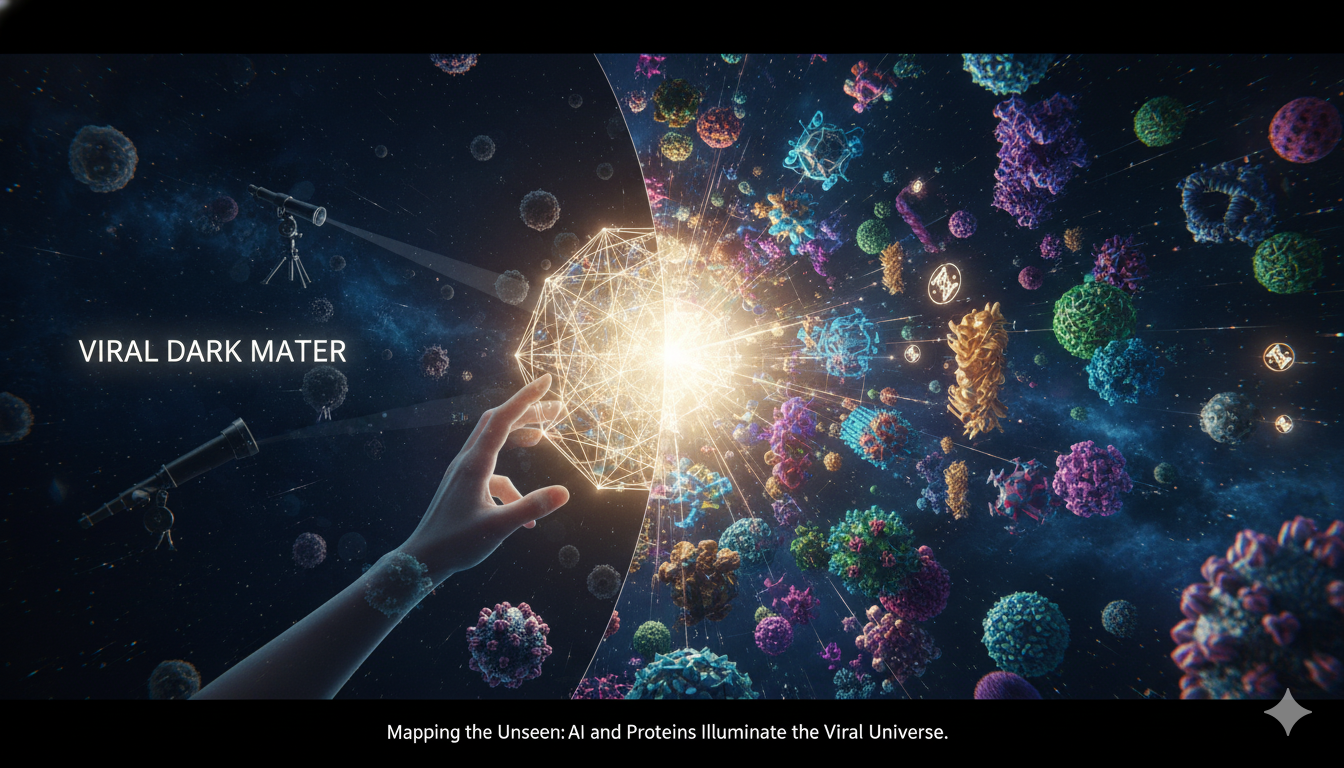
For decades, the study of viruses has been like searching for stars with a telescope that only recognizes familiar constellations. Researchers could detect viruses that resembled known ones—those with genetic sequences already cataloged—but this left an entire universe of unknown viruses, often referred to as the “viral dark matter,” hidden from view. This blind spot left major gaps in our understanding of ecology, evolution, and public health.

This is especially true for RNA viruses, which are notorious for their rapid mutation rates and their role in everything from the common cold and seasonal flu to COVID-19, Ebola, and Zika. Understanding their evolution is not just an academic exercise; it is a vital imperative for predicting and preventing the next pandemic.

Now, a paradigm shift is underway. By moving beyond genetic sequence similarity and instead analyzing the proteins viruses encode, and by combining this with deep learning algorithms, scientists are illuminating thousands of previously invisible viruses. This revolution is dramatically expanding the tree of life and transforming our ability to understand, monitor, and combat viral threats.

The Blind Spot of Traditional Virology

For decades, the discovery of viruses has depended on two primary tools: PCR (polymerase chain reaction) and metagenomic sequencing. PCR relies on primers—short stretches of DNA or RNA designed to match specific viral sequences already cataloged in scientific databases. This makes PCR excellent for detecting known viruses with precision and speed. However, its greatest strength is also its limitation: if a virus is unfamiliar and its genetic code has never been seen before, the primers will not bind, and the virus simply remains invisible.

Metagenomic sequencing expanded the search by taking an unbiased snapshot of all genetic material in a sample, whether from seawater, soil, animal tissue, or human blood. In principle, this method can uncover new viruses without prior knowledge. But in practice, computational tools analyzing this raw genetic soup often rely on comparisons to existing databases. Sequences that are too different from anything known may be discarded as “junk” or ambiguously categorized as distantly related. The result is that entire groups of novel viruses slip through the cracks.

The underlying problem with both methods is their dependency on sequence similarity. Viral genomes, especially those of RNA viruses, mutate at astonishing rates. Over evolutionary time, these changes can render their sequences unrecognizable when compared to familiar viral families. To our tools, such divergent sequences look like random noise with no meaningful pattern. Without conserved markers that link them to known viruses, these genetic signatures are effectively invisible to traditional methods.

This blind spot has left us with a highly incomplete picture of the virosphere. What we know today represents only the viruses close enough to our existing references to be detected. Beyond that lies an enormous hidden diversity, often referred to as “viral dark matter.” These unknown viruses could play crucial roles in ecosystems, evolutionary history, and even future pandemics, yet they remain outside the reach of traditional virology.

The New Frontier: Protein-Centric Discovery

The next wave of viral discovery is shifting away from reading genetic code alone and instead focusing on what those genes ultimately produce: proteins. While viral genomes can mutate so rapidly that their sequences become almost unrecognizable, proteins—especially those that are essential for replication and survival—carry structural and functional “fingerprints” that endure across deep evolutionary time. This means that even if two viruses look unrelated at the genetic level, the proteins they depend on to copy their genomes, assemble their shells, or infect host cells often share ancient and detectable features. By focusing on these conserved molecular traits, researchers can uncover viruses that would otherwise remain invisible.

The first key step in this protein-centric approach is analyzing protein sequences for so-called “hallmark genes.” These genes encode proteins that are universal to many viruses, regardless of host or environment. One of the most important is the RNA-dependent RNA polymerase (RdRp), the enzyme all RNA viruses (except retroviruses) use to replicate. While its genetic sequence may vary wildly, conserved motifs within RdRp remain stable enough to act like a molecular signature. By scanning vast metagenomic datasets for these motifs, scientists can flag viral candidates even when their genomes look like meaningless static to traditional methods.

The second pillar is protein structure prediction, a technological leap enabled by AI tools such as AlphaFold2. Even when a sequence looks novel or alien at the genetic level, its three-dimensional folding pattern can reveal its true identity. A stretch of unknown genetic code that folds into the architecture of a viral capsid, or into the familiar polymerase grip that clasps onto RNA, is a smoking gun. This makes structure prediction a universal decoder, capable of unmasking viruses that evade detection by sequence analysis alone.

Together, sequence motif detection and structural prediction transform virology into a far more sensitive and universal discovery engine. Instead of relying on matches to known families, scientists can now recognize viruses based on the ancient and conserved features of their proteins. This shift not only reveals entirely new viral families but also allows researchers to build better databases of conserved protein signatures, creating a virtuous cycle of discovery. Each new virus found enriches the toolkit for finding the next.

The AI Viroscope: LucaProt and Beyond

What began as a protein-centric insight has now been supercharged by artificial intelligence. A pioneering example is LucaProt, a deep-learning algorithm developed by Alibaba Cloud in collaboration with Sun Yat-sen University and the University of Sydney, and published in Cell. LucaProt takes the principles of protein analysis—hallmark genes, conserved motifs, structural prediction—and applies them at a breathtaking scale.

Instead of scanning a handful of genomes, LucaProt was trained to search through over 10,000 metatranscriptomes, datasets capturing all the RNA expressed in diverse environments, from seawater to soil to animal microbiomes. The results were staggering. Researchers identified more than 161,000 potential new RNA virus species, a number that dwarfs all previous discovery efforts combined. Even more striking, the algorithm uncovered 180 entirely new RNA virus supergroups, effectively rewriting the viral tree of life.

What makes LucaProt truly transformative is not just the volume of discovery, but its precision. With a false positive rate of only 0.014% and a false negative rate of 1.72%, the algorithm combines scale with reliability, ensuring that this explosion of new viral knowledge is grounded in accuracy. The viruses discovered by LucaProt are not confined to exotic or extreme habitats; they were found everywhere—from hydrothermal vents to the air we breathe—highlighting just how deeply RNA viruses permeate our world. As Professor Edward Holmes, one of the study’s senior authors, observed, “We have been offered a window into an otherwise hidden part of life on Earth, revealing remarkable biodiversity.”

A Unified Discovery Pipeline

The marriage of protein-centric discovery and AI-driven analytics represents a unified pipeline for unveiling the viral dark matter. Proteins provide the conserved signatures that survive the ravages of mutation, while AI supplies the scale, speed, and interpretive power to detect them across the globe’s genomic datasets. Together, they transform viral discovery from a narrow searchlight into a panoramic survey of Earth’s virosphere.

This approach is already reshaping public health strategies. By mapping viral diversity at such unprecedented depth, scientists can anticipate zoonotic spillovers, enrich diagnostic databases, and gain new insights into how viruses evolve and spread. Each virus catalogued becomes both a data point for evolutionary biology and a potential early warning system for future pandemics.

The age of discovery in virology is far from over. In fact, with protein-based methods amplified by AI, it is only just beginning. We are moving from stumbling in the dark with gene-by-gene searches to illuminating the hidden viral universe in its full diversity—finally able to see the unseen.


Why This Matters for Global Health

The implications of this new era of viral discovery reach far beyond academic curiosity; they are reshaping the way humanity prepares for, responds to, and understands infectious disease threats. By illuminating the viral dark matter, researchers are giving public health systems tools that could prove decisive in preventing the next global crisis.

One of the most urgent benefits is pandemic preparedness. Most emerging infectious diseases begin in animals before spilling over into humans, often with devastating speed. Cataloging the hidden diversity of viruses circulating in wildlife and other reservoirs allows scientists to perform early risk assessments, identifying which viral families pose the greatest danger of crossing species barriers. Surveillance can then be targeted where it matters most, in places where these threats are most likely to emerge. Without knowledge of these viruses, we are left blind to the possibility of future spillovers.

Another major advance is in diagnostics. Traditional tools often fail when patients are infected with novel pathogens that do not match known sequences. With AI-driven, protein-based methods, laboratories can detect both familiar and previously unknown viruses in clinical samples. This means that a patient presenting with a mysterious illness may no longer go undiagnosed simply because the pathogen has never been catalogued before. Faster and smarter detection accelerates response, helping to contain outbreaks before they spiral into epidemics.

The enrichment of global databases is equally transformative. Every newly discovered viral sequence strengthens the foundation for future discoveries, creating a feedback loop in which each addition makes AI models smarter and more accurate. As these databases grow, so too does our capacity to recognize viral threats quickly and reliably, enabling the scientific community to stay one step ahead in the arms race with pathogens.

Finally, mapping the virosphere expands our understanding of life itself. Viruses are not only agents of disease; they are central players in evolution and ecology. Endogenous viral elements embedded in our genomes have shaped the course of human biology, influencing everything from immune function to reproduction. A fuller map of the viral universe is therefore not only a tool for protecting public health but also a key to understanding our own origins and the intricate web of interactions that sustain ecosystems across the planet.

For biosecurity and global health strategy, this new approach could be a game-changer. By integrating protein-centric viral discovery into WHO-led surveillance systems, nations can create earlier and more sensitive warning networks for outbreaks. The insights also feed directly into vaccine and therapeutic platforms, allowing medical countermeasures to be designed not only for known pathogens but also for entire viral families with pandemic potential. In this sense, the technology goes beyond discovery—it becomes a cornerstone of global defense, strengthening resilience against both natural pandemics and engineered biological threats.

Conclusion: A New Era of Virology

The shift from a gene-centric to a protein- and AI-centric perspective represents nothing short of a paradigm shift in virology. Traditional approaches were like searching the cosmos with a narrow-beam flashlight—capable of revealing what lies directly in front of us but blind to the vastness beyond. Protein analysis, powered by advanced AI, is more like switching on the floodlights, illuminating the immense and intricate viral universe that has always surrounded us but remained hidden in the dark.

By harnessing the conserved structures of viral proteins and the pattern-recognition capabilities of artificial intelligence, scientists are uncovering viral lineages that were previously invisible. This revolution not only deepens our understanding of evolution and biodiversity but also strengthens the foundations of global health, providing new avenues for early detection, risk assessment, and pandemic preparedness.

What emerges is a powerful message: the age of viral discovery is not behind us—it is entering a bold new chapter. With smarter tools, broader lenses, and global collaboration, we are beginning to map the true extent of the virosphere. Each discovery adds not only to the richness of science but also to humanity’s resilience against the infectious threats of tomorrow.

About Rajesh Uppal

Check Also

Beyond the Lens: How AI That Understands Human Action is Changing Our World

From Observation to Understanding For decades, surveillance cameras have acted as silent witnesses, capturing vast …

error: Content is protected !!