The Next Generation of Road Safety: How AI and Sensors Are Working to Eliminate Drunk Driving

Despite decades of public campaigns and strict enforcement, drunk driving remains one of the leading causes of road fatalities worldwide. Traditional countermeasures—such as roadside breathalyzers—are fundamentally reactive, intervening only after a driver is already impaired and behind the wheel. But what if the car itself could recognize impairment and step in before disaster strikes? That vision is quickly becoming reality.

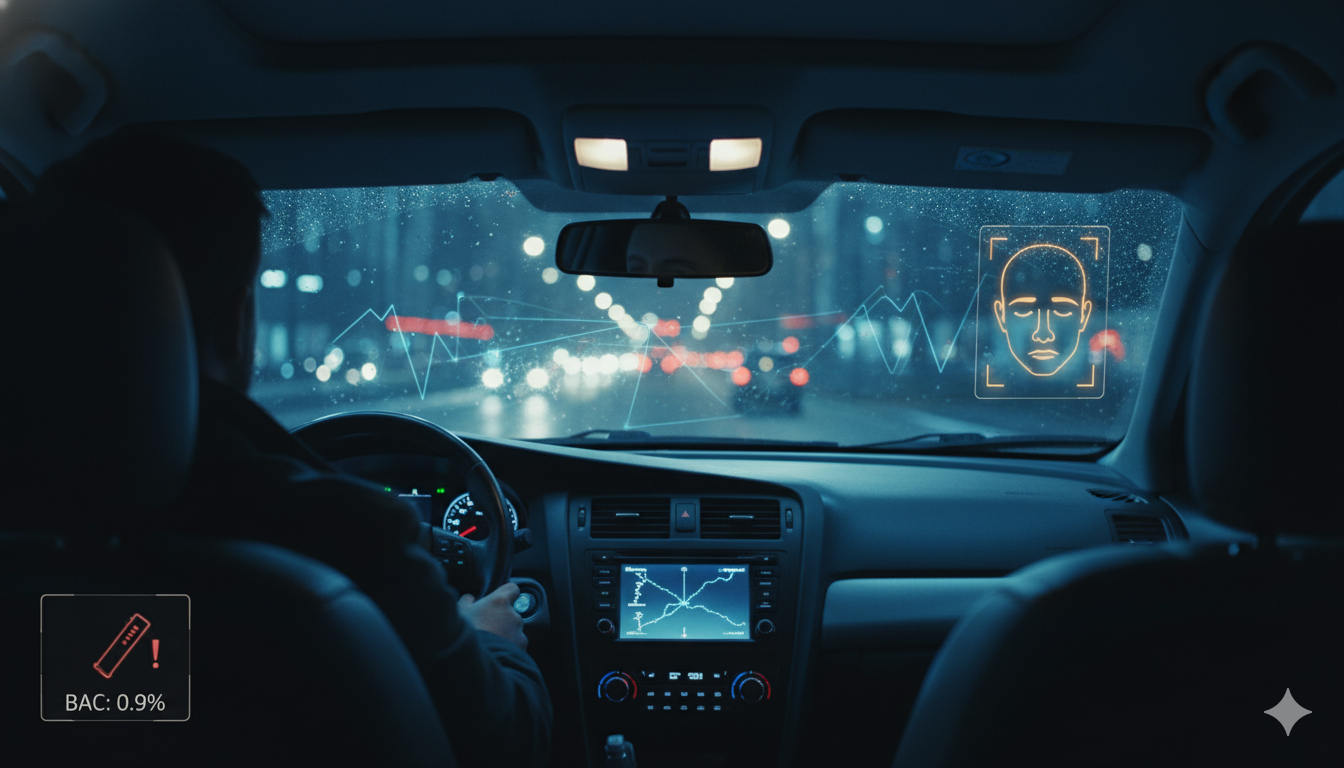
 A new generation of smart vehicle safety technologies is shifting the focus from punishment to prevention, embedding real-time impairment detection directly into cars. These systems go beyond a single test, using a multi-layered approach that integrates facial recognition, behavioral monitoring, and advanced in-cabin air sensors to create a comprehensive picture of driver alertness.

At the core of this transformation are AI-powered, multi-sensor platforms that continuously analyze chemical, behavioral, and driving-performance data. Alcohol traces in cabin air, subtle changes in facial expressions or eye movement, and irregularities in steering, braking, or lane control are all cross-referenced to detect impairment with greater accuracy while reducing false alarms.

With mandates like the HALT Act and the Infrastructure Investment and Jobs Act (IIJA) in the United States requiring passive alcohol-detection systems in all new vehicles, this future is not decades away—it is arriving far sooner than many expect.

Most countries set legal blood alcohol concentration (BAC) limits to define when a driver is considered impaired, though thresholds vary by region. In the United States and much of Europe, the standard limit is 0.08% BAC, meaning 80 milligrams of alcohol per 100 milliliters of blood, while some countries like Sweden and Japan enforce stricter limits of 0.02–0.03% BAC to further reduce risk. Commercial drivers and young or novice drivers are often held to zero-tolerance or near-zero limits due to higher safety concerns. Research consistently shows that even low levels of alcohol—well below legal thresholds—can slow reaction times, impair judgment, and reduce coordination, making BAC limits a regulatory compromise rather than a guarantee of safety.

While blood alcohol concentration (BAC) limits provide a clear legal threshold, the reality is more complex—impairment often begins before drivers even reach those limits, and roadside enforcement can only catch a fraction of offenders. This gap between legal standards and real-world safety underscores the need for smarter, continuous monitoring solutions. That’s where next-generation in-vehicle systems come in, shifting detection from the roadside to the driver’s seat.

The Triple-Layer Defense: How the Integrated System Works

The strength of this new approach lies in its layered design. Instead of relying on a single data point, the most advanced systems use a multi-sensor, AI-powered framework that builds a complete, highly accurate picture of driver impairment.

The first line of defense comes from interior air sensors—sometimes called the “digital nose.” These devices, often mounted in the ceiling or dashboard, use spectroscopy to silently sample the air inside the cabin. By shining specific wavelengths of light through the air, the system detects the unique absorption signature of alcohol molecules. This process requires no action from the driver and provides the earliest and most objective signal of alcohol consumption.

The second layer is a driver-facing camera system, or the “watchful eye.” Mounted near the steering column, the camera monitors facial and ocular behavior using computer vision algorithms. It tracks whether the driver’s eyes are drooping, blinking abnormally slowly, or closing for extended moments. It also detects head position, nodding movements, and abnormal pupillary responses. Together, these cues offer powerful behavioral evidence of impairment, supplementing the chemical signals detected in the cabin air.

The third and final layer is direct vehicle integration—sometimes called “the feel of the drive.” The system connects to the vehicle’s internal network, analyzing steering, braking, speed control, and lane positioning in real time. Jerky steering corrections, inconsistent speed, or erratic braking patterns are strong indicators that impairment is affecting actual driving performance. This data helps confirm impairment while reducing false positives, ensuring the system intervenes only when necessary.

From Detection to Intervention: A Graded Response

What makes these systems truly intelligent is not just detection but how they respond. Instead of abruptly shutting a car down, the technology uses a graduated intervention model designed to prioritize both safety and practicality.

In the earliest stages of detection, when alcohol levels are low or signs of impairment are just beginning to appear, the system might issue a soft audio or visual alert. This could be as simple as a dashboard prompt asking, “Are you okay to drive?”

If the system becomes more confident that impairment is increasing—such as approaching the legal limit—it escalates. Warnings grow louder, more visual, and harder to ignore. Some systems may even vibrate the seat or briefly tighten the seatbelt to grab the driver’s attention.

Finally, if clear evidence of legal impairment emerges, the system initiates intervention. Rather than abruptly disabling the vehicle, it may limit performance by reducing speed, increase the use of driver-assist systems like lane keeping or emergency braking, and activate hazard lights to warn surrounding traffic. Some designs can even guide the vehicle to a controlled stop at a safe location, preventing the impaired driver from endangering others on the road.

VinAI’s Breakthrough: From Detection to Intervention

A major milestone in the fight against drunk driving was unveiled at InCabin Europe 2024 in Barcelona, where VinAI introduced its groundbreaking DrunkSense system. Touted as the world’s first passive drunk-driving detection technology requiring no breathalyzer, DrunkSense combines facial recognition, vehicle control monitoring, and advanced in-cabin air alcohol sensors to achieve impairment detection with up to 85% accuracy—an 8% improvement over current standards. Unlike traditional tools that require direct driver interaction, DrunkSense operates silently in the background, issuing early warnings or interventions even when blood alcohol concentration (BAC) levels remain below the legal threshold. By doing so, it closes dangerous gaps where drivers may be technically “legal” but still unsafe to drive.

The debut of DrunkSense reflects growing regulatory pressures in both Europe and the U.S., where initiatives like the HALT Act and the IIJA are accelerating mandates for preventive safety systems in all new vehicles. VinAI’s executives positioned the technology as a direct response to these shifts, highlighting its potential to transform compliance into life-saving innovation. Alongside DrunkSense, the company also showcased InteriorSense, a broader AI-powered driver and occupant monitoring suite that enhances both safety and comfort. Already integrated into more than 50,000 vehicles, VinAI projects its deployment to scale to 700,000 within five years, underscoring its role as a global leader in automotive AI.

Yet, what truly sets systems like DrunkSense apart is not only their ability to detect impairment but their capacity to respond intelligently. By employing a graduated intervention model, vehicles can escalate from subtle dashboard or audio cues to stronger warnings, and ultimately to active safety interventions if intoxication is confirmed. These measures may include limiting vehicle speed, enhancing driver-assist features such as lane-keeping, or even guiding the car to a controlled stop. Such proactive safeguards represent a historic shift in traffic safety, moving beyond punishment toward prevention and protection for all road users.

With innovators like VinAI leading the charge, the future of mobility is set to evolve into more than just electric, connected, and autonomous—it will also be intelligently proactive, ensuring that impairment never reaches the point of tragedy. For the first time, the long-standing vision of eliminating drunk driving fatalities appears within reach.

The Future is Preventive

This emerging technology marks a fundamental shift in road safety—from punishing drunk driving after the fact to preventing it altogether. By embedding detection and intervention directly into vehicles, the industry can protect not only drivers but also every passenger, cyclist, and pedestrian who shares the road. The car of the future won’t just be electric or self-driving—it will also be intelligent, vigilant, and, above all, sober.

Yet important questions remain about data privacy, system accuracy, and regulatory oversight. These challenges must be addressed through transparent design, strict safeguards, and clear legal frameworks. With governments in Europe and the United States tightening regulations around impaired driving, technologies like DrunkSense are arriving at exactly the right moment. If widely adopted, they could mark a turning point in the decades-long fight to eliminate drunk driving fatalities.

The automotive industry is in the midst of a transformation that goes beyond electrification and autonomy. Safety is being redefined as proactive, AI-driven, and deeply embedded into the vehicle itself. With innovators like VinAI leading the charge, the long-standing dream of ending drunk-driving deaths could finally move within reach.