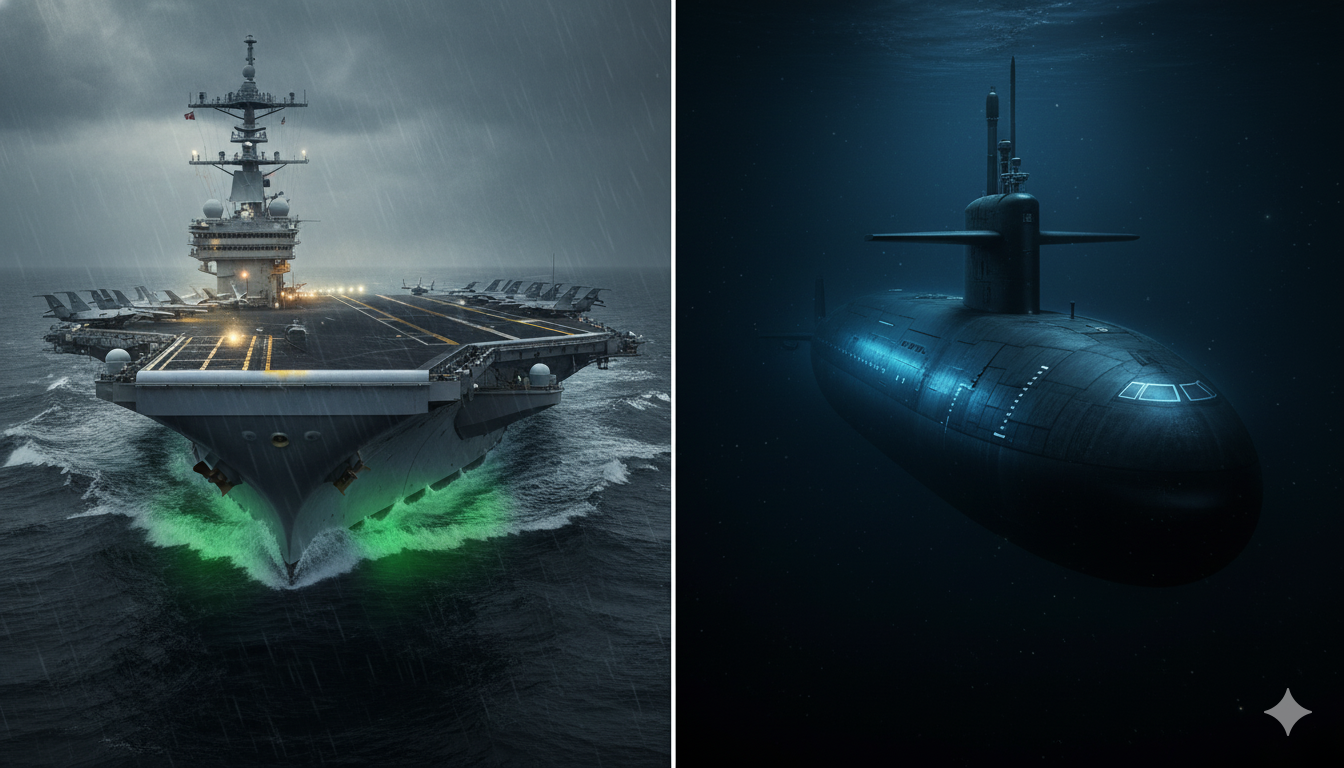
For decades, nuclear power has been the silent force beneath the waves, driving the world’s most advanced submarines. This technology grants them the ability to remain submerged for months, travel vast distances undetected, and operate free from the logistical tether of conventional fuel supplies. Yet on the surface, nuclear propulsion tells a very different story. Only a handful of nations—most notably the United States and Russia—have invested in nuclear-powered surface combatants, and even then, almost exclusively for aircraft carriers and icebreakers.
Why has nuclear propulsion flourished in the deep but stalled on the open seas? The answer lies in a complex mix of economics, geopolitics, engineering, and public perception.
The Submarine Advantage
For submarines, nuclear propulsion isn’t just useful—it’s indispensable. Unlike diesel-electric or air-independent propulsion (AIP) systems, nuclear reactors provide virtually unlimited range and endurance. A nuclear submarine can remain submerged for years without surfacing, constrained only by food and crew endurance. This endurance eliminates the need for frequent snorkeling, making nuclear submarines far stealthier than their conventionally powered counterparts.
Equally important, nuclear reactors give submarines the ability to sustain high speeds over long periods—an advantage that is critical when evading detection, closing in on adversaries, or repositioning across oceans. These capabilities explain why all U.S. submarines, and those of other major naval powers such as the UK, France, Russia, and China, are powered by nuclear reactors. In the silent chess match of undersea warfare, nuclear propulsion is the defining advantage.
Why Surface Ships Lag Behind
The story changes on the surface, where the costs and complications of nuclear power outweigh the benefits for most navies.
First, cost is a formidable barrier. Designing, building, and maintaining nuclear reactors is extraordinarily expensive. Specialized infrastructure, rigorous radiological controls, and the recruitment of highly trained nuclear-qualified personnel make nuclear surface ships a luxury few countries can afford.
Second, nuclear vessels face port restrictions. Many countries bar nuclear-powered ships from entering their harbors due to environmental, safety, or political concerns. For navies that rely heavily on access to foreign bases or port visits as part of diplomacy, this limitation significantly reduces operational flexibility.
Third, public perception remains a challenge. High-profile accidents, from the sinking of Russia’s Kursk submarine to the Fukushima Daiichi disaster, have left the public wary of nuclear technology. Even though naval reactors are designed with far stricter safety standards, public and political anxiety often dictates policy.
Finally, technical challenges matter. Fitting a reactor into a destroyer or frigate requires space for shielding, cooling, and safety systems. This inevitably comes at the expense of payload capacity—reducing room for weapons, sensors, or crew accommodations. For ships that already operate in tight design margins, this is a costly trade-off.
Where Nuclear Surface Ships Excel
Despite these drawbacks, there are niches where nuclear propulsion is unmatched.
Aircraft carriers are the most prominent example. The U.S. Navy’s Nimitz– and Ford-class carriers use nuclear reactors not only to cruise for decades without refueling but also to generate the immense power needed for catapult launches, advanced sensors, and future energy weapons. Nuclear propulsion reduces the logistical tail of refueling and enhances survivability, allowing these massive ships to project power globally with minimal dependence on tankers.
Icebreakers represent another success story. Russia’s fleet of nuclear-powered icebreakers, such as the 50 Let Pobedy and the new Arktika-class, are indispensable in maintaining Arctic sea routes. Operating year-round in extreme polar conditions, they clear paths for shipping, support military and commercial ventures, and serve as symbols of national technological prowess.
Cruisers and battlecruisers provide a historical case study. The U.S. Navy once operated nuclear-powered cruisers like the Long Beach and Virginia classes, while Russia still fields its massive Kirov-class battlecruisers. However, most of these ships were retired due to prohibitive operating costs.
The Legacy of Nuclear Propulsion
Nuclear propulsion revolutionized naval operations by eliminating the constraints of traditional fuel. With nuclear reactors, ships could stay at sea for years without refueling, extending operational reach and reducing logistical dependency. A historic milestone in this journey was the USS Enterprise (CVN-65), the world’s first nuclear-powered aircraft carrier, commissioned in 1961. Its eight nuclear reactors not only demonstrated the immense power of nuclear propulsion but also paved the way for decades of innovation in naval engineering.
Today, that legacy continues with the USS Gerald R. Ford (CVN-78), the lead ship of a new carrier class. Its two advanced reactors provide enough power not only for propulsion but also for cutting-edge systems such as the Electromagnetic Aircraft Launch System (EMALS), advanced radar, and potentially directed-energy weapons. This leap demonstrates how nuclear energy has become the backbone of modern carrier strike groups, enabling them to operate as self-sustaining, power-rich hubs of maritime power.
The Next Generation: Micro-Reactors and Gen IV Systems
Recent advances in reactor technology are reopening the debate over nuclear propulsion for surface warships. At the forefront are Micro-Modular Reactors (MMRs)—compact, factory-built systems designed to be sealed, low-maintenance, and inherently safe. With passive safety mechanisms and simplified logistics, MMRs could extend nuclear propulsion beyond aircraft carriers and icebreakers to smaller combatants like destroyers, frigates, or even autonomous vessels. Their scalability and reduced operational complexity make them an attractive candidate for navies seeking endurance without the logistical burden of constant refueling.
At the same time, the broader nuclear power industry has been evolving through successive reactor generations, each building on decades of operational lessons. Generation 2 reactors form today’s global fleet, while Generation 3 and 3+ designs add greater safety and efficiency. Now, the focus is shifting toward Generation IV systems—including molten salt reactors (MSRs), sodium-cooled fast reactors (SFRs), and high-temperature gas-cooled reactors (HTGRs). These designs promise closed fuel cycles, minimal waste, and enhanced sustainability. Although their naval applications remain largely theoretical, if successfully adapted they could transform nuclear propulsion into a safer, cleaner, and more politically acceptable option for future warships.
Case Study: Russia’s Nuclear Icebreakers
Russia’s nuclear icebreaker program is perhaps the clearest example of where surface nuclear power thrives. Since the launch of the Lenin in 1959, these vessels have been central to Moscow’s Arctic ambitions. Capable of breaking through thick ice and operating in extreme polar environments without resupply, they enable Russia to maintain control over vital northern sea routes and resource-rich regions.
Their success highlights a key principle: when mission requirements justify the cost and complexity, nuclear-powered surface ships are not only viable but essential.
The U.S. Navy’s Nuclear Legacy and Future
The U.S. Navy remains the global leader in naval nuclear propulsion, with over 200 nuclear-powered vessels built by 2010. Its commitment to nuclear power is absolute for submarines and carriers, where the strategic advantages are undeniable.
Yet, the Navy has resisted extending nuclear propulsion to smaller surface combatants. The Zumwalt-class destroyers, initially conceived as nuclear-powered, reverted to conventional propulsion due to cost constraints. However, with the rise of unmanned systems and the increasing energy demands of railguns, lasers, and advanced sensors, the Navy is once again studying advanced reactor technologies—not only for ships but also for unmanned underwater vehicles (UUVs) and forward-deployed energy stations.
Renewed Nuclear Vision for UK Surface Fleet
The UK Royal Navy is taking a forward-looking step by investigating the feasibility of powering its surface vessels—including auxiliary ships and combatants—using Generation IV nuclear reactor technologies. In September 2024, the Ministry of Defence issued a formal Request for Information (RFI) to defense industry players, seeking insights into integrating advanced reactors such as small modular reactors (SMRs) into its surface fleet. This exploratory move underscores the Navy’s intent to explore whether nuclear propulsion, long the domain of submarines, could deliver similar endurance and operational advantages on the surface—as seen in vessels like the USS Nimitz, Ford, and France’s Charles de Gaulle.
The initiative has already progressed beyond paperwork. In February 2025, the Ministry of Defence hosted an industry workshop at its Portsmouth naval headquarters, bringing together stakeholders to discuss the potential benefits, technical challenges, and strategic implications of a future nuclear-powered surface fleet. Despite this momentum, officials emphasize that the program remains in an information-gathering stage, and any move toward nuclear surface ships would still require regulatory approvals, safety assessments, and long-term investment commitments.
Futuristic & Next-Generation Concepts
Looking ahead, naval engineers are exploring hybrid and advanced nuclear-electric designs to support the ships of tomorrow. These concepts are aimed at enabling sustained high-energy demands for railguns, lasers, and next-generation sensors.
A striking example is Russia’s Leader-class nuclear destroyer concept, envisioned as a massive 17,000-ton vessel powered by nuclear reactors. While still on the drawing board, it represents a bold leap in warship design—projecting a future where naval fleets rely heavily on nuclear power to sustain not only propulsion but also advanced weapons and integrated defense networks.
Such visionary designs, whether realized or not, highlight the trajectory of naval propulsion: from the trailblazing USS Enterprise, to the cutting-edge USS Ford, and onward to conceptual giants like the Leader-class destroyer. Each milestone underscores the growing importance of nuclear power as the foundation for both present and future naval dominance.
The Debate: Costs, Risks, and Rewards
Yet nuclear propulsion is far from a universally accepted solution. While it provides unmatched endurance and power, it comes with enormous upfront costs, complex maintenance, and heightened safety concerns. Nuclear-powered warships require highly trained crews, specialized dockyards, and long-term disposal strategies for spent reactors. These challenges make them economically and politically difficult for many nations, limiting widespread adoption.
Regulatory restrictions tightly govern the export and operation of naval nuclear technology, limiting its spread. Training and maintaining a nuclear-qualified crew requires years of investment, further driving up costs. Strategically, nuclear ships are also high-value assets; their destruction or accidental loss could create both military and environmental disasters.
Environmental concerns also weigh heavily. Accidents, while rare, pose catastrophic risks, and the management of nuclear waste remains unresolved in many contexts. Critics argue that advanced conventional technologies, such as gas turbines or hybrid-electric propulsion, may provide a more cost-effective balance of capability and sustainability—especially for navies without global expeditionary ambitions.
Until these challenges are resolved, nuclear propulsion will remain a specialized solution for missions that demand extreme endurance, heavy power loads, or operations in unique environments.
The Future of Naval Power
The debate over nuclear-powered warships ultimately reflects a deeper question: what kind of navies will dominate the 21st century? For global superpowers like the U.S. and potentially Russia, nuclear propulsion enables unmatched reach, power projection, and technological superiority. For smaller nations, advanced conventional systems may remain the pragmatic choice.
What is clear is that naval propulsion is no longer a technical afterthought—it is the linchpin of strategy. From the pioneering USS Enterprise, to the game-changing USS Ford, to the ambitious Leader-class concept, nuclear propulsion has redefined what warships can achieve. Whether or not every navy embraces this path, the propulsion systems chosen today will shape the balance of maritime power for decades to come.
Conclusion: A Niche with Growing Potential
Nuclear-powered warships will never dominate the world’s fleets, but they will continue to play a vital, if limited, role. For aircraft carriers, icebreakers, and potentially unmanned or Arctic-focused vessels, nuclear propulsion offers unmatched endurance and power.
As micro-reactors and next-generation reactor designs mature, we may see nuclear technology extend to smaller ships and new mission profiles, reshaping naval strategy in an era of great-power competition and climate-driven Arctic change. What remains certain is that nuclear propulsion, though controversial, will remain a cornerstone of maritime power projection for decades to come.