Home / Defense & Military / Air Force & Aviation / DARPA’s Cost-Efficient Cargo Program: Revolutionizing Military Logistics with Affordable, High-Capacity Airships

DARPA’s Cost-Efficient Cargo Program: Revolutionizing Military Logistics with Affordable, High-Capacity Airships

In an era of rapidly evolving global threats and dispersed operations, the ability to move heavy equipment and supplies quickly, efficiently, and affordably is more critical than ever. Enter DARPA’s Cost-Efficient Cargo (CEC) program—an ambitious initiative aimed at reinventing military logistics through the development of modern, high-capacity airships capable of transporting massive payloads across vast distances at a fraction of the cost of traditional airlift.

Here’s a closer look at how the CEC program could redefine strategic and tactical logistics for the U.S. Department of Defense and beyond.

The Logistics Challenge

Military operations often require the movement of oversized cargo—such as vehicles, artillery, and infrastructure—across continents and oceans. Today’s options all come with trade-offs. Air transport, provided by aircraft like the C-17 Globemaster III, offers speed but is prohibitively expensive. Sea transport, while much cheaper, can take weeks for a single transoceanic journey. Ground transport is limited by terrain accessibility and is particularly vulnerable in contested or unstable regions.

These constraints become especially acute in remote or austere theaters where infrastructure is scarce, or where time-sensitive deployment is critical. DARPA’s CEC program seeks to bridge this gap with a hybrid solution: the advanced airship, capable of combining the best aspects of air and sea transport into a single, highly flexible platform.

What Is the Cost-Efficient Cargo Program?

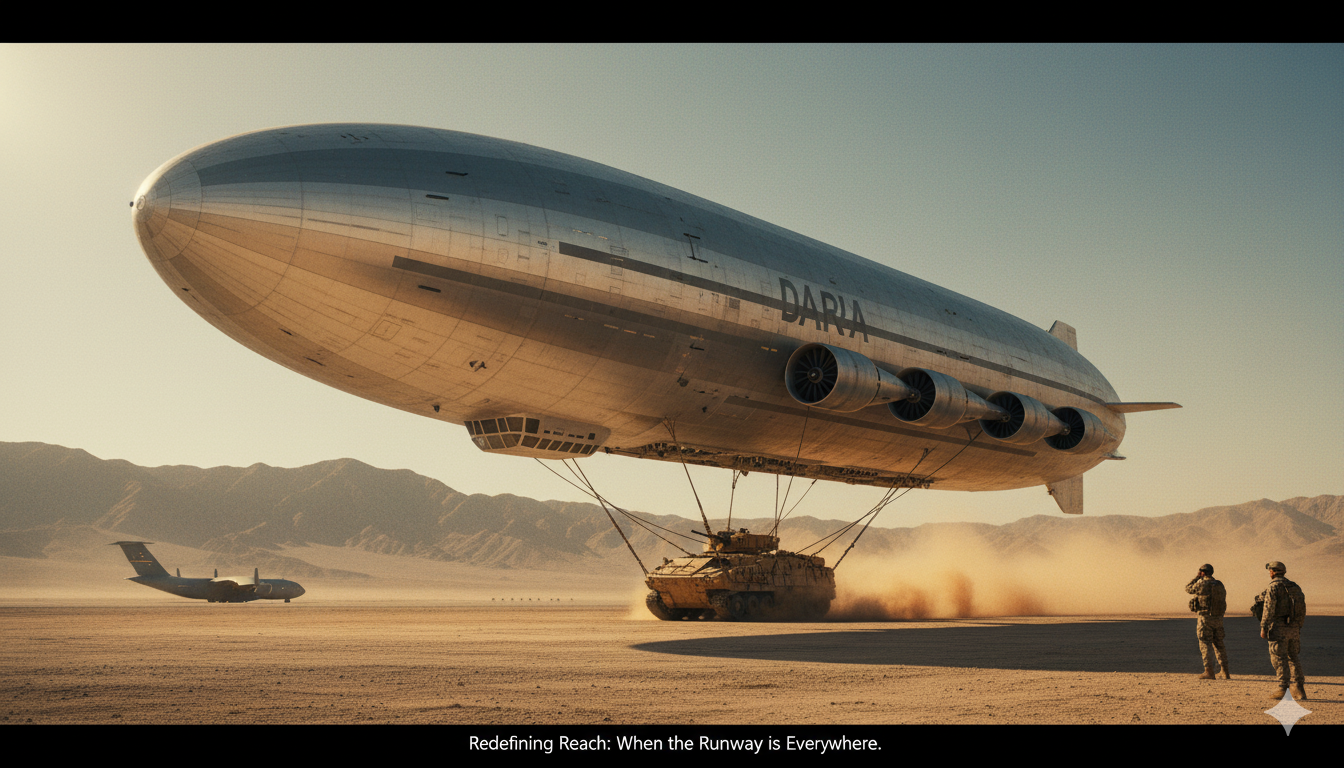
The CEC program is designed to deliver a new class of lighter-than-air (LTA) vehicles that can outperform existing options in both payload and cost. These airships are envisioned to carry as much as 500 tons of cargo, more than twice the lifting capacity of the U.S. Air Force’s C-5M Super Galaxy. They would be capable of operating across ranges of 6,000 nautical miles while maintaining speeds of 100 knots or greater, allowing them to deliver equipment across oceans in days rather than weeks.

Equally important, these airships would be able to transport cargo directly to unimproved landing zones without the need for extensive port or runway infrastructure, a capability that could prove game-changing in contested or disaster-stricken regions. By leveraging modern technology, DARPA projects that the cost per ton-mile could be reduced by 50–75 percent compared to current airlift platforms, making them not only strategically valuable but also economically attractive.

How DARPA’s Airship Concept Stacks Up Against Existing Platforms

To appreciate the disruptive potential of DARPA’s ultra-large airship, it helps to compare it against today’s premier heavy-lift workhorses. The U.S. Air Force’s C-17 Globemaster III carries about 170,900 pounds (85 tons) of cargo with a range of ~2,400 nautical miles. The much larger C-5M Super Galaxy extends this to 281,000 pounds (140 tons) of payload with a 5,500-nautical-mile range. On the rotary side, the Marine Corps’ CH-53K King Stallion, the world’s heaviest-lift helicopter, maxes out at around 36,000 pounds (18 tons) under optimal conditions.

DARPA’s envisioned ultra-large, ultra-light airship would surpass these figures by orders of magnitude, with payload capacity potentially measured in thousands of tons, not merely tens or hundreds. Its endurance would be weeks rather than hours, and its ability to operate without runways or traditional infrastructure would make it uniquely suited for delivering outsized payloads directly into austere environments.

This is not simply an incremental improvement—it represents a step-change in strategic mobility. While aircraft like the C-17 and C-5M are bound by airbase access and high fuel burn, an airship platform could provide persistent, flexible, and energy-efficient transport at scale. If realized, it would redefine heavy lift, bridging the gap between sea and air logistics in ways current aircraft cannot match.

Key Technologies Enabling CEC Success

At the core of the CEC vision are several enabling technologies. Advances in materials science—including stronger composites, lightweight structural systems, and resilient fabrics—make it possible to design airframes that are larger, tougher, and more durable than their historical counterparts. Propulsion systems are also being reimagined, with hybrid-electric and hydrogen-based engines promising longer endurance, greater efficiency, and reduced emissions, all while lowering operational costs.

Autonomy plays a critical role as well. With modern onboard AI and advanced command-and-control systems, these airships could operate with minimal human oversight, reducing personnel requirements while improving responsiveness and mission flexibility. Finally, innovative heavy-lift design features, such as integrated cargo handling and vertical takeoff and landing (VTOL) capabilities, would allow these platforms to load and unload massive payloads without the need for specialized ground infrastructure.

Potential Applications

The military applications of CEC platforms are vast. They could enable the rapid deployment of armored vehicles, missile systems, or humanitarian aid directly into contested or denied environments where traditional ports and airfields are unavailable or unsafe. Beyond combat, these airships could play a pivotal role in disaster relief, delivering emergency supplies, mobile hospitals, or power-generation equipment to remote areas cut off by natural disasters.

Commercial industries could also benefit. Airships with heavy-lift capacity could transport oversized industrial components—such as wind turbine blades, prefabricated construction modules, or mining equipment—to locations where roads and ports cannot support such loads. In this way, DARPA’s investment in military logistics could spark a parallel revolution in global commerce.

Why Now? The Return of the Airship

Airships have long captured the imagination as heavy-lift platforms, but past attempts fell short due to limits in materials, propulsion, and weather survivability. Today, those barriers are finally eroding. Advances in AI and autonomy allow for precise navigation and reduced crew demands, while new materials dramatically improve durability and gas retention. Meanwhile, modern propulsion technologies provide speed and reliability that previous generations of airships could not achieve.

In short, DARPA’s CEC initiative is not merely reviving an old concept—it is reengineering it for the 21st century battlefield and beyond.

Challenges Ahead

Despite its promise, the program faces formidable hurdles. Survivability remains a critical question, as these massive platforms must withstand high winds, storms, and potential threats in contested airspace. Cost targets are ambitious, demanding a dramatic reduction in ton-mile expenses that will test engineering ingenuity. Finally, the challenge of scalability—designing, building, and testing airships of unprecedented size—represents a leap into uncharted territory for aerospace development.

Looking Forward

The CEC program is still in its early stages, with DARPA actively engaging industry, academia, and innovators to explore feasibility, design pathways, and potential demonstrators. If successful, these airships could usher in a logistics paradigm where transporting a battalion’s worth of equipment across an ocean is not only possible but routine—faster than ships, cheaper than aircraft, and far more flexible than either.

Conclusion: Flying Into the Future of Logistics

DARPA’s Cost-Efficient Cargo program represents a bold step toward solving one of the military’s oldest and most persistent challenges: how to move big things, far away, quickly and cheaply. By harnessing advances in materials, propulsion, and autonomy, the CEC program has the potential to transform not just defense logistics, but also humanitarian relief and global commerce.

The sky, once seen as a limit, could soon become the new highway of heavy cargo movement.

About Rajesh Uppal

Check Also

The Next Wave in Underwater Operations: Small UUVs Redefining Maritime Missions

In the ever-evolving landscape of naval and special operations, small Unmanned Underwater Vehicles (UUVs) are …

error: Content is protected !!