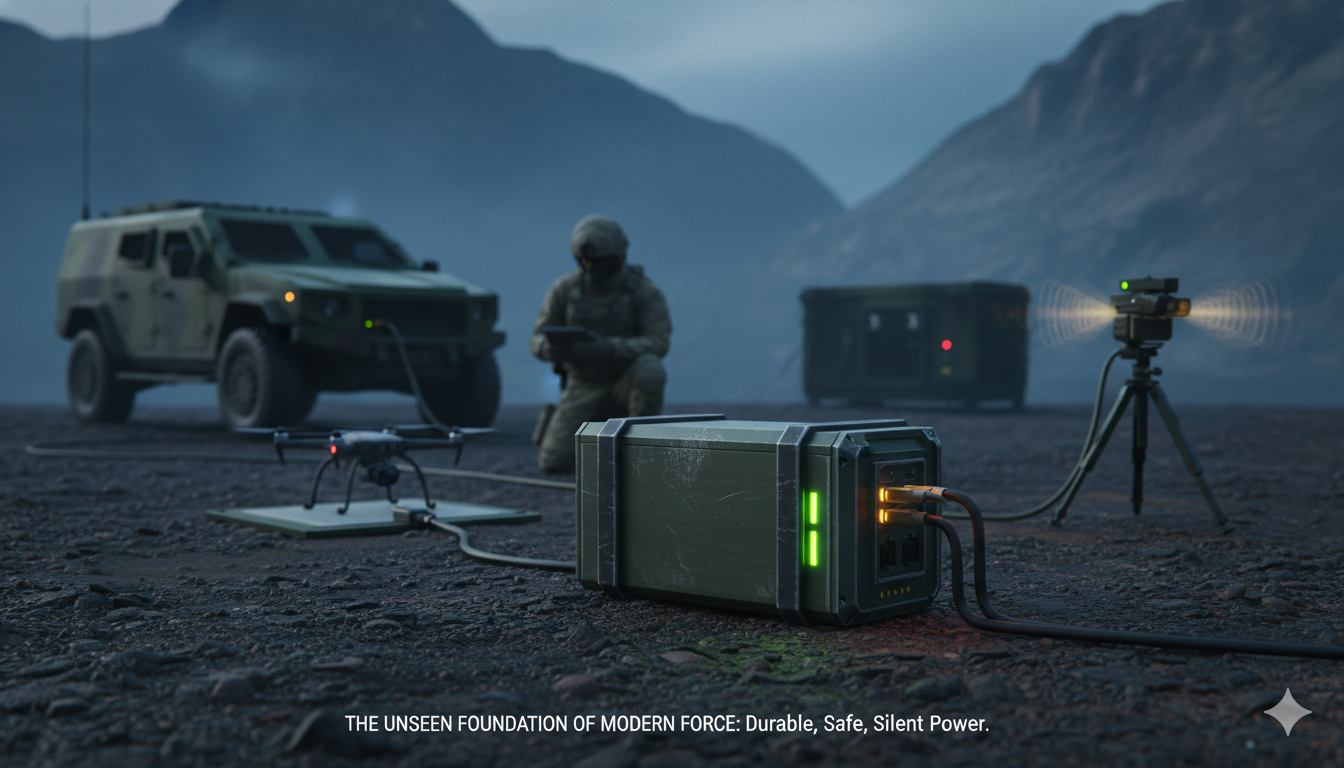
In today’s battlespace, power is as critical as firepower. From portable radios and drones to electric vehicles and directed energy weapons, modern militaries depend on reliable energy storage to gain and sustain a tactical edge. The humble battery, once an afterthought, has become a strategic enabler. Among the competing chemistries, Lithium Iron Phosphate (LFP) has emerged as a leading choice, thanks to its safety, resilience, and unmatched durability in combat conditions.
While lithium-ion batteries based on cobalt or nickel often dominate headlines, it is LFP—built on iron and phosphate—that is quietly becoming indispensable to defense forces worldwide. Its unique chemistry delivers qualities that align perfectly with the demands of modern warfare, making it the backbone of the military’s electrification push.
What is LFP?
Lithium Iron Phosphate (LiFePO₄ or LFP) is a lithium-ion battery chemistry built for stability, safety, and long operational life. Unlike alternatives such as lithium cobalt oxide (LCO) or nickel manganese cobalt (NMC), LFP relies on iron and phosphate—materials that are abundant, inexpensive, and environmentally benign. This makes it not only cost-effective but also less vulnerable to supply chain disruptions, giving it a strategic edge in sectors like defense where sourcing reliability is as critical as performance.
What sets LFP apart is its exceptional resilience. While it offers slightly lower energy density than cobalt- or nickel-based chemistries, LFP provides superior thermal stability, longer cycle life, and consistent performance across wide temperature extremes. These traits make it particularly well-suited for demanding military environments—whether powering unmanned systems, supporting base operations, or enabling electrified combat vehicles—where reliability and safety often matter far more than squeezing out the highest possible energy per kilogram.
Why Defense is Favoring LFP Over NMC/NCA
In civilian markets, Nickel Manganese Cobalt (NMC) and Nickel Cobalt Aluminum (NCA) batteries dominate because of their superior energy density, enabling longer driving ranges for electric vehicles. But in military contexts, the calculus is fundamentally different. Here, the goal is not to squeeze out maximum mileage, but to ensure mission assurance—power that is safe, resilient, and reliable under the harshest conditions. This is where Lithium Iron Phosphate (LFP) has become the chemistry of choice.
The most decisive factor is safety. Unlike NMC or NCA cells, which are prone to thermal runaway and can ignite when punctured, overheated, or overcharged, LFP batteries are remarkably stable under abuse. In combat zones, batteries face gunfire, shrapnel, rough handling, and exposure to extreme temperatures. A single battery fire inside an armored vehicle, ship, or forward operating base could be catastrophic. By dramatically lowering this risk, LFP ensures that energy storage remains an asset, not a liability.
Equally important is longevity and logistics. LFP cells routinely last three to five times longer than NMC or NCA, delivering thousands of charge–discharge cycles while retaining most of their original capacity. For militaries, this translates into fewer replacements, lighter logistical demands, and lower long-term costs. Add to this their ability to discharge quickly without voltage loss—ideal for high-power needs such as drone launches, electric mobility, or directed energy weapons—and LFP provides unmatched operational reliability across a wide temperature spectrum, from arctic cold to desert heat.
Finally, there is the supply chain factor, a growing concern in defense planning. NMC and NCA chemistries depend on cobalt and nickel, minerals heavily concentrated in regions with geopolitical and ethical challenges such as the Democratic Republic of Congo and Russia. LFP, by contrast, is based on iron and phosphate—materials that are abundant, widely distributed, and easier to source from trusted allies. This gives militaries not only a safer and more durable technology but also a strategically independent one.
In short, while NMC and NCA remain indispensable in commercial EVs, their higher risks, shorter lifespans, and vulnerable supply chains make them ill-suited for defense. LFP may be somewhat heavier and bulkier, but for militaries, the trade-off is clear: safer, longer-lasting, cheaper, and geopolitically resilient power that can be trusted in the field.
LFP in Action: Military Applications
On the battlefield, LFP is already proving indispensable. For silent watch and reconnaissance missions, it allows vehicles and soldiers to operate radios, sensors, and command systems without noisy engines, preserving stealth while conserving fuel. Drones and unmanned ground vehicles benefit from LFP’s fast recharge cycles and long operational life, enabling multiple sorties per day without battery degradation.
At the individual level, soldiers now carry lightweight LFP-powered packs that support radios, night-vision devices, and electronic warfare jammers. The longer runtimes reduce the battery burden on infantry, freeing them to carry other mission-critical gear. Larger systems, such as mobile command posts and field hospitals, rely on LFP to power communications, medical devices, and computing equipment without the noise and heat signature of generators. Meanwhile, defense contractors are testing electric light tactical vehicles, such as modified JLTVs, powered by LFP to deliver silent mobility, reduced thermal signature, and lower fuel dependency.
Challenges and Trade-Offs
Despite its many advantages, LFP comes with certain trade-offs. Its lower energy density compared to nickel- or cobalt-based chemistries means batteries must be bulkier to deliver the same energy. This added weight is less problematic for ground vehicles, ships, or stationary storage but can constrain size-sensitive applications like micro-drones, wearable soldier systems, or next-generation aircraft where compactness directly impacts performance. Additionally, LFP has a lower nominal voltage, which can limit power output per cell and necessitate more cells in series to achieve required voltages.
Another technical hurdle lies in its flat voltage curve, which makes it difficult to estimate state of charge without sophisticated battery management systems (BMS). For militaries, this requires investment in more advanced electronics and monitoring algorithms to ensure reliability in the field. Supply chain concentration is also a consideration—China dominates global LFP production, raising concerns for countries seeking strategic independence in critical defense technologies. Even with these limitations, most defense organizations view LFP’s safety, resilience, and long cycle life as well worth the compromises, particularly in the harsh and unpredictable conditions of modern battlefields.
The Future of LFP in Defense
The future of LFP is being defined by a wave of innovation. Advances such as nanostructured cathodes are aimed at boosting energy density without compromising safety, while solid-state LFP prototypes promise to merge ruggedness with greater performance. Militaries are also experimenting with second-life use cases—repurposing retired vehicle batteries into stationary storage for forward operating bases. This not only extends the utility of each cell but also supports resilient, distributed power in contested environments.
The U.S. Department of Defense is taking the lead in exploring LFP for tactical vehicles, naval support systems, and unmanned platforms, but it is far from alone. The U.S. Department of Defense’s recent $12.9 million award to Nano One Materials Corp. highlights the growing importance of LFP in defense energy security. Backed by the Defense Production Act Investments (DPAI) program and the Inflation Reduction Act, this initiative aims to expand North American production of LFP cathode materials—reducing dependence on foreign supply chains while strengthening national security. With production facilities in Québec and British Columbia, Nano One will scale commercial-grade LFP to meet the rising demand for safer, longer-lasting, and lower-cost batteries across both military and civilian sectors.
This investment also underscores the deepening U.S.-Canada partnership in critical minerals and energy transformation. Canada’s role as a “domestic source” for defense supply chains ensures North America can secure reliable access to key materials while building sustainable manufacturing capacity. For defense applications, LFP’s rugged safety profile, long cycle life, and ability to be fully sourced within the continent make it the military’s preferred cathode chemistry—offering battlefield resilience without the geopolitical vulnerabilities tied to nickel and cobalt.
China has already standardized LFP as its chemistry of choice across much of its electric vehicle and military battery programs, benefiting from a domestic industrial base that produces the majority of the world’s LFP cells. Russia, while more limited in industrial capacity, is investing in LFP-based stationary power systems for remote bases and Arctic deployments where reliability outweighs energy density. Meanwhile, European NATO members such as Germany and France are funding R&D into next-generation LFP and hybrid chemistries for armored vehicles and logistics fleets, seeing it as a safer and more sustainable alternative to nickel- and cobalt-heavy chemistries.
Taken together, these efforts signal a global shift toward LFP as the backbone of battlefield electrification. While different regions emphasize different applications—China on industrial-scale adoption, the U.S. on tactical versatility, Europe on sustainability, and Russia on rugged off-grid power—the convergence is clear. LFP is evolving from a “civilian EV battery” into a military-grade technology that could shape the energy architecture of future conflicts.
Conclusion: The Right Chemistry for the Mission
Lithium Iron Phosphate may not dominate consumer markets, but in defense, it is rapidly becoming the battery of choice. Its unmatched combination of safety, durability, and reliability under extreme conditions makes it ideally suited for mission-critical applications where failure is not an option.
As armed forces continue their transition toward electrified vehicles, advanced sensors, and energy-hungry weapon systems, LFP stands as more than just another battery—it is a tactical advantage that ensures soldiers, vehicles, and systems have the power to fight, survive, and win.
International Defense Security & Technology Your trusted Source for News, Research and Analysis