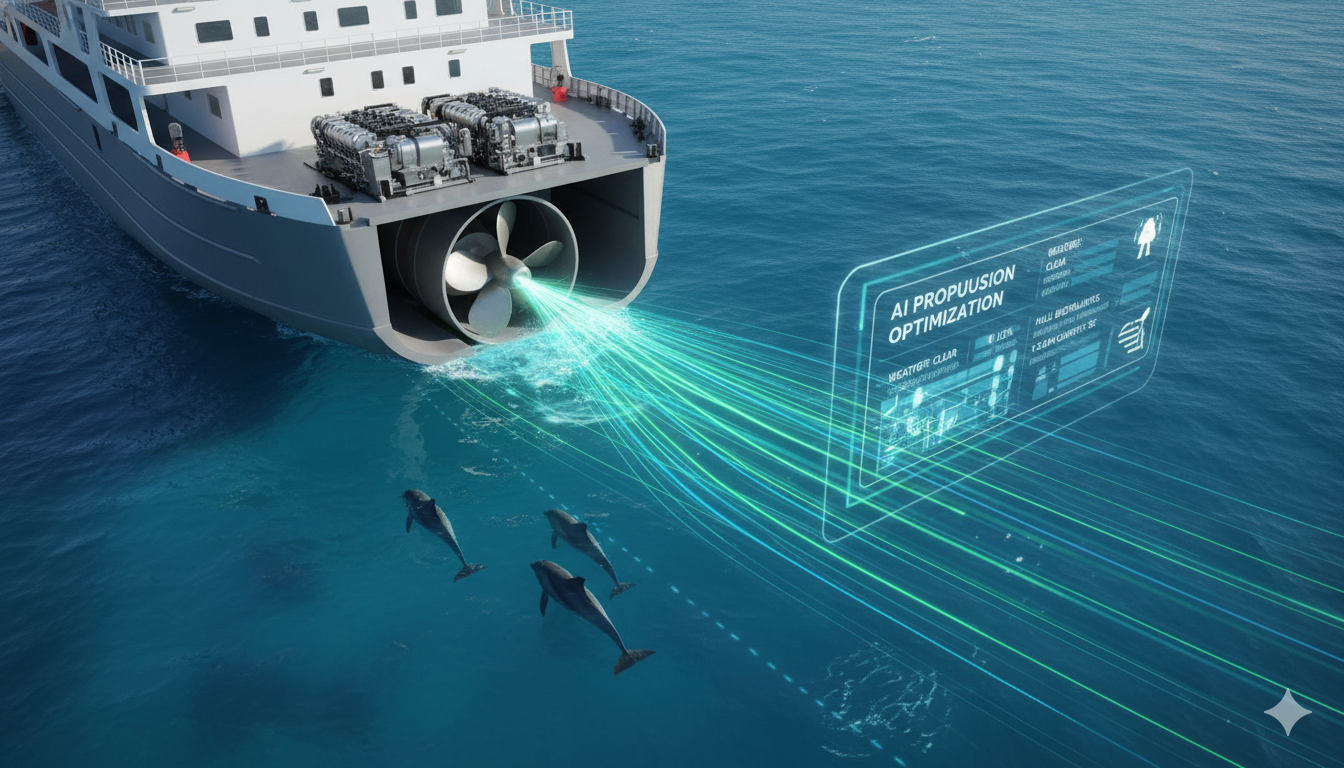
The Challenge: Meeting Emissions Targets While Cutting Costs
The global shipping industry is at a critical juncture. The International Maritime Organization’s (IMO) 2050 zero-emission target is fast approaching, and the looming implementation of carbon pricing mechanisms will fundamentally change the economics of maritime transport. For shipowners and operators, this creates a triple challenge: ensuring regulatory compliance, maintaining profitability, and optimizing operational efficiency.
The pressure doesn’t end there. The IMO’s Carbon Intensity Indicator (CII) regulations are already tightening, pushing vessels to improve efficiency year on year. Rising fuel costs further intensify the squeeze, forcing companies to identify solutions that can be deployed immediately without waiting for next-generation ship designs or costly retrofits.
While traditional efficiency measures—such as advanced hull coatings, optimized propeller designs, or switching to alternative fuels—can yield measurable benefits, they come with substantial trade-offs. These solutions typically require large upfront capital investments, extended periods in dry dock, and complex engineering modifications. The process not only disrupts operational schedules but also ties up assets during implementation, delaying the return on investment.
Even after such upgrades are completed, the anticipated performance gains often fail to fully materialize under real-world operating conditions. Variations in weather, sea state, cargo load, and routing can erode expected fuel savings, leaving ship operators with underwhelming results. This mismatch between projected and actual efficiency can prolong payback periods, keep operational costs high, and leave fleets vulnerable to regulatory penalties and competitive pressure in an increasingly decarbonized market.
The Solution: AI-Driven Smart Propulsion
Smart Propulsion represents a breakthrough in maritime efficiency—one that relies on artificial intelligence and machine learning rather than costly mechanical overhauls. This technology delivers measurable fuel savings and performance improvements without the need for extended dry-dock periods or disruptive structural modifications.
At its core, Smart Propulsion harnesses real-time data from a vessel’s propulsion, navigation, and environmental systems. The AI platform processes this information to dynamically optimize engine output, propeller pitch, and other critical parameters—adapting instantly to shifts in weather, sea state, or operational demands. Unlike conventional upgrades that remain fixed in their capabilities, this system is inherently adaptive.
Over time, the machine learning algorithms become smarter, refining strategies based on historical voyage data and predictive models. The longer it operates, the more precise its adjustments become, ensuring peak performance under virtually any operating condition. This continuous learning loop allows operators to sustain maximum efficiency, reduce emissions, and maintain a competitive edge in a fast-changing regulatory and commercial environment.
How It Works – The Four Pillars of AI Optimization
Smart Propulsion begins with continuous, high-resolution data collection. A distributed network of sensors monitors critical operational metrics such as fuel flow, shaft RPM, propeller torque, engine load, vessel speed over ground, trim, and draft. Simultaneously, it captures environmental variables like wind speed, wave height, ocean currents, and water temperature—giving the AI a holistic, real-time snapshot of the vessel’s operating conditions.
This information is then processed by advanced machine learning models trained on extensive historical voyage datasets. The AI detects subtle inefficiencies—such as incorrect propeller pitch, uneven engine loads, or weather-induced fuel spikes—and makes dynamic adjustments to propulsion parameters on the fly. Unlike conventional control systems that rely on static rules, the AI evolves with each voyage, creating a ship-specific performance model that enables increasingly precise optimizations over time.
The most sophisticated platforms extend this capability into predictive control. By incorporating weather forecasts, marine traffic trends, and oceanographic data, the AI can anticipate conditions like approaching storms, favorable currents, or port delays. It then proactively adjusts propulsion and routing to reduce unnecessary fuel use, maintain optimal speeds, and ensure just-in-time arrivals—turning efficiency into a strategic advantage.
Proven Results in the Field
Independent trials and commercial deployments have demonstrated that Smart Propulsion delivers measurable fuel efficiency gains across different vessel types. For ships equipped with controllable pitch propellers (CPPs)—propellers whose blade angles can be adjusted while the shaft is turning—fuel savings of up to 15% have been achieved. These gains come from real-time pitch adjustments, allowing the AI system to fine-tune blade angles for the most efficient thrust under varying loads and sea conditions.
For vessels using fixed pitch propellers (FPPs)—propellers with blades set at a permanent angle—Smart Propulsion focuses on speed optimization and engine load balancing to reduce fuel consumption. Speed optimization ensures the ship travels at the most fuel-efficient velocity for given conditions, while engine load balancing evenly distributes power demand across engines, preventing overloading and reducing unnecessary fuel burn. These techniques have led to documented savings of up to 5% for FPP-equipped ships.
In addition to fuel savings, these systems improve CII ratings, keeping ships compliant with current and upcoming IMO requirements. Carbon emissions are directly reduced, lowering exposure to carbon taxes and improving environmental, social, and governance (ESG) performance.
Why Smart Propulsion Stands Out
Case Study: Real-World Performance of AI-Driven Smart Propulsion Systems
Across the global marine industry, the push for environmental sustainability and operational cost efficiency is forcing vessel owners to adopt solutions that deliver tangible fuel savings while meeting tightening regulatory standards such as the IMO’s 2050 zero-emission target and evolving Carbon Intensity Indicator (CII) requirements. The challenge lies in finding technology that delivers measurable results without imposing high capital expenditure, lengthy dry-docking, or operational disruption.
One system that has consistently met these demands is SmartPropulsion, developed by Emerson in collaboration with Frugal Technologies. This AI- and machine-learning-driven platform optimizes propulsion efficiency by monitoring a vessel’s operating parameters in real time and applying predictive adjustments to propeller pitch, engine load, and other key variables. The result is documented fuel savings of up to 15% on vessels with controllable pitch propellers (CPPs) and up to 5% on those with fixed pitch propellers (FPPs). Each installation begins with a business case evaluation using historical operational data, ensuring owners have a clear forecast of savings and return on investment before deployment.
SmartPropulsion’s design is particularly attractive because it functions as an “on-top” system, interfacing with the existing propulsion control system rather than altering the engine or propeller hardware. Installation takes as little as three days, requires no dry docking, and has minimal crew training requirements. As a software-driven solution, ongoing maintenance is negligible. Using model predictive control and cloud-based analytics, the system continuously learns from operational data, refining performance curves over time and even integrating with predictive maintenance systems to address issues before they escalate.
The technology’s performance has been proven in diverse operational contexts. Uni-Tankers reported a 12.2% reduction in fuel consumption on a chemical tanker within nine months, achieving full return on investment and improving CII ratings. The company has since expanded the installation to eight additional vessels. Christiania Shipping recorded 8–12% savings on two CPP-equipped tankers and 2–4% savings on four FPP vessels, with SmartPropulsion also managing shaft power limitations to comply with calculated EEXI limits. Based on this success, they are now upgrading more ships.
Projections for a 6,000 TEU container vessel with FPP and 240 annual sailing days suggest potential annual savings of $4.5 million in fuel costs, alongside a reduction of approximately 2,200 metric tons of CO₂ emissions—a significant boost to regulatory compliance and ESG performance.
Given its combination of high savings potential, minimal capital outlay, short installation times, and proven compliance benefits, SmartPropulsion stands out as one of the most effective energy-efficiency retrofits currently available. In an industry where even a 1% efficiency gain is considered valuable, the possibility of achieving up to 15% makes it a clear contender for widespread adoption.
The Future of AI in Maritime Propulsion
As artificial intelligence continues to evolve, Smart Propulsion systems will move beyond standalone optimization to become an integral part of fully autonomous navigation platforms. This will enable unmanned, efficiency-optimized voyages, where vessels automatically adjust propulsion parameters based on route, weather, traffic, and operational priorities without human intervention.
These systems will also integrate seamlessly with hybrid propulsion and alternative fuel technologies, using real-time analytics to determine the most efficient fuel blending and fuel-switching strategies. This will be crucial in balancing cost, performance, and emissions compliance across varying operating conditions.
At the fleet management level, AI will coordinate multiple ships as a unified operational network—scheduling synchronized arrivals to reduce port congestion, optimizing berthing windows for faster turnaround, and enhancing weather routing to minimize delays and fuel waste. The result will be an interconnected, AI-driven maritime ecosystem that drives efficiency gains not just at the vessel level, but across the entire global supply chain.
Conclusion: Smarter, Greener, More Profitable Shipping
With regulatory deadlines approaching and fuel prices unpredictable, shipowners cannot afford to wait for the perfect future vessel. Smart Propulsion is a practical, proven, and rapidly deployable solution that harnesses AI to cut costs, boost efficiency, and ensure compliance today—while keeping fleets competitive in the decades to come.
The question is no longer whether the industry will adopt AI-powered propulsion, but which fleets will lead the way.
International Defense Security & Technology Your trusted Source for News, Research and Analysis