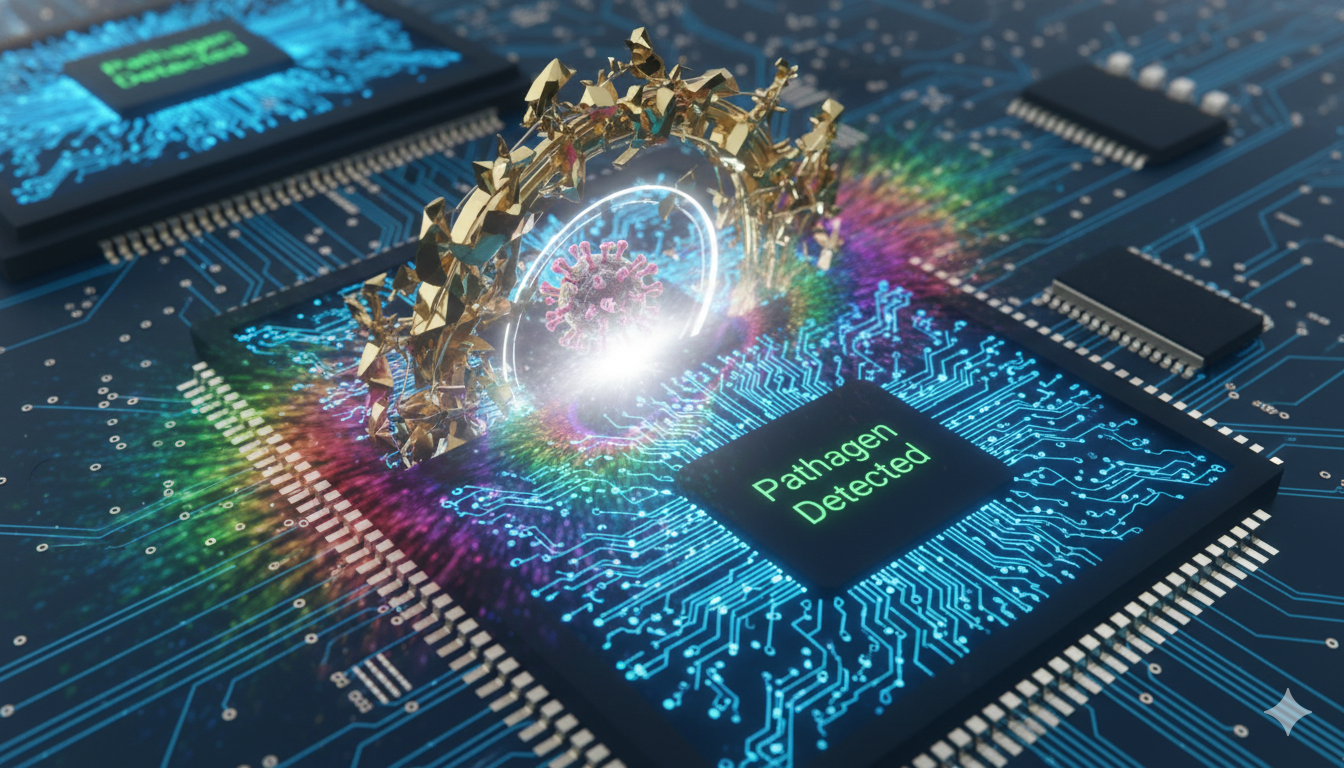
Next-Generation Optical Biosensors: Merging Nanophotonics, Quantum Effects, and AI for Smart Diagnostics


Introduction: The New Diagnostic Revolution

Biosensors have garnered attention for their potential to address a wide array of biomedical and public health issues. These include early disease diagnosis, identification of drug-resistant organisms, detection of emerging epidemics, and identifying low-concentration toxins and pathogens in food and water.

However, the road to developing these biosensors is fraught with challenges. They must be exquisitely sensitive, capable of detecting even the faintest traces of pathogens in biological fluids. Simultaneously, they must offer real-time results to enable swift medical interventions.

Healthcare, environmental monitoring, and agriculture are rapidly being transformed by a new era of diagnostic precision—one driven by the convergence of nanophotonics, quantum mechanics, and artificial intelligence. These next-generation biosensors are capable of detecting diseases, pollutants, and biomolecular interactions in real time, at sensitivities and speeds previously unattainable. Their ability to monitor biological processes at the molecular and even atomic scale is reshaping how we detect, treat, and prevent illness, while also offering critical tools for food safety, water quality assessment, and climate monitoring.

Unlike traditional biosensing systems, which often require centralized laboratories, invasive procedures, or bulky, power-intensive equipment, these cutting-edge biosensors leverage nanoscale engineering to miniaturize and simplify diagnostics. Many rely solely on light and electrons—no reagents, no complex labeling—offering non-invasive, portable, and cost-effective platforms suitable for both urban hospitals and remote field settings. This leap forward is not merely incremental; it represents a paradigm shift in how biological information is captured, interpreted, and acted upon.

With the global nanophotonic biosensor market projected to exceed $12 billion by 2030, we are witnessing the transition of these technologies from academic research tools into scalable, real-world solutions. Whether embedded in wearable devices for continuous health monitoring or mounted on drones to track environmental toxins, these sensors are laying the foundation for a future of precision diagnostics—where early intervention, personalized medicine, and rapid response are no longer aspirations, but everyday realities.

Self-Illuminating Plasmonic Sensors: Light from the Abyss

Researchers at the École Polytechnique Fédérale de Lausanne (EPFL), in collaboration with ETH Zurich, ICFO, and Yonsei University, have developed a compact, self-illuminating plasmonic biosensor that eliminates the need for external light sources—an important step toward fully integrated, portable quantum diagnostics. Researchers at the École Polytechnique Fédérale de Lausanne (EPFL), in collaboration with institutions like ETH Zurich and ICFO, have engineered nanoscale metasurfaces composed of gold nanowires. These act simultaneously as both electron tunneling platforms and photon emitters.

Leveraging inelastic electron tunneling, the device emits photons when electrons pass through a multilayer structure containing a thin insulating layer and a gold nanowire metasurface. As electrons traverse the ultrathin insulating layer in these structures, they lose energy to plasmons—quantized oscillations of electrons—which subsequently release photons. In essence, these sensors create their own light, allowing detection in places and situations where traditional optics fall short.

These gold nanoantennas not only enable quantum light emission but also concentrate light to nanometer volumes, making the detection of single biomolecules like proteins and amino acids possible. This dual-function metasurface significantly enhances both the spectral sensitivity and the refractive index detection range, making it ideal for real-time diagnostics and environmental sensing at the point of care. The innovation aligns with the broader trend in quantum biosensing: shrinking complex lab equipment into smart, field-deployable platforms with unmatched sensitivity and specificity.

What makes this technology transformative is its label-free operation, ultra-compact form, and extraordinary sensitivity—capable of detecting biomolecular targets like viral RNA at attomolar concentrations, far surpassing PCR in both sensitivity and speed, and eliminating the need for amplification. During the 2025 Omicron BA.5 outbreak, these self-illuminating sensors were deployed in several international airports, where they rapidly identified asymptomatic carriers, curbing transmission and offering a glimpse into the future of responsive diagnostics. Their low power demands and chip-scale integration make them uniquely suited for field-based applications, from point-of-care diagnostics in rural clinics to drone-mounted biosensing platforms monitoring environmental toxins or agricultural pathogens. This convergence of nanophotonics and quantum tunneling represents not just an incremental improvement—but a paradigm shift in how we illuminate, interpret, and act on the molecular world.

Quantum-Enhanced Biosensing: Harnessing the Subatomic

While plasmonic biosensors achieve remarkable sensitivity by mimicking some quantum behaviors through the manipulation of light at the nanoscale, quantum-enhanced biosensing harnesses true quantum mechanical principles—tunneling, superposition, and entanglement—to push detection capabilities even further. Among these techniques, quantum tunneling junctions utilize the phenomenon where electrons can pass through classically forbidden energy barriers. When a target biomolecule binds to a functionalized sensor surface, it alters the tunneling current, producing a measurable signal. This method enables the detection of ultra-trace contaminants, such as mercury in drinking water, at concentrations below 0.005 parts per billion, offering a tool for real-time environmental and biomedical diagnostics at previously inaccessible thresholds.

Pushing the frontier even deeper are nitrogen-vacancy (NV) diamond sensors. These sensors contain engineered defects in synthetic diamond crystals that emit fluorescence in response to changes in local magnetic or electric fields. The resulting signals are exquisitely sensitive and stable at room temperature, enabling the monitoring of neuronal activity by tracking ion flow, temperature gradients, or pH fluctuations within single living cells. These sensors offer real-time, non-invasive insights into brain function and cancer metabolism at nanometric resolution. Alongside NV sensors, optically pumped magnetometers (OPMs) provide another powerful modality. These cryogen-free quantum devices are now integrated into wearable brain-scanning helmets—a transformative development for pediatric neurology. Children can move naturally while undergoing high-resolution scans, allowing clinicians to localize seizure foci, map functional areas, and diagnose developmental disorders with precision previously reserved for rigid, hospital-bound systems. Together, these technologies are enabling a new era of quantum-informed diagnostics that are portable, precise, and profoundly personal.

Nanophotonic Architectures: Sculpting Light at the Nanoscale

At the core of next-generation biosensing lies nanophotonic architecture, which enables the manipulation of light at scales smaller than its wavelength. These structures allow for exquisite sensitivity by intensifying light–matter interactions in confined spaces. CMOS-compatible microring resonators and photonic crystal arrays are now being co-fabricated with traditional electronics to create compact, integrated biosensing platforms. These photonic circuits detect subtle shifts in the refractive index when biological agents—such as pathogens or toxins—bind to sensor surfaces, allowing for parts-per-billion level detection of contaminants in food, beverages, and clinical samples.

Equally powerful are metasurface nanoantennas, engineered from materials like silver iodide (AgI) and graphene. These nanoscale structures generate evanescent fields that dramatically enhance molecular interaction sensitivity. As a result, they can detect protein biomarkers at concentrations as low as 10 zeptograms per milliliter and trace metal pollutants—like lead or arsenic—in water at sub-ppb levels. The addition of 3D-printed microfluidics further enhances biosensor functionality, enabling precise sample handling and delivery. These lab-on-a-chip platforms now support rapid diagnostics, such as the real-time identification of COVID-19 variants in under 10 minutes, using surface plasmon resonance sensors connected to smartphone-based readouts. Together, these nanophotonic advancements are bridging the gap between laboratory precision and point-of-care practicality.

The AI Engine: From Data Deluge to Diagnostic Insights

What powers the smart diagnostics revolution is not just the hardware, but the AI algorithms that decode sensor output into clinical or environmental decisions. Machine learning models filter out environmental noise, differentiate true biomarker signals from background variation, and enhance sensitivity in complex biological fluids. These models have already demonstrated a 68% reduction in false negatives when interpreting data from multiplexed biosensors.

AI also provides predictive capabilities. Recurrent neural networks, trained on real-time cytokine data, are now used in intensive care units to forecast sepsis onset hours before clinical symptoms arise. With the rise of edge computing, such processing can occur directly on the device, eliminating the need for cloud-based infrastructure. In agriculture, for instance, autonomous drones now analyze pathogen signatures mid-flight using onboard AI-photonic fusion, enabling precision farming in real time. However, this fusion is not without risks: AI models must be trained on diverse data to avoid biased diagnostics. Federated learning—where decentralized hospitals share anonymized model updates—has become a best practice to mitigate this issue.

Real-World Impact: From Clinics to Climate

The real-world impact of next-generation optical biosensors is already profound, with transformative applications emerging across healthcare, environmental monitoring, food safety, and pandemic response. In clinical medicine, NV-diamond biopsy chips are offering a new frontier in oncology by detecting exosomal microRNA signatures that signal early-stage pancreatic cancer, a condition notoriously difficult to diagnose in time. Meanwhile, environmental scientists are deploying plasmonic sensors on drones to map heavy metal pollution in waterways. These autonomous platforms can scan hundreds of river sites per hour, precisely locating mercury or arsenic contamination with automated geotagging, vastly improving the speed and scope of environmental interventions.

The food industry is also seeing a leap forward in safety standards. Silver iodide (AgI) nanoantenna tags, embedded directly into packaging materials, can now detect bacterial contamination in meat products, triggering real-time smartphone alerts when pathogens like E. coli are present—minimizing the risk of foodborne illness outbreaks. Pandemic control has also entered a new era. AI-powered photonic breathalyzers, tested in major airports and transportation hubs, are capable of analyzing exhaled biomarkers to identify novel viral variants with over 90% accuracy—enabling rapid screening without invasive tests. A particularly striking deployment occurred during the 2024 Chennai water crisis, when graphene-based photonic sensors, connected via AI monitoring networks, detected early biochemical signals of toxic algal blooms nearly 48 hours in advance, allowing officials to act swiftly and prevent mass poisoning. These applications collectively highlight how optical biosensors are moving beyond laboratories into critical infrastructure, safeguarding public health on multiple fronts.

Challenges: Bridging Lab and Market

Despite rapid advancements, the journey from laboratory innovation to real-world deployment remains fraught with challenges. One of the most pressing technical barriers is scalability. Currently, fewer than 10% of quantum-enabled sensors can be reliably produced at wafer scale, limiting their mass adoption. To address this, researchers are turning to hybrid integration techniques, combining silicon-nitride waveguides with CMOS-compatible platforms, enabling more seamless incorporation into existing semiconductor fabrication lines. Meanwhile, biocompatibility presents another hurdle. Many silver-based nanostructures, prized for their sensitivity in biosensing, exhibit cytotoxic effects when introduced into biological systems. Promising progress has been made with silica-coated and biodegradable alternatives, which have demonstrated a 90% reduction in cellular toxicity, making them safer for clinical use.

In parallel with these technical challenges, the regulatory landscape remains underdeveloped. There is currently no standardized approval framework from major bodies like the FDA or EMA for AI-enhanced biosensing systems, particularly those incorporating quantum or nanophotonic components. To address this gap, the World Health Organization (WHO) introduced the 2025 Biosensor Validation Protocol, a pioneering initiative that sets global benchmarks for accuracy, interpretability, and bias mitigation in AI-powered diagnostics. This framework emphasizes the use of diverse, multi-ethnic datasets to ensure biosensor performance across different populations, while also demanding transparency in AI decision-making—a crucial step toward equitable and safe deployment of next-generation diagnostics worldwide.

Future Frontiers: The 2030 Horizon

As 2030 approaches, the future of biosensing lies in the seamless convergence of quantum mechanics, artificial intelligence, and next-generation photonics. This fusion is enabling a new class of intelligent biosensors that don’t just detect molecules—they learn from them. By training neural networks on quantum molecular simulations, researchers are creating systems that can anticipate biological behavior, such as the rise of antibiotic-resistant superbugs or mutations in viral proteins. These simulations provide high-resolution models of molecular interactions, enabling biosensors to go beyond diagnostics and into predictive bioanalytics.

One frontier in development is holographic organ mapping using NV-diamond sensor arrays, capable of capturing 4D metabolic activity—tracking time-resolved changes in temperature, magnetic fields, and electric potentials across tissues. This could allow real-time visualization of cancer progression, ischemic injuries, or neurodegenerative decay at a level of detail never before possible. At the same time, advances in energy harvesting are making biosensors more autonomous. Through piezophotonic mechanisms, future sensors could convert body movements or cellular vibrations into usable energy, creating self-illuminating, self-powered diagnostic devices with no external infrastructure.

As Dr. Elena Rossi of MIT’s BioMEMS Lab aptly summarizes, “The convergence of photonics, quantum engineering, and AI isn’t just improving sensors—it’s creating cognitive diagnostic systems that learn from every molecule they touch.” This shift marks a profound transformation—not only in technology but in our entire approach to health, biology, and the environment.

Conclusion: The Invisible Made Invaluable

The evolution of biosensing is no longer a concept confined to research papers—it is an active transformation reshaping our world. Across hospitals, farms, airports, and environmental systems, next-generation optical biosensors are converting previously invisible biological phenomena into actionable insights in real time. Innovations like self-illuminating plasmonic sensors, nitrogen-vacancy diamond defects, quantum tunneling junctions, and photonic crystal resonators are now embedded in compact, AI-driven platforms. These tools are not only detecting diseases and toxins with attomolar precision but also enabling continuous, context-aware diagnostics across diverse settings. As photonics, quantum mechanics, and artificial intelligence merge into a unified diagnostic framework, biosensing is evolving from a passive detection method into an intelligent interface with biology itself—redefining our ability to sense, interpret, and protect life at its most fundamental level.


References & Further Exploration

  1. Nanophotonic Biosensors for Viral Diagnostics (Sci. Total Environ., 2023)
  2. CMOS-Integrated Photonics: Scaling Quantum Biosensors (Nanomaterials, 2025)
  3. AI Mitigation of False Positives in Biosensors (Diagnostics, 2025)
  4. AgI Nanostructures for Clinical Biosensing (Explor. BioMat-X, 2024)

For real-time updates on biosensor deployments, subscribe to our Biosensing Weekly newsletter.