Home / Critical & Emerging Technologies / Biotech & Synthetic Biology / Global Innovations in Biological Hydrogen Production: From Microalgae and Paper Waste to Solar-Bio Hybrids and Industrial Synergie

Global Innovations in Biological Hydrogen Production: From Microalgae and Paper Waste to Solar-Bio Hybrids and Industrial Synergie

As the world accelerates its transition to clean energy, hydrogen has emerged as a cornerstone of decarbonization strategies—particularly in hard-to-electrify sectors like steelmaking, shipping, and heavy transport. However, the majority of today’s hydrogen is still produced from fossil fuels through carbon-intensive processes like steam methane reforming, known as “grey hydrogen.” This undermines the climate benefits of hydrogen as a fuel. To meet global net-zero targets, the energy sector must pivot toward sustainable hydrogen production methods that are both low-emission and scalable.

Biological hydrogen production offers a compelling alternative. By harnessing natural systems—such as photosynthetic microalgae, fermentative bacteria, and organic waste streams—these methods can generate hydrogen without the heavy carbon footprint. Many of these biological processes can be powered by sunlight or fueled by agricultural and municipal waste, making them not only renewable but circular. Their integration into industrial ecosystems has the potential to transform pollution into power while addressing the dual challenges of energy security and environmental restoration.

Algae to Energy: Russian Breakthrough Turns Pollution into Clean Hydrogen Fuel

In a striking intersection of environmental science and clean energy innovation, researchers at Saint Petersburg State University have developed a revolutionary carbon-negative hydrogen production system powered by microalgae. This approach not only captures industrial emissions but transforms them into usable hydrogen fuel through a closed-loop biological process.

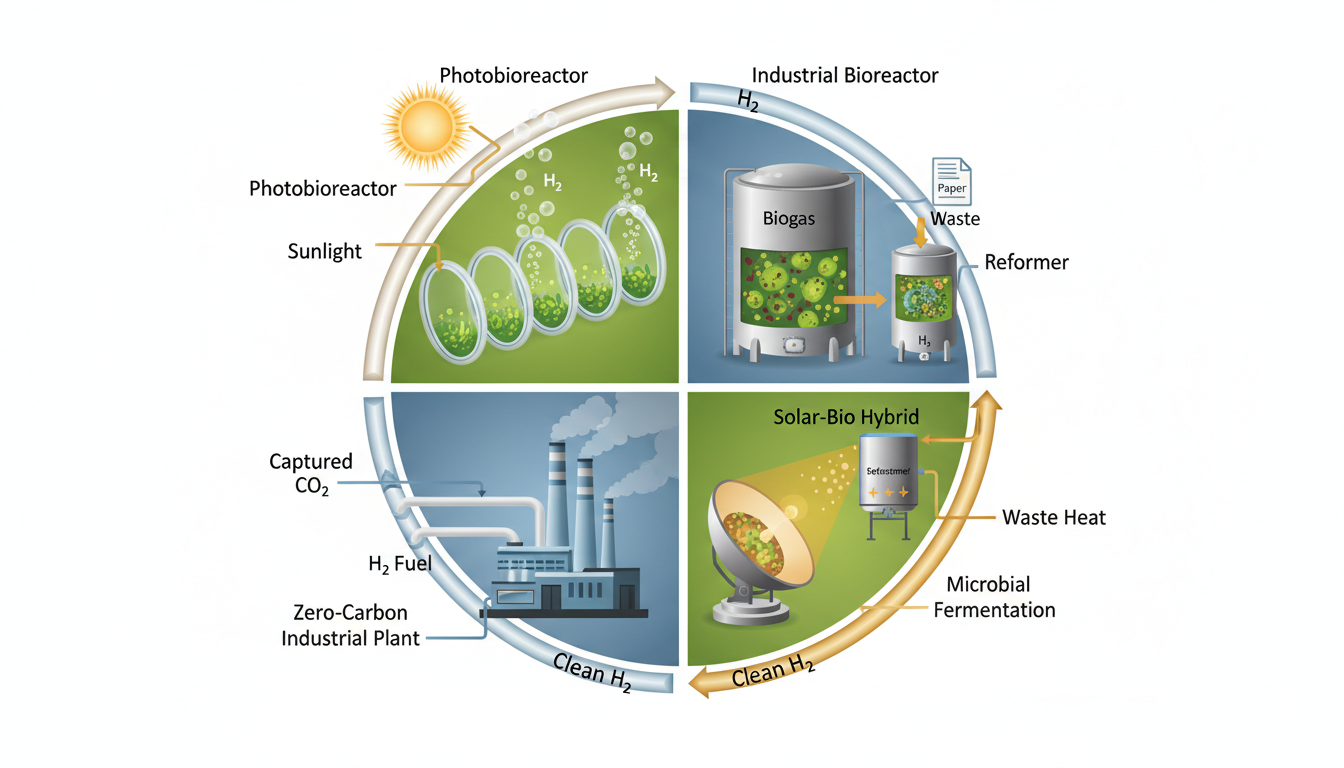
The breakthrough begins with the capture of carbon dioxide directly from factory exhaust. Instead of releasing this greenhouse gas into the atmosphere, it is diverted into specially designed bioreactor ponds. These ponds are filled with microalgae, which naturally consume carbon dioxide as part of their photosynthetic cycle. Once the algae reach sufficient biomass, they are harvested and sent through a dark fermentation process—a light-independent, bacteria-driven method that produces hydrogen gas as a byproduct. This hydrogen can then be used to power turbines, fuel cells, or hydrogen-powered vehicles, offering a fossil-fuel-free energy source derived from pollution itself.

The resulting hydrogen can be fed directly into turbines, fuel cells, or hydrogen-powered vehicles—completely bypassing the need for fossil-based inputs. According to Prof. Natalia Politeeva, the lead researcher, “We’re not fighting nature—we’re collaborating with it. Microalgae convert waste into energy while scrubbing the air.” Unlike conventional hydrogen production methods, this technique functions continuously and is not dependent on solar or wind availability.

This innovation is especially impactful for three reasons. First, it is inherently carbon-negative—each kilogram of biohydrogen removes approximately 1.8 kilograms of CO₂ from industrial flue gases. Second, the system is designed to be scalable, allowing bioreactors to be seamlessly integrated into existing industrial facilities without competing for arable land. Finally, the continuous nature of dark fermentation allows hydrogen production around the clock, eliminating the intermittency issues that plague solar- and wind-based methods.

With global hydrogen demand projected to increase by 500% by 2050, this algae-based system could offer a cost-effective and ecologically beneficial solution. While green hydrogen produced via electrolysis currently costs between $4 and $6 per kilogram, the algae-driven alternative may reduce that to just $1.50/kg, all while drawing carbon out of the atmosphere.

Researchers at the university are now developing genetically enhanced algae strains capable of tripling hydrogen yields. They have already initiated collaborations with Ural-based steel plants for pilot deployments expected to launch by 2026. If successful, this technology could help heavy industry meet decarbonization targets while generating clean fuel on-site.

“This is where environmental science and energy intersect,” Politeeva emphasizes. “We’re growing fuel from pollution.”

Beyond Microalgae: Global Innovations in Biological Hydrogen Production

While the Russian breakthrough with microalgae represents a significant advance, other pioneering efforts around the world are expanding the frontier of biological hydrogen production. In California, for instance, SGH2 Energy has developed an industrial-scale hydrogen plant in the city of Lancaster that utilizes paper waste as its primary feedstock. Using ultra-high-temperature plasma torches—reaching an astonishing 3,500 to 4,000°C—the facility converts up to 42,000 tons of waste annually into clean hydrogen. This process not only diverts municipal waste from landfills but also achieves hydrogen production costs five to seven times lower than conventional electrolysis. Remarkably, the plant produces up to 11,000 kilograms of hydrogen per day, with lifecycle carbon emissions far lower than those of most green hydrogen pathways.

This solution is particularly attractive due to its scalability and integration with existing waste management systems. It transforms environmental liabilities into valuable clean energy, making it ideal for urban-industrial areas with high volumes of paper or biomass waste. Moreover, the process operates independently of weather or solar conditions, offering consistent output and grid-level reliability. The environmental benefits are twofold: significant reductions in methane emissions from decomposing waste and avoidance of carbon-intensive hydrogen production methods. SGH2’s project serves as a model of circular economy innovation that repurposes waste streams while accelerating the transition to carbon-negative hydrogen.

A complementary and increasingly favored approach among biorefineries is the integration of biological and thermochemical techniques in a hybrid hydrogen production system. In this dual-stage process, agricultural residues or organic municipal waste are first subjected to dark fermentation—an anaerobic microbial process that produces hydrogen-rich biogas. The residual biomass, still rich in carbon, is then gasified at high temperatures to extract additional hydrogen and syngas. This tandem method boosts the total energy recovery by over 40% compared to using either fermentation or gasification alone. The improved efficiency, combined with the utilization of widely available feedstocks, makes this a highly attractive solution for rural and semi-urban deployment.

Beyond its technical merits, the hybrid system enhances economic viability and environmental performance. It allows facilities to adjust processing methods based on feedstock availability or energy demand, thereby improving resilience and operational flexibility. When co-integrated with microalgae systems—where algal biomass can be fermented or gasified—the synergy becomes even more powerful, creating closed-loop biorefineries capable of addressing both waste disposal and clean energy generation. This convergence of microbial processes and thermochemical innovation could become central to the next generation of decentralized, low-carbon hydrogen ecosystems.

Innovations are also emerging from biologically inspired but non-biological systems that mimic or support life-based processes. A prominent example is Germany’s Synlight project, a high-intensity solar simulation facility that aims to replicate the sun’s power using a matrix of 149 xenon lamps. By concentrating light to 10,000 times the intensity of natural sunlight, Synlight can generate temperatures near 3,000°C—sufficient to thermally split water molecules into hydrogen and oxygen without catalysts or electricity. Though the current experiments are small-scale and energy-intensive, the technology represents a leap in understanding high-temperature solar chemistry and its potential applications in renewable fuel production.

Looking ahead, such solar-thermal breakthroughs may be coupled with biological systems to create hybrid reactors where solar energy fuels algae photobioreactors or drives bioreactor heating cycles. These solar-biological hybrids could dramatically reduce energy input requirements for biohydrogen production while leveraging the ultra-high thermal energy for sterilization or biomass pretreatment. By combining the precision and scalability of engineered systems with the adaptability of living organisms, this new class of solutions could redefine the boundaries of biological hydrogen production and establish a foundation for decentralized, solar-driven fuel ecosystems.

Industry Integration: From Waste to Wheels

The rapid maturation of hydrogen technologies is catalyzing a wave of industrial adoption, as companies seek cleaner alternatives to fossil fuels without compromising performance or economic viability. SGH2’s waste-to-hydrogen facility exemplifies this shift, converting landfill-bound paper waste into low-cost, carbon-negative hydrogen. This approach not only mitigates waste management challenges but also bypasses the food-vs-fuel dilemma that plagues many bioenergy solutions. In Southeast Asia, Thailand’s EGAT-BIG initiative is integrating low-carbon hydrogen with natural gas to supply cleaner electricity—reportedly achieving emissions reductions of up to 95% compared to traditional blue hydrogen pathways that rely on methane reforming with carbon capture.

Heavy industry, long considered difficult to decarbonize, is also undergoing transformation through sustainable hydrogen use. The steel sector, responsible for nearly 8% of global carbon emissions, is turning to biohydrogen as a viable path to green production. Japanese conglomerate Nippon Steel has initiated trials involving biohydrogen injection into blast furnaces, aiming to curb the carbon intensity of steelmaking. This trend is part of a broader global momentum, with more than $15 billion in investment committed to hydrogen-powered metallurgy. From electricity generation to foundational manufacturing, these industrial applications underscore hydrogen’s emerging role as a cornerstone of decarbonized economies—especially when derived from waste or biological sources.

Navigating Challenges

Despite its considerable promise, biological hydrogen production still faces notable technical and economic obstacles. One major limitation lies in the photosynthetic efficiency of microalgae, which typically ranges from just 3% to 6%. This means that vast cultivation areas are required to generate significant hydrogen yields, making large-scale deployment both land- and resource-intensive. Furthermore, the current cost of producing green and biohydrogen remains considerably higher than conventional grey hydrogen. While hydrogen from natural gas (without carbon capture) costs around $1 to $2 per kilogram, biohydrogen generally falls in the range of $3 to $8 per kilogram—posing a substantial economic barrier to widespread adoption.

To close this cost gap and stimulate market competitiveness, policy interventions are becoming increasingly crucial. In the U.S., the 45V tax credit offers a strong financial incentive for clean hydrogen production, potentially bringing biohydrogen closer to parity with fossil-based options. However, the supporting infrastructure remains underdeveloped. Europe’s proposal to create a 50,000+ kilometer hydrogen pipeline network is an ambitious step forward but still largely in the planning phase. For biohydrogen to fulfill its potential, coordinated efforts between governments, research institutions, and industry players will be essential—not only to improve efficiency and cost-effectiveness but also to establish a global hydrogen logistics and distribution framework.

Comparative Technology Snapshot

To better understand how Russia’s algae-based hydrogen stacks up globally, here’s a look at some key technologies:

Technology Key Advantage Deployment Status
Russian Microalgae Carbon-negative, on-site production 2026 pilot planned
SGH2 Plasma Gasification 11,000 kg/day from recycled waste Operational in California
Synlight Solar Reactor Ultra-high-efficiency water splitting Experimental in Germany
EGAT Hydrogen Blending 95% cleaner than blue hydrogen Scaling in Thailand

“We’re turning smokestacks into fuel factories. Every ton of CO₂ absorbed by algae is a ton erased from our footprint—and a kilogram of hydrogen created.”

The Road Ahead

As the world pivots toward cleaner energy futures, the roadmap for biological hydrogen production hinges on innovation at multiple levels. Advances in genetic engineering are pushing the boundaries of algal efficiency, with researchers developing strains capable of far higher hydrogen yields under controlled conditions. Simultaneously, modular bioreactor designs are gaining traction, allowing for decentralized deployment across industrial sites and agricultural regions. These compact, scalable units promise to reduce logistical costs and emissions by producing hydrogen exactly where it’s needed—transforming waste into fuel in a closed-loop system.

Equally important is the policy environment that underpins these technologies. National and international frameworks must move beyond subsidies and toward systemic integration—funding pilot programs, accelerating permitting processes, and ensuring grid readiness for hydrogen deployment. As Prof. Politeeva of Saint Petersburg State University remarked, the vision is one of “integrated systems where waste streams become feedstocks and energy production enables circular economies.” With such a blueprint, the world could transform biological hydrogen from a niche innovation into a pillar of the global clean energy transition.

Conclusion

Biological hydrogen production stands at the crossroads of biotechnology, sustainability, and energy innovation. From engineered algae in Russian labs to hybrid biorefineries and solar-assisted systems in Germany and the U.S., the global momentum is unmistakable. These diverse approaches—rooted in nature yet enhanced by human ingenuity—hold the promise of transforming waste into clean, storable, and versatile energy. As industries like steelmaking and power generation begin to adopt biohydrogen solutions, it becomes clear that this is not merely a scientific experiment but a viable path toward decarbonization.

However, realizing this vision at scale will require coordinated efforts across research, infrastructure, and policy. Challenges such as low photosynthetic efficiency, high production costs, and limited transport networks must be addressed through sustained investment and innovation. The integration of modular systems, smart policy incentives, and circular economy models offers a roadmap to overcome these barriers. With the right ecosystem in place, biological hydrogen could emerge as a cornerstone of the global energy transition—powering everything from factories and vehicles to homes, while helping the world achieve its climate goals.


About Rajesh Uppal

Check Also

3D-Printed Weapons: The Next Frontier of Terrorism and Global Security Threats

Introduction Additive manufacturing, more commonly known as 3D printing, has evolved from a niche prototyping …

wpChatIcon
wpChatIcon