
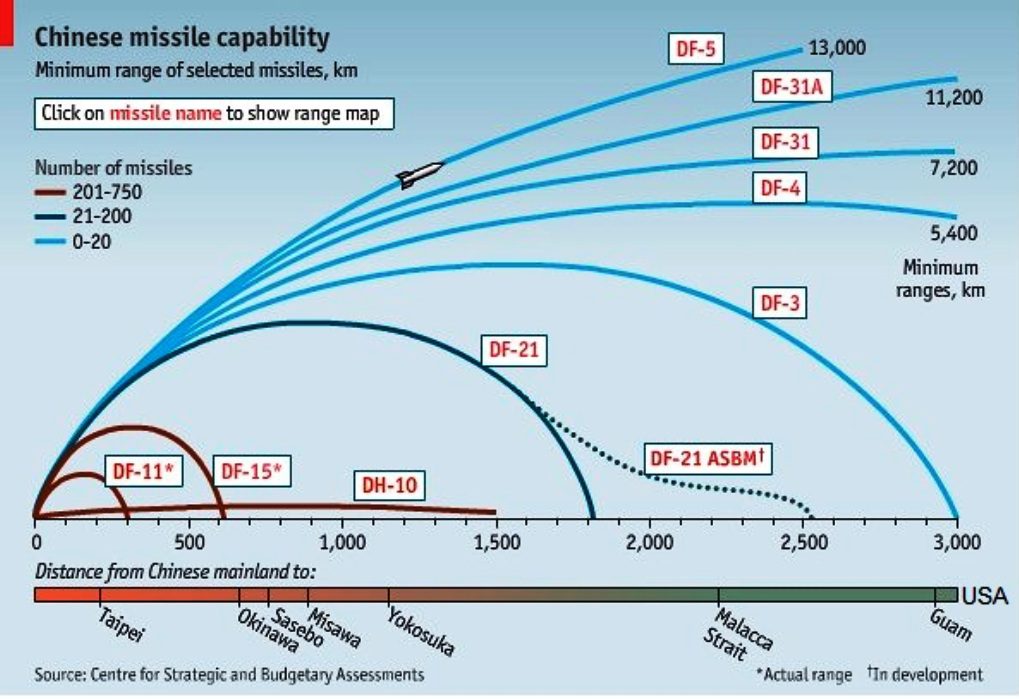

“The greatest military threat to U.S. vital interests in Asia may be one that has received somewhat less attention: the growing capability of China’s missile forces to threaten U.S. bases in the region,” write Thomas Shugart and Javier Gonzalez in a report released last month by the Center for a New American Security (CNAS). In the report, they argue that China could use its missile forces to conduct a surprise preemptive strike against U.S. military bases in the region to prevent U.S. intervention in a conflict over Taiwan or the Senkaku Islands. Shugart and Gonzales run two different models of a simulated preemptive attack, keeping in mind what they know about U.S. and allied missile defense systems in the region. In both models, “enough ballistic missiles seemed likely to leak through to cause highly significant damage to U.S. bases and forces in the region.”
Beijing has the largest land-based missile arsenal in the world. According to Pentagon estimates, this includes 1,200 conventionally armed short-range ballistic missiles, two hundred to three hundred conventional medium-range ballistic missiles and an unknown number of conventional intermediate-range ballistic missiles, as well as two to three hundred ground-launched cruise missiles. Many of these are extremely accurate, which would allow them to destroy targets even without nuclear warheads. As a Rand Corporation report noted, Chinese missiles’ “circular error probabilities have decreased from hundreds of meters in the 1990s to as few as five or ten meters today.” Some of them, including the much discussed DF-21D “carrier killer” missile, have maneuverable reentry vehicles that further improve accuracy and allows them to evade missile defense systems.
Some of the results of the attacks include: “Almost every major fixed headquarters and logistical facility struck, with key headquarters struck within the first few minutes of the conflict” ;“Almost every U.S. ship in port in Japan struck pierside by ballistic missiles”; “In most cases, cratering by ballistic missiles of every runway and runway-length taxiway at all major U.S. air bases in Japan”; “As a result of runway cratering, headquarters destruction, and air defense degradation, more than 200 trapped U.S. aircraft destroyed on the ground in the first hours of the conflict.”
PLA is continuing to improve key capabilities that would be used in theater contingencies, including cruise missiles; short, medium, and intermediate-range ballistic missiles; high performance aircraft; integrated air defense networks; information operations capabilities; and amphibious and airborne assault units. The PLA is developing and testing new intermediate- and medium-range conventional ballistic missiles as well as long-range, land-attack, and anti-ship cruise missiles, which once operational would extend the military’s reach and push adversary forces further from potential regional conflicts, says annual report to congress.
Indeed, according to PACOM’s Harris, approximately 95 percent of the missiles in the People’s Liberation Army Rocket Force arsenal fall in the 500 to 5,500-km range, Harris told a House Armed Services Committee hearing in February — meaning key U.S. facilities throughout Japan could already be within range of thousands of difficult-to-defeat advanced ballistic and cruise missiles. Some regional security experts have even speculated that the Chinese military may be practicing for pre-emptive missile strikes on the forward bases that underpin U.S. military power in the Western Pacific.
China has revealed footage of its next-generation Dongfeng-26 ballistic missile showing improved stability and accuracy, a move analysts say aims to send a message to the United States about its military strength. The People’s Liberation Army Rocket Force launched at least one DF-26 missile during the drill. China’s defence ministry in April confirmed the DF-26 had been put into service with the Rocket Force. “The DF-26 is attached to a brigade under the People’s Liberation Army (PLA) Rocket Force that operates in Northwest China’s plateau and desert areas.” “A mobile missile launch from deep in the country’s interior is more difficult to intercept,” the Global Times quoted an expert as explaining. After the missile enters a later stage, its speed is so high that chances for interception are significantly lower.”
The US recently has called on its international allies — including Australia — to ramp up pressure on Beijing’s attempt to assert control over the international shipping lanes and fisheries through an increased tempo of ‘freedom of navigation operations’ (FONOPS) by their warships.
China’s military conducted a salvo of 10 missile flight tests of DF-21 intermediate-range ballistic missiles during the transition to the Donald Trump administration. The missiles “can destroy U.S. Asia-Pacific bases at any time,” the dispatch from the official Xinhua news agency reported. The DF-21 is the basis for several types of missiles, including the anti-ship variant known as the DF-21D. Another version is believed to be part of China’s anti-satellite arsenal. The DF-21C is a land-attack maneuvering missile with a range of about 1,000 miles.
China conducted a flight test of a new missile known as the Dong Ning-3 that the Pentagon believes is a missile designed to hit US satellites in space. The DN-3 is known as a direct-ascent anti-satellite missile that destroys satellites with a warhead that rams into orbiting systems at high speeds. The DN-3 is also said to have the capability to intercept ballistic missiles in flight. Fisher, senior fellow at the International Assessment and Strategy Center, said the DN-3 could be capable of hitting satellites more than 18,640 miles away in space—more than enough to reach large U.S. surveillance satellites that occupy orbit 186 to 620 miles from earth.The Chinese Defense Ministry dismissed published reports of the ASAT test as “groundless.”
China is now testing strategic missiles armed with multiple warheads that represent a quantum increase in strategic nuclear lethality. China’s most potent intercontinental ballistic missile, the new DF-41 was flight tested in December 2015 .The DF-5C missile, which is a newer variant of China’s DF-5 ICBM, was launched earlier in January from the Taiyuan Space Launch Center in central China and landed in an impact range in the desert in western China, according to the Washington Free Beacon. Mounted on the missile were 10 multiple independently targetable reentry vehicles, or MIRVs, each one containing a nuclear warhead capable of leveling an entire city.
China is conducting substantial research into both countering and developing hypersonic, precision-guidance, and boost-glide technologies, with the DF-21D and WU-14 weapon systems as just two recent examples, according Dr. Lora Saalman, Associate Professor at the Asia-Pacific Center for Security Studies. The congressional U.S.-China Economic and Security Review Commission stated in its latest annual report that the China’s hypersonic glide vehicle program is “progressing rapidly” and the weapon could be deployed by 2020. China also is building a powered version of the high-speed vehicle that could be fielded by 2025.
China has allegedly tested a weapon of mass destruction capable of hitting London and other major European or American cities in just 30 minutes. Chinese President Xi Jinping has said the newly formed Rocket Force of the PLA which handles the country’s growing arsenal of missiles has played an “irreplaceable” role in helping Beijing to become a “major power” by warding off war threats.
Inspecting the People’s Liberation Army’s (PLA) Rocket Force, Mr. Xi, general secretary of the Communist Party of China (CPC) and also chairman of the Central Military Commission (CMC), described the force as a “core of strategic deterrence, a strategic buttress to the country’s position as a major power, and a cornerstone on which to build national security.” Mr. Xi’s comments came amid growing tensions with the U.S. and Japan over the South China Sea, disputed islands in the East China Sea and efforts by North Korea to ramp up its nuclear capability despite international sanctions.