Home / Critical & Emerging Technologies / Biotech & Synthetic Biology / Biofoundries: The Automated Engine Powering the Global Bioeconomy Revolution

Biofoundries: The Automated Engine Powering the Global Bioeconomy Revolution

Biofoundries are automated biological factories combining AI, robotics, and synthetic biology to power the global bioeconomy, reshaping manufacturing, national security, energy systems, and the future of industrial civilization.

The $30 Trillion Bio-Horizon

Synthetic biology, once a frontier science confined to academic labs, is rapidly evolving into an economic powerhouse. By 2030, it is projected to influence more than one-third of global manufacturing output—an estimated $30 trillion sector. Powering this seismic transformation is the emergence of biofoundries: fully automated facilities that integrate robotics, AI, and synthetic biology to program life at scale. These industrial platforms enable breakthroughs in medicine, agriculture, sustainable materials, and even national defense—bringing biology into the heart of the Fourth Industrial Revolution.

Biotechnologies—particularly synthetic biology—are rapidly emerging as foundational pillars of the 21st-century economy. No longer confined to academic labs, synthetic biology is now a multi-billion-dollar industry driving innovation across diverse sectors including healthcare, energy, chemicals, food, agriculture, and environmental management. By the end of the decade, products engineered through synthetic biology are expected to comprise more than one-third of global manufacturing output, representing an economic value of over $30 trillion. The defense sector is also being transformed, with biofabrication enabling on-demand production of mission-specific drugs, fuels, sensors, coatings, and novel materials—all engineered from the molecular level to meet precise operational needs.

At its core, synthetic biology applies an engineering mindset to the fabric of life itself. It involves redesigning natural biological systems and constructing new ones by manipulating an organism’s DNA—the genetic code that determines how it senses, processes, and responds to its environment. Technologies such as DNA sequencing, gene editing, and DNA synthesis lie at the heart of this transformation. Advanced sequencing tools allow scientists to decode the biological instructions written in an organism’s genome, facilitating early diagnosis of genetic disorders and enabling personalized medicine. Tools like CRISPR-Cas9 have revolutionized gene editing, offering precise, efficient, and cost-effective means to add, delete, or modify genetic material to treat diseases or enhance traits. Meanwhile, breakthroughs in enzymatic DNA synthesis and the advent of DNA printers now allow scientists to write new genetic codes from scratch, enabling the design of tailor-made organisms that function as living factories.

These innovations have turned biology into a programmable and scalable platform—ushering in a new era of manufacturing. Instead of sourcing chemical compounds from nature or refining them through polluting industrial processes, synthetic biology companies are programming microbes, plants, or animal cells to produce desired outputs—pharmaceuticals, biofuels, biodegradable plastics, cancer therapies, and more—within controlled environments. The self-replicating nature of DNA allows these engineered organisms to multiply, making it possible to scale production to industrial levels. Ultimately, synthetic biology is not just an extension of biotechnology; it is redefining how we create, scale, and distribute materials, making biology the next engine of economic and technological progress.

Biofoundries streamline the Design-Build-Test-Learn (DBTL) cycle

At their core, biofoundries are high-throughput biological factories, designed to accelerate the Design-Build-Test-Learn (DBTL) cycle. This iterative framework—once a manual, time-consuming process—has been transformed into an efficient, automated loop.

Synthetic biology relies on the Design-Build-Test-Learn (DBTL) cycle—an engineering-driven framework that allows iterative development of biological systems with desired traits such as increased yield, production rate, or metabolic efficiency. In the Design phase, researchers use computational tools to model metabolic pathways and genetic circuits, defining how biological components like sensors, enzymes, and regulatory elements should interact. Tools like COBRA and FluxML help simulate metabolic fluxes, while software such as PartsGenie and novoPathFinder assist in optimizing DNA sequences and pathway design. Designs are translated into genetic constructs, organized into operable sequences, and checked for compatibility to ensure they perform the intended biological functions.

The Build phase turns these digital designs into reality. DNA sequences are synthesized and introduced into host organisms through genome editing, regulation, or assembly techniques. Automation-friendly methods like Gibson assembly, Twin-Primer Assembly, and in vivo yeast recombination allow high-throughput and accurate construction of genetic circuits. Companies like Amyris have scaled this process using TAR-based automation, achieving over 1,500 DNA constructs per week with high fidelity. Despite these advances, quality assurance remains challenging, as many protocols still require expert intervention and often suffer from inconsistent results.

The Test phase evaluates whether the engineered organisms meet the initial specifications using cell analysis, omics profiling, and high-throughput screening. However, mapping experimental results back to the original models remains a complex task, often requiring both qualitative interpretation and advanced data analysis.

Finally, the Learn phase—though historically underdeveloped—is increasingly powered by machine learning and systems biology. This stage integrates data from previous testing to refine models and optimize future designs, allowing the DBTL cycle to evolve toward greater accuracy and efficiency. Automation platforms play a critical role here, generating large-scale biological data that can be mined for patterns, correlations, and predictive insights. As a result, synthetic biology is becoming more precise, reproducible, and scalable, transforming laboratory experimentation into a streamlined and industrialized engineering discipline.

Biofoundries represent a transformative leap in biological research and development, merging principles of engineering—such as standardization, modularization, and automation—with the genetic manipulation of living systems. These highly automated, high-throughput laboratories serve as the manufacturing engines of the synthetic biology revolution. By integrating robotic workflows, computational design tools, and advanced analytics, biofoundries streamline the Design-Build-Test-Learn (DBTL) cycle, enabling the rapid prototyping and optimization of engineered organisms. From a handful of genetic designs, a biofoundry can synthesize DNA, assemble constructs, transform host organisms, and assay thousands of microbial variants simultaneously, drastically reducing development time and increasing experimental accuracy.

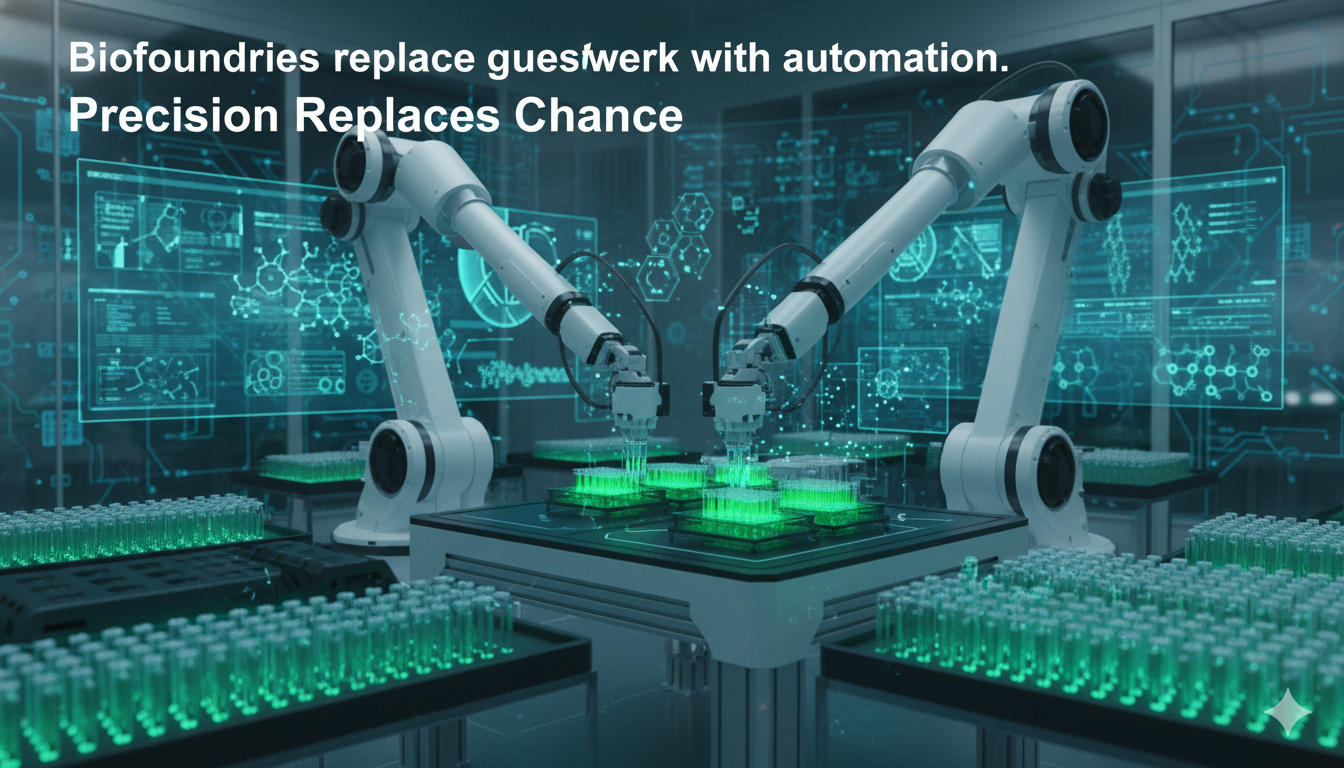
These facilities operate around the clock with minimal human intervention, maximizing the efficiency of research and manufacturing pipelines. High-throughput liquid-handling robots, automated screening systems, and data-driven feedback loops allow for continuous iteration and refinement of biological designs. The infrastructure found in biofoundries mirrors the development environments that catalyzed the computer revolution in the 1970s—except this time, the design substrate is living cells. Globally, more than two dozen major institutions, including Harvard and Imperial College London, have established biofoundries to drive innovation in synthetic biology and sustainable biomanufacturing. These platforms are uniquely positioned to convert industrial waste into valuable products, such as methane-fed microbial biomass for animal feed or engineered bacteria producing diesel from glucose, offering compelling alternatives to petrochemical and agriculture-based inputs.

Metric Traditional Lab Biofoundry
DNA Constructs/Week 5–10 1,500+ (Amyris)
Error Rate 15–30% <10%
Strain Optimization 6–12 months 85 days (Manchester)
Cost per Experiment High Low (at scale)

This leap in automation has already proven its potential. Under pressure-test conditions, the Broad Institute was able to produce six novel molecules in just 90 days—an achievement that would have taken years using traditional methods.

Beyond industrial bioproduction, biofoundries are enabling the development of next-generation healthcare solutions. These include rapid vaccine prototyping, personalized cell therapies, engineered gut microbiomes for health optimization, and biosensors capable of detecting environmental toxins and infectious diseases in resource-limited settings. Microbial cell factories produced within biofoundries are already generating bioplastics, commodity chemicals, protein-rich foods, and antibiotics. As biofoundries scale and connect into a global collaborative network, they will play a critical role in shaping a more resilient, sustainable, and decentralized bioeconomy. Their potential to revolutionize how we manufacture, medicate, and manage environmental health places them at the frontier of 21st-century science and innovation.

Technological Leaps Fueling the Surge

Revolution in DNA Synthesis

A new era of biological manufacturing is being driven by a revolution in DNA synthesis technology. At the forefront is Enzymatic DNA Synthesis (EDS), which replaces traditional, hazardous chemical methods with a cleaner, more precise enzymatic approach. Unlike older techniques that generated toxic waste and were limited to short strands, EDS enables the creation of error-free DNA sequences exceeding 1,000 base pairs—a critical threshold for complex gene synthesis. This leap in fidelity and length has dramatically accelerated the pace of synthetic biology experimentation and reduced barriers to entry for labs worldwide.

Tools like DNA Script’s Syntax are bringing this capability directly to the lab bench. These compact DNA printers allow researchers to generate custom genetic sequences within hours, bypassing the delays and logistical bottlenecks of outsourced synthesis services. Meanwhile, genome engineering tools are also evolving rapidly. For instance, the GTR-CRISPR system enables simultaneous editing of multiple genes—such as modifying six yeast genes in under three days—leading to breakthroughs like a 30-fold increase in fatty acid production. These innovations collectively shrink development timelines from months to days, empowering a new wave of agile, automated biodesign across industries.

AI-Driven Biodesign

Artificial intelligence is rapidly transforming the landscape of biological engineering, enabling scientists to design, predict, and optimize living systems with unprecedented speed and precision. Generative AI tools, such as Evo, are now capable of designing novel DNA and RNA sequences from scratch, opening the door to biological functions that do not yet exist in nature. These tools explore vast genetic design spaces, helping researchers move beyond trial-and-error methods toward algorithm-guided innovation.

Platforms like Ginkgo Bioworks’ automated strain engineering system further exemplify the power of AI-driven biodesign at scale. Capable of screening over 100,000 microbial strains each month, this system identifies variants with the most desirable traits for producing enzymes, fuels, fragrances, therapeutics, and more. Meanwhile, advanced initiatives such as CABBI’s FAST-PB (Fluorescence-Assisted Single-cell Transcriptomics and Proteomics for Biodesign) integrate single-cell mass spectrometry with machine learning to optimize lipid synthesis in genetically modified plant cells. These converging capabilities signal a new paradigm where biology becomes a programmable, data-driven discipline, guided by intelligent algorithms that can learn, iterate, and improve across cycles of experimentation.

Robotic Workflow Integration

Modern biofoundries are defined by their modular, automated, and cloud-connected infrastructures, which bring speed, precision, and scalability to biological engineering. At the core of these systems are affordable liquid-handling robots like Opentrons’ OT-2, which democratize lab automation by performing complex pipetting routines at a fraction of the cost of traditional systems. These platforms enable small labs and startups to access high-throughput capabilities once reserved for large institutions.

Cloud-based infrastructure is also transforming how experiments are conducted. The Illinois iBioFoundry, for example, exemplifies the next generation of cloud-integrated biology, where researchers can design workflows and remotely control robotic systems through programmable interfaces—enabling real-time collaboration across global teams. Complementing this automation are environmentally relevant testing platforms like EcoFAB, which simulate soil and plant microenvironments inside miniature bioreactors. These systems allow researchers to evaluate the behavior of engineered microbes under natural conditions, bridging the gap between lab-based design and field-level performance. Together, these robotic and virtual platforms are reshaping synthetic biology into a fully integrated, high-throughput engineering discipline.

Real-World Impact: From Pandemics to Planet-Scale Challenges

Healthcare Transformation

The COVID-19 pandemic served as a powerful proof of concept for the role of biofoundries in global health resilience. Leveraging their automated design-build-test-learn (DBTL) infrastructure, researchers were able to generate mRNA vaccine candidates in under 48 hours, dramatically accelerating the vaccine development timeline and demonstrating the potential of rapid-response bioengineering platforms. This success has laid the foundation for next-generation vaccine development—targeting not only seasonal influenza but also emerging infectious diseases.

Beyond vaccines, biofoundries are advancing a new class of programmable therapeutics. Engineered strains of E. coli, designed to deliver tumor-targeting TNFα proteins, are now progressing into clinical trials, offering novel approaches to cancer immunotherapy. At the same time, high-throughput screening technologies have reinvigorated the search for antibiotics—a field plagued by decades of stagnation. In 2024 alone, biofoundry-driven pipelines identified seven promising new antimicrobial candidates, underscoring their potential to combat antibiotic resistance and revitalize infectious disease treatment. These developments illustrate how biofoundries are not only accelerating innovation but also reshaping the future of medicine.

Building a Sustainable Bioeconomy

Biofoundries are at the heart of a new industrial paradigm—one where waste streams and greenhouse gas emissions are transformed into high-value, sustainable products. Companies like LanzaTech are leading the way by using genetically engineered microbes to convert industrial carbon emissions, including CO₂ and carbon monoxide, into jet fuel and other bio-based chemicals. This closed-loop approach not only reduces pollution but creates a scalable model for decarbonizing hard-to-abate sectors like aviation.

In the materials space, firms such as Bolt Threads are harnessing fermentation technologies to produce Microsilk™, a synthetic spider silk protein with the strength and elasticity of its natural counterpart—crafted without the need for animal farming or petroleum-based inputs. Meanwhile, Genomatica’s Bio-Nylon, made using metabolically engineered microbes, offers a 50% reduction in carbon emissions compared to traditional fossil-derived nylon. These innovations exemplify how biofoundries enable the shift from extractive, petrochemical-based manufacturing to circular, carbon-conscious production systems—laying the groundwork for a truly sustainable bioeconomy.

Food and Agriculture Innovation

Programmable biology is redefining agriculture, enabling faster, more sustainable solutions to global food security challenges. At the Center for Advanced Bioenergy and Bioproducts Innovation (CABBI), bioengineers recently compressed a two-year crop improvement cycle into just eight weeks by inserting oil-boosting genes into camelina plants using high-throughput biofoundry workflows. This rapid trait enhancement not only improves biofuel yield but also opens doors for climate-resilient crop development.

In the realm of alternative proteins, companies like Perfect Day are pioneering precision fermentation to produce animal-free dairy proteins, identical to those found in cow’s milk but without the need for livestock. These proteins are now featured in over 1,000 commercial food products, offering a scalable path toward cruelty-free and low-carbon food systems. Meanwhile, Pivot Bio is transforming the fertilizer industry by engineering soil microbes that naturally fix nitrogen, reducing reliance on synthetic fertilizers that contribute to environmental degradation. Together, these breakthroughs highlight how synthetic biology is enabling a new era of climate-smart, sustainable agriculture, rooted in biology rather than chemical inputs.

Global Race: National Security and Economic Sovereignty

Strategic Investments Worldwide

The rise of biofoundries has ignited a new frontier in the global race for technological leadership, economic resilience, and national security. As synthetic biology becomes a cornerstone of 21st-century innovation, countries are investing heavily to establish sovereign biomanufacturing capabilities and reduce dependence on fragile global supply chains. The United States, through the National Science Foundation (NSF), has committed $75 million to build a network of five regional biofoundries, each specializing in strategic domains such as RNA therapeutics, extremophile biology, and cloud-connected biological infrastructure. These hubs are not only accelerating research but also serving as national assets for health security, defense logistics, and on-demand manufacturing.

In Asia, governments are equally assertive. China’s SynCTI (Synthetic Biology Center of Excellence) and South Korea’s national BioFoundry are advancing capabilities in next-generation vaccines, engineered biomaterials, and high-throughput metabolic engineering, backed by strong state support and long-term industrial policy. Meanwhile, the European Union, under the strategic umbrella of its Green Deal, has pledged a staggering €43 billion to scale up bio-based manufacturing, promote circular economies, and reduce carbon emissions through synthetic biology-driven innovation. These investments are not only scientific or economic in nature—they reflect a broader recognition that biofoundries are becoming as vital as semiconductor fabs in securing national interests in health, food, energy, and environmental sustainability.

Supply Chain Resilience and Field Deployment

Biofoundries offer unmatched flexibility for distributed biomanufacturing. They are capable of producing insulin and other critical pharmaceuticals during supply shortages, synthesizing battlefield biosensors on demand, and printing climate-resilient crop seeds locally. This decentralized model ensures continuity and sovereignty in biological production.

“Nations without biofoundries will be as disadvantaged as those without semiconductor fabs.”
Dr. Emily Leproust, CEO, Twist Bioscience

Challenges on the Frontier

Despite their transformative potential, biofoundries still face a range of systemic and technical challenges. Foremost among these is the persistent “Valley of Death”—the critical gap between successful lab-scale discoveries and scalable industrial deployment. Bridging this divide requires not only robust process optimization but also techno-economic analysis and life-cycle assessment (TEA/LCA), as exemplified by the Agile Biofoundry’s efforts to develop tools that streamline this transition. Without such mechanisms, many promising innovations risk stalling before reaching real-world application.

Another major hurdle is the lack of standardized data and interoperable systems across institutions and platforms. Biofoundries rely on high-throughput data and automated workflows, making the need for harmonized data formats, metadata standards, and open-access databases more pressing than ever. The Global Biofoundry Alliance (GBA) plays a leading role in promoting these standards, ensuring that designs, results, and protocols can be seamlessly shared and reproduced across global networks. Parallel to this, ethical oversight and governance are becoming increasingly critical. As bioengineering advances, international organizations like the OECD are working to establish global frameworks for biosafety, security, and responsible innovation in synthetic biology.

Finally, the rapid evolution of biofoundry technologies is outpacing the current workforce capacity. Addressing this talent gap is essential to scale operations and ensure equitable access to these powerful platforms. Initiatives backed by the U.S. National Science Foundation (NSF)—including targeted training at Historically Black Colleges and Universities (HBCUs) and community colleges—are equipping a new generation of bioengineers with the skills needed in automation, synthetic biology, and data analytics. Closing this skills gap will be critical not only for sustaining innovation but also for democratizing access to the bioeconomy.

Global Biofoundry Alliance (GBA): Building a Networked Bioeconomy Infrastructure

Established in 2019, the Global Biofoundry Alliance (GBA) serves as a collaborative platform that unites public biofoundries around the world with the goal of promoting open-source innovation in synthetic biology. Its vision is rooted in accelerating the rapid and reliable prototyping of engineered biological systems by encouraging the open development of software, hardware, protocols, standards, and best practices. As synthetic biology becomes increasingly central to addressing global challenges—from pandemics to climate resilience—GBA offers an infrastructure for agile, interoperable, and collaborative biological engineering at scale.

One of the Alliance’s most significant contributions is the facilitation of knowledge sharing and technical standardization. Each biofoundry within the network typically specializes in particular cell types, processes, or application domains—ranging from medical therapeutics to industrial materials, fuels, food, and environmental technologies. The GBA allows these specialized capabilities to be shared, creating a collective repository of biological “chassis” options and engineering expertise. This shared understanding fosters international collaborations that would otherwise be constrained by geographic or institutional silos, enabling joint efforts to develop solutions to globally relevant challenges. It also ensures that any member—whether in Singapore, London, or Boston—can access peer expertise, reference materials, and shared data frameworks.

Today, the Alliance includes 28 public biofoundries, with a strong presence in Asia: 4 in China, 2 in South Korea, and one each in Japan and Singapore. Many of these centers, such as the London Biofoundry and Singapore Biofoundry, not only serve as innovation hubs but also provide cost-effective access to expensive infrastructure and small-scale prototype evaluation for academic labs and biotech startups. These foundries are at the forefront of collaborative bioengineering milestones—such as the Broad Institute’s production of six novel molecules under a 90-day challenge, or the University of Manchester’s creation of 17 potential monomers within just 85 days. During the COVID-19 pandemic, the London Biofoundry rapidly reconfigured its platform to develop and validate automated diagnostics for SARS-CoV-2, exemplifying the alliance’s responsiveness to global emergencies.

Looking ahead, the GBA will be pivotal in realizing globally distributed, interoperable biofoundry ecosystems. As nations such as India develop synthetic biology roadmaps, establishing national biofoundries becomes essential for embedding bioengineering capabilities into future bioeconomies. Beyond technical innovation, the Alliance supports workforce development, offering researcher exchange programs, training in automation and AI-driven workflows, and collaborative protocol testing. GBA members are preparing the next generation of bioengineers to operate and innovate within these high-throughput systems. Meanwhile, commercial leaders like Ginkgo Bioworks and Zymergen complement the academic ecosystem by translating these innovations into scalable, real-world applications—driving progress in enzyme discovery, custom microbial hosts, and platform automation. Together, public and private stakeholders within the GBA framework are laying the groundwork for a robust, resilient, and globally interconnected biomanufacturing future.

2030 Vision: Biology as a Programmable Platform

Looking ahead, biofoundries are set to redefine the very fabric of industry. By 2030, they will enable personalized cancer therapies developed in 72-hour production cycles, direct conversion of CO₂ into fuels using electro-microbes, and the deployment of living sensors—such as engineered moss capable of detecting environmental toxins. Decentralized, plug-and-play “micro-foundries” will become commonplace, manufacturing medicines or materials at the point of need.

With synthetic biology markets expected to exceed $192 billion by 2034, nations are recognizing biofoundries not just as R&D hubs, but as strategic infrastructure on par with semiconductor fabs in the digital era.

Conclusion: The Second Industrial Revolution Has Gone Biological

The rise of biofoundries marks a turning point in humanity’s relationship with nature. We are no longer passive observers of biology—we are becoming its authors. From crop-optimizing robots in Illinois to pandemic-response systems in Singapore, biofoundries form an expanding network of biological innovation. These automated platforms are not merely accelerating progress; they are reshaping the foundation of civilization.

In Manchester, engineered bacteria transform agricultural waste into biodegradable plastics. At Imperial College, robotic arms pipette CRISPR solutions into tens of thousands of wells, searching for genetic pathways to treat Alzheimer’s. This is the silent hum of the bioeconomy—one automated cycle at a time.


References and Resources also include:

https://www.weforum.org/agenda/2019/10/biofoundries-the-new-factories-for-genetic-products/

https://www.fiercebiotech.com/medtech/lab-platform-opentrons-closes-200m-series-c-to-build-out-robotics-diagnostics-cell

https://theplosblog.plos.org/2019/05/are-biofoundries-the-solution-to-synbio-democratization/


About Rajesh Uppal

Check Also

3D-Printed Weapons: The Next Frontier of Terrorism and Global Security Threats

Introduction Additive manufacturing, more commonly known as 3D printing, has evolved from a niche prototyping …

wpChatIcon
wpChatIcon