Home / Critical & Emerging Technologies / Biotech & Synthetic Biology / From Waste to Weapons-Grade Resources: How DARPA is Turning Battlefield Trash into Tactical Treasure

From Waste to Weapons-Grade Resources: How DARPA is Turning Battlefield Trash into Tactical Treasure

The modern military runs on logistics. For every meal, spare part, and bullet delivered to the front lines, a hidden cost follows in the form of waste. Mountains of plastic packaging, empty water bottles, and food containers pile up, creating not just an environmental problem but also a logistical and tactical burden. Disposing of this waste often means burning it in open pits—a practice that releases toxic fumes, reveals a base’s position to adversaries, and leaves behind long-term ecological damage.

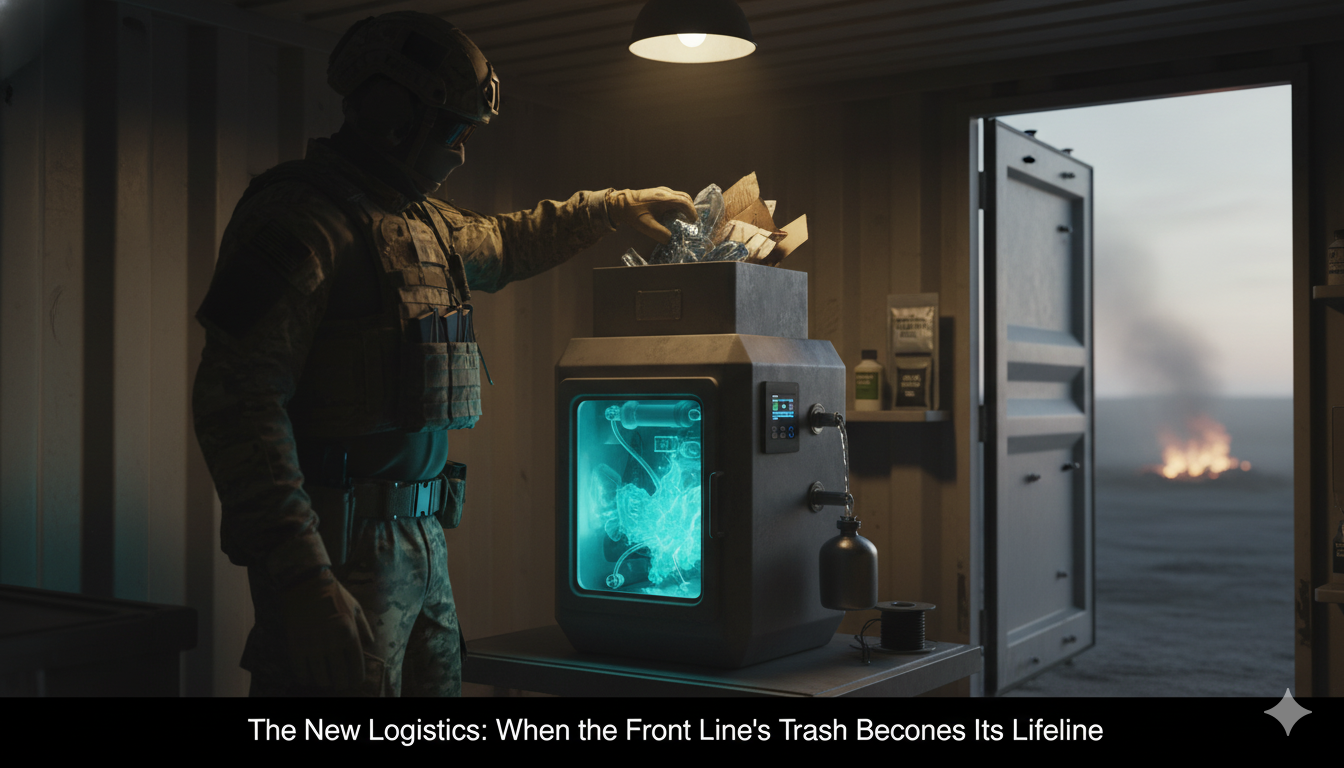
But what if battlefield trash could become a soldier’s lifeline? What if an empty water bottle could be converted into potable water, or a food wrapper could be broken down into emergency nutrients? This is the radical vision behind DARPA’s ReSource program, an ambitious initiative designed to transform military waste into mission-critical supplies—right at the point of need.


Over the past decades, global plastic production and consumption have witnessed a meteoric rise. Plastic is durable, easy to produce, lightweight, unbreakable, odourless, and chemically resistant. Its low manufacturing cost and durability are the two main factors responsible for the industry’s rapid growth. A so-called wonder product of the twentieth century, this entity is gradually choking our environment and polluting our mountain ranges and seas.

Single-use plastic items have caused a lot of damage to the environment and there’s an urgent need to collectively curb its usage, monitor its disposal, and, if possible, avoid using it altogether. Some plastic is naturally degradable, with the timing for this ranging from years to centuries. Yet in many cases, the products include toxins that themselves are more resistant. In all cases, however, waste is a product of use, therefore production, driven by demand.

The Battlefield Waste Problem: More Than Just Trash

Modern militaries face two pressing challenges in austere environments: sustaining forces with vital supplies and managing the enormous amounts of waste generated during operations. Traditionally, forward-deployed troops have relied on long, vulnerable supply chains to deliver essentials like fuel, lubricants, adhesives, and food. At the same time, handling battlefield trash — especially mixed plastics and paper waste — often requires costly logistics chains to haul it away.

Waste in combat zones is not a side issue—it is a direct threat to military effectiveness. The packaging and protective materials that are essential for preserving supplies before deployment become an immediate liability once consumed.

Before combat can even begin, militaries start generating waste. Disposing of refuse, such as wrappers, containers, and disused packaging, is a problem at every stage of the life cycle. It takes energy to ship the packaging into a country, it requires dedicated resources to get rid of it, and improper disposal can leave long-lasting damage on the environment and on people who breathe the fumes from burn pits.

Common military practice is to carry out or burn in place things such as empty water bottles, food packaging and human waste. Incinerators and burn pits, which were for years the default waste disposal method of the US military in Afghanistan, come with health risks in the form of hazardous byproducts, durable ground contamination, and the additional risk of light; running an incinerator at night means illuminating part of a base, allowing hostile forces to better see their targets.

On a logistical level, waste eats up precious cargo space on convoys and aircraft, forcing militaries to allocate resources just to move, collect, and dispose of it. Tactically, the problem becomes even more dangerous. Burn pits and incineration create smoke, fire, and odor that can be detected by enemy forces, putting soldiers at greater risk. At the same time, personnel exposed to the toxic fumes face long-term health hazards. Beyond the battlefield, the environmental impact lingers, with open burning contaminating soil and water supplies, undermining humanitarian and stabilization efforts in local communities.

The waste problem, therefore, is not simply about trash management—it is about operational readiness, troop safety, and strategic sustainability. DARPA’s ReSource program, which recently concluded after four years of cutting-edge experimentation, aimed to solve both problems simultaneously. Its mission: convert waste materials generated in the field into mission-critical resources.

In a recent interview, Leonard Tender, program manager for ReSource in DARPA’s Biological Technologies Office, summarized the effort’s bold vision:

“The notion is that we can connect the two — convert waste materials into useful materials. Then you’re not worrying about getting those waste materials off-site, and you’re not worrying about bringing those useful materials on-site. You’re just converting one to the other.”

The Science of Conversion: From Waste to Worth

At the heart of the program is a multidisciplinary fusion of biology, chemistry, and engineering. The conversion process typically unfolds in three phases.

First, waste is pre-treated and broken down into its molecular building blocks. This includes some of the most stubborn plastics known, such as polyethylene from packaging and polyethylene terephthalate from water bottles. Once reduced, these molecules are ready for the second stage: biological reformation.

Here, genetically engineered microorganisms take over inside bioreactors. These microbes have been programmed to metabolize the molecular fragments and output valuable compounds, such as amino acids, oils, or polymers. The final step is recovery and purification, where these microbial products are extracted and refined into usable supplies. The result is lubricant for a rifle, a nutrient bar for a soldier, or even water for survival.

The real breakthrough lies in speed. Naturally, these biological processes can take months or years. DARPA’s challenge, as Battelle Principal Research Scientist Jake Lilly explained, is to accelerate these reactions from months down to hours, making them operationally relevant in the fast pace of combat environments.

From Proof of Concept to Integrated Prototypes

The ReSource program has already demonstrated that the idea is more than theoretical. In Phase I, teams from institutions such as Battelle, MIT, Iowa State University, and Michigan Technological University validated their technologies in the lab. One of the standout achievements came from Michigan Tech, where researchers engineered bacteria to convert plastic into protein powder—a breakthrough that earned the 2021 Future Insight Prize for its potential to reshape global food and waste systems.

ReSource supported research teams from Battelle, Iowa State University, MIT, and Michigan Technological University, each developing unique approaches. The goal was clear: design a self-contained, transportable unit — no larger than a pickup truck — that could take in trash on one side and output usable products on the other.

The range of outputs was remarkable. For example, fuels and lubricants were produced through engineered microbes and chemical processes capable of breaking down plastics and organic matter into usable hydrocarbons. This capability means that forces in the field could manufacture their own power sources without waiting on fuel convoys, which are often vulnerable to attack.

Battelle developed a prototype system designed to operate with minimal power consumption—roughly the equivalent of a household dishwasher—and run autonomously with little intervention. The system focused on converting two of the most common battlefield plastics—polyethylene and polyethylene terephthalate, often found in packaging and bottles—into a material of high tactical value. The chosen output was gun lubricant, a critical supply for soldiers in the field where weapon reliability can be the difference between mission success and failure. By transforming waste packaging into lubricant, the system aimed to reduce logistical burdens and ensure soldiers had immediate access to what they needed.

The approach relied on genetically engineered microorganisms housed in bioreactors to break down plastics and upgrade them into useful compounds. Because bacteria can self-replicate, require little power, and remain shelf-stable in dormant form, they were well-suited for this application. The primary challenge was accelerating naturally slow degradation processes to operate within hours rather than months. To address this, Battelle integrated its expertise in synthetic biology, polymer chemistry, and systems engineering to create a ruggedized, user-friendly solution. The result was a system that not only advanced battlefield sustainability but also demonstrated how synthetic biology can turn persistent waste into mission-enabling resources

The teams also developed the ability to produce adhesives and tactical fibers from waste streams. These materials could be used for quick battlefield repairs, improvised shelters, or reinforcing critical equipment. In high-pressure environments, where even minor equipment damage can compromise mission success, access to on-demand repair materials could dramatically enhance resilience.

Another breakthrough was the generation of potable water. By processing waste and harnessing biochemical pathways, the systems demonstrated the ability to recover clean drinking water — one of the scarcest and most logistically challenging supplies to transport in conflict zones. For troops deployed in arid regions, this could mean the difference between dependence on supply chains and genuine autonomy.

Perhaps most surprising was the production of edible macronutrients, including pancake-like protein powders derived from engineered bacteria. While it might not be gourmet dining, this capability could sustain troops during extended missions in environments where traditional rations are unavailable or resupply is impossible. Turning trash into food represents not only a survival mechanism but also a radical step toward fully closed-loop sustenance systems.

Now, in Phase II, the stakes are higher. Teams must prove that their systems can handle complex, mixed waste streams under real-world conditions while operating with minimal energy—about the same as a household dishwasher. These prototypes must be rugged, portable, and simple enough that any warfighter can use them with minimal training, even in remote or hostile environments.

The final goal is a field-deployable system that soldiers can rely on during missions, reducing their dependency on long and vulnerable supply chains while ensuring they have access to the essentials for survival.

DARPA is working with the U.S. Food and Drug Administration to ensure all relevant safety guidelines are adhered to and regulatory standards are met.

Strategic Impact on Logistics

The implications for warfighting are enormous. Reducing dependence on extended supply lines not only cuts costs but also saves lives, as convoys delivering fuel and food are often prime targets. Likewise, converting trash into resources helps forces maintain a lighter, more agile footprint while reducing the environmental burden of deployed operations.

By tackling both waste management and supply sustainability, DARPA has effectively “de-risked” the concept of waste-to-value conversion. As Tender put it:

“DARPA doesn’t like to make products that people go and buy. Our goal is to sort of de-risk the original concept — and we have done that.”

Beyond the Battlefield: Civilian and Global Impacts

Although ReSource was designed for extreme military conditions, its potential stretches far beyond defense. Program manager Dr. Blake Bextine captured the broader value when he noted, “There is more energy in the packaging of an MRE (meal, ready-to-eat) than in the MRE itself.” If that energy can be reclaimed, the possibilities multiply.

Like many DARPA breakthroughs, ReSource has dual-use potential. The ability to turn waste into protein, water, or fuels could benefit commercial sectors — from humanitarian relief in disaster zones to space exploration missions requiring closed-loop resource systems. In the aftermath of natural disasters, when infrastructure collapses and logistics grind to a halt, portable units like those envisioned in ReSource could provide life-saving water, food, and energy.

In space applications, where every kilogram of payload is critical, a system that can recycle waste into fuel or nutrients could support long-duration missions on the Moon or Mars. Beyond defense, the program could also influence the circular economy movement by demonstrating practical, scalable pathways for converting post-consumer waste into high-value products.

In humanitarian assistance and disaster relief operations, portable conversion systems could generate clean water and nutritional supplements in devastated areas where infrastructure has collapsed. Remote communities, particularly those isolated by geography or climate, could reduce their dependence on long and costly supply chains by producing essential goods from local waste. And in space exploration, where every kilogram carried has enormous cost implications, a closed-loop waste-to-resource system could enable astronauts to sustain themselves on long-duration missions.

What begins as a military technology could, therefore, help build a circular economy for waste management, redefining sustainability on Earth and beyond.

Conclusion: Turning a Weakness into a Weapon

With ReSource, DARPA has shown that battlefield waste is not just a problem to be removed — it’s an untapped resource that can strengthen frontline resilience. By pioneering technologies that transform trash into tactical assets, DARPA has opened new pathways for sustainable logistics, with potential to ripple far beyond defense into global sustainability efforts.

By blending synthetic biology with advanced engineering, ReSource is creating a future where soldiers can sustain themselves from their own leftovers. It is not just a solution for waste management—it is a radical shift in the logistics of survival. And as these innovations transition into civilian life, they could pave the way toward a world where waste is no longer an environmental hazard but a cornerstone of sustainability and self-reliance.

In essence, ReSource has proven that in war — and perhaps in the wider world — waste truly equals value.


References and Resources also include:

https://www.popsci.com/technology/darpa-military-waste-management/

About Rajesh Uppal

Check Also

The Next Semiconductor Revolution: How DARPA’s Ultra-Wide Bandgap Program Is Redefining Power Electronics

In the world of microelectronics, efficiency is everything. From data centers and electric grids to …

error: Content is protected !!