Home / Cyber & IW / The Digital Doomsday Clock: How Cyber Threats Are Forcing a Global Upgrade of Nuclear Command & Control

The Digital Doomsday Clock: How Cyber Threats Are Forcing a Global Upgrade of Nuclear Command & Control

This article explores how cyber warfare is reshaping the future of nuclear security. As hackers gain the ability to disrupt sensors, communications, and decision-making networks, the risk of miscalculation in nuclear command and control (NC3) systems has never been greater. Nations are now racing to modernize these systems to protect against both physical and digital threats, redefining what deterrence means in the digital age.

Cyberattack on Nuclear grid and Cyberwarfare

The world is witnessing a new dimension of conflict—cyberwarfare—where nations use hackers as strategic weapons to disrupt rival critical infrastructure. Unlike traditional warfare, cyberattacks can silently target power grids, water systems, and nuclear facilities, with consequences just as devastating as missiles or bombs. What makes this form of conflict particularly dangerous is its stealth: attackers can infiltrate networks, remain undetected, and strike at the precise moment when disruption would cause maximum damage. U.S. intelligence assessments since then have warned that both Russia and China possess the capability to disrupt natural gas pipelines and electricity distribution networks. Similar risks extend far beyond America—India, for instance, now reports as many as 30 cyberattacks a day on its power sector, with many originating from China, Russia, and other regional actors.

Among the most alarming targets in the energy sector are nuclear facilities. Since 1990, there have been more than 20 documented cyber incidents involving nuclear plants worldwide. While some of these cases stemmed from relatively minor issues—such as software bugs, poorly tested updates, or inadvertent errors—others were deliberate intrusions aimed at probing or disrupting nuclear systems. The fact that such incidents have already occurred underscores a sobering reality: nuclear power is not immune to cyber threats.

The risk is growing as nuclear plants undergo increasing levels of digitalization. Modern reactors now rely heavily on advanced digital instrumentation and control systems, which, while improving efficiency, also widen the attack surface for hackers. This shift has made nuclear operators more dependent on connected technologies that can be exploited if not rigorously secured. Unlike conventional power outages, which are disruptive but recoverable, a successful cyber intrusion in a nuclear facility carries unique and potentially catastrophic consequences.

Rapid advances in cyberspace and emerging technologies such as artificial intelligence (AI) and hypersonic weapons compound the risks of close calls, mishaps and misunderstandings in the nuclear domain.

The spectrum of possible outcomes ranges from the theft of sensitive employee or operational data to forced shutdowns of reactors or, in a worst-case scenario, physical damage to critical infrastructure. Such an event could not only endanger public safety and the environment but also trigger a major national security crisis. In short, the nuclear grid represents the most sensitive and high-stakes frontier in the ongoing battle to defend critical infrastructure from cyber warfare.

The threat of cyber attacks on  nuclear facilities is no longer speculative; real-world incidents have already demonstrated their disruptive potential. India’s Kudankulam Nuclear Power Plant experienced a chilling warning in 2019. The Nuclear Power Corporation of India Ltd. confirmed that malware had infected its administrative network, with investigations later linking the attack to a North Korean group. Although critical reactor controls remained unaffected, the breach shattered assumptions about the invulnerability of air-gapped systems. Even nuclear facilities with limited internet connectivity are not immune when attackers use sophisticated intrusion methods.

Iran’s Natanz nuclear facility stands as the most infamous example of cyber sabotage with physical consequences. In 2010, the Stuxnet worm—widely attributed to U.S. and Israeli intelligence—disrupted and destroyed nuclear centrifuges by manipulating industrial control systems. This event remains one of the most sophisticated cyber operations ever uncovered. A decade later, in 2020, Natanz suffered a mysterious explosion and fire that severely damaged its centrifuge assembly hall. Cyber sabotage was strongly suspected, signaling that adversaries continue to view Iran’s nuclear program as a high-value target.

Military and intelligence leaders consistently warn that foreign adversaries are probing America’s grid and, in some cases, have already gained access to critical control systems. Former U.S. Defense Secretary William Cohen has cautioned that a coordinated attack could spark widespread economic damage and civil unrest, while former Homeland Security Secretary Janet Napolitano argues the U.S. system remains far too vulnerable. The stark reality is that deterrence cannot be taken for granted. Nation-states may hesitate due to fear of retaliation today, but less rational actors—or the escalation of global conflict—could trigger devastating cyber strikes tomorrow.

Nuclear doctrines themselves are amplifying global risks, as the combination of brinkmanship, miscalculation, and aggressive posturing increases the likelihood of escalation. North Korea’s rapid nuclear advancements in 2017 underscored the danger of accidents or misunderstandings spiraling out of control, while political rhetoric on both sides further heightened instability. Similarly, both Pakistan and Russia have integrated the early use of nuclear weapons into their military strategies, lowering the threshold for potential deployment. Russian President Vladimir Putin has openly warned that U.S. and NATO missile defense initiatives are aimed at neutralizing Moscow’s deterrent, vowing to develop weapons capable of defeating any shield. Such doctrines not only embolden nuclear signaling but also magnify the risk that misperception or crisis pressures could push the world toward a nuclear exchange.

Terrorist organizations such as Al Qaeda and the Islamic State (ISIS) have long expressed interest in acquiring nuclear weapons as a means of striking their enemies with catastrophic effect. Reports have surfaced of ISIS envisioning scenarios in which its vast financial resources could be used to purchase a nuclear device from corrupt networks in Pakistan and smuggle it across porous borders through regions like Libya and Nigeria before reaching the West. While many experts argue that the technical and logistical barriers to such a plot remain immense, the very ambition highlights the grave risk posed by non-state actors seeking to exploit corruption, instability, and illicit trafficking networks to pursue nuclear capabilities.

The New Synergy Between Arms Control and Nuclear Command and Control | Arms Control Association

Nuclear Command and Control: The Backbone of Deterrence Under Pressure

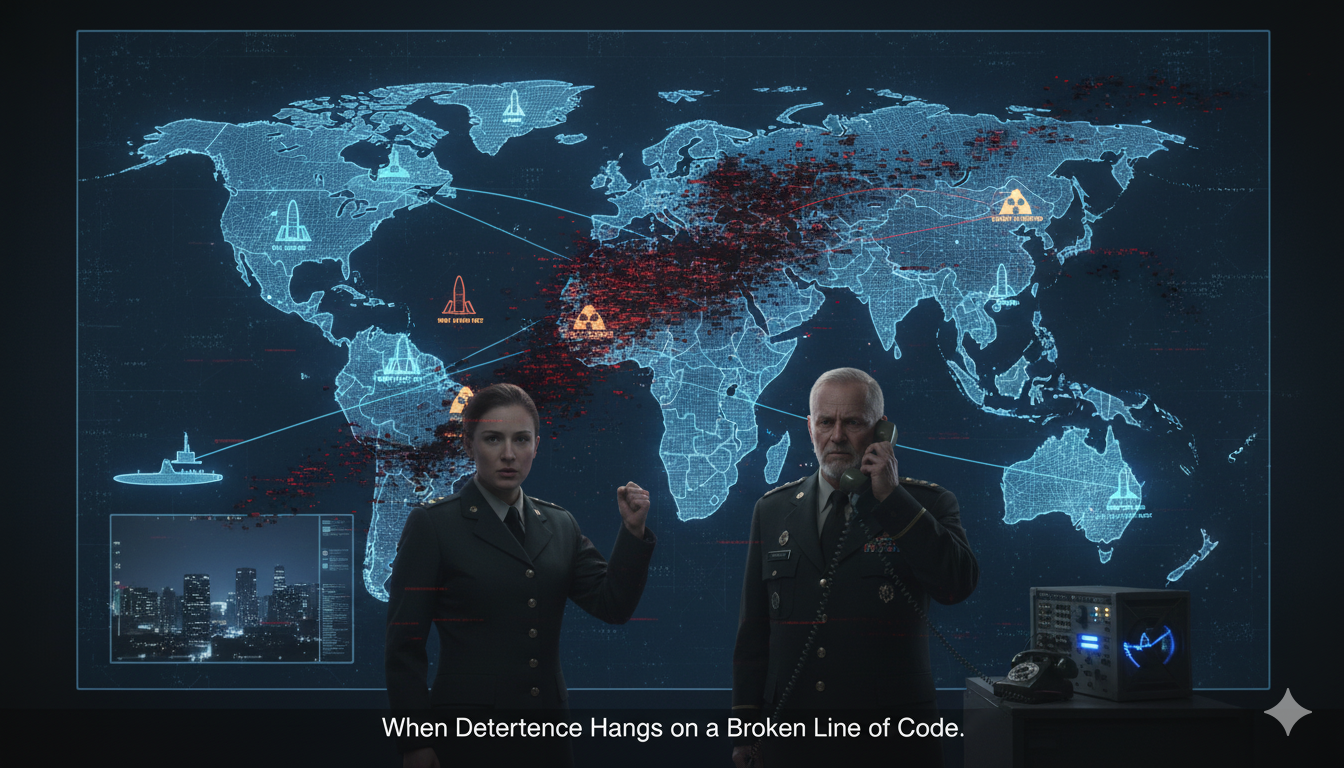
The specter of nuclear war never vanished; it simply evolved. While the Cold War-era triad of bombers, ICBMs, and submarines remains intact, the environment in which they operate has been transformed by the digital age. Today, the greatest threat to strategic stability may not be a new missile, but a sophisticated line of code.

Nuclear Command, Control, and Communications (NC3) form the backbone of a nation’s nuclear arsenal, ensuring that leaders can reliably detect threats, communicate decisions, and, if necessary, launch a retaliatory strike. Originally built for the Cold War era, many of these systems still rely on outdated technologies that were never designed to withstand the cyber challenges of today. As nuclear arsenals expand and doctrines evolve to consider faster or even preemptive use of nuclear weapons, the pressure to upgrade NC3 systems has become urgent. Without modernization, the risk grows that cyber interference, misinformation, or technical failure could trigger a catastrophic miscalculation in a crisis.

Nations are now in a silent arms race to modernize their Nuclear Command, Control, and Communications (NC3) systems. This modernization is not just about replacing aging hardware; it is a desperate sprint to protect the most devastating weapons ever created from a new generation of threats emerging from cyberspace.

The entire logic of nuclear deterrence—Mutually Assured Destruction (MAD)—rests on a single assumption: that a nation’s ability to command and retaliate with its nuclear forces is both survivable and reliable. Cyber threats directly challenge this assumption, making the world more unstable than at any time since the Cold War.

Major powers such as the United States, Russia, and China are investing heavily in modernizing their arsenals, while regional powers like North Korea expand theirs at a rapid pace. North Korea’s open nuclear threats and the possibility of nuclear proliferation in volatile regions like the Middle East add new layers of uncertainty. At the same time, terrorist groups continue to pursue the ambition of building a crude nuclear device or radiological weapon—an event that, even if limited in scope, could destabilize the international order overnight.

Doctrinal shifts further raise the risks. Countries like Russia and Pakistan openly embrace strategies that allow for early or even first use of nuclear weapons in a conventional conflict. By compressing decision-making timelines, these doctrines make accidents, misinterpretations, or rash decisions far more likely—especially when combined with the fog of digital interference.

The Digital Battlefield: Cyber Threats to the Nuclear Triad

The 2010 Stuxnet attack on Iran’s Natanz nuclear facility was a watershed moment in cyber warfare. It proved, for the first time, that a piece of malicious code could cause physical destruction to critical nuclear infrastructure. Stuxnet shattered the long-held belief that “air-gapped” systems—those isolated from the internet—were immune to outside interference. Since then, the nuclear command, control, and communications (NC3) environment has been recognized as a prime target for sophisticated cyber adversaries.

Data Manipulation (Spoofing)

One of the most alarming threats comes from the manipulation of sensor and early-warning data. An adversary could compromise satellites, radar systems, or ground sensors to display a false nuclear launch or incoming missile attack. With national leaders often having only minutes to make a decision, even a brief deception could trigger a catastrophic retaliatory strike based entirely on fabricated data.

Communication Jamming and Spoofing

The nuclear chain of command depends on secure and unbroken communication between leaders and deployed forces. Hackers could attempt to block legitimate launch orders or, even more dangerously, inject fraudulent commands. This could create chaos, hesitation, or mistrust within the command hierarchy—undermining deterrence and raising the possibility of unauthorized escalation.

System Degradation and Paralysis

A cyberattack does not need to trigger a false launch to be effective. By disabling or degrading key communication links, adversaries could blind national leadership and cut off the President or commanders from their nuclear forces. Even temporary paralysis would weaken deterrence, embolden adversaries, and leave decision-makers unsure of the readiness of their arsenal at a critical moment.

The Entanglement Problem

Modern militaries often use overlapping or shared networks for both conventional and nuclear operations. This creates the danger of entanglement: an attack on conventional systems such as air defenses, satellites, or power grids could inadvertently affect nuclear command systems. In a crisis, such disruptions might be misinterpreted as a deliberate attempt to neutralize nuclear capabilities—pushing leaders toward considering a nuclear response to a non-nuclear attack.

Threats to Nuclear Command and Control

Compressed Decision Timelines

Nuclear command and control systems operate under extreme time pressure. At NORAD, operators have less than three minutes to verify early-warning alerts of an incoming missile strike. Long-range missiles from Russia could reach U.S. territory in around 30 minutes, while submarine-launched weapons could arrive in half that time. This means that the U.S. President may have less than ten minutes to review intelligence, consider options, and make a launch decision. The system, as former CIA director General Michael Hayden observed, is “designed for speed and decisiveness, not debate.” Under such pressure, even false or manipulated data could trigger catastrophic decisions.

Cyber Threats to NC3

The reliability of nuclear command, control, and communications (NC3) is increasingly at risk from cyberattacks. Cyber operations can manipulate early-warning data, jam communication channels, or spoof launch orders—introducing dangerous uncertainty into nuclear decision-making. The fear that adversaries could prevent a retaliatory strike by paralyzing NC3 might push leaders to adopt “launch on warning” postures, raising the likelihood of miscalculation. Studies warn that manipulated or corrupted information could lead to accidental nuclear use, while the mere suspicion of compromised data could accelerate escalation.

System Vulnerabilities and Escalation Risks

NC3 is the “brain” of the nuclear arsenal, ensuring that weapons can only be launched on legitimate authority. Yet history shows the system is not foolproof: false alarms, system failures, and human error have nearly triggered nuclear war multiple times. As nuclear systems become increasingly network-connected, they also become more exposed to malware, insider threats, and cyber intrusion. Offensive cyber operations against conventional systems may also be misinterpreted as targeting nuclear assets, creating pathways to unintended escalation.

Erosion of Deterrence Credibility

Cyber threats undermine the predictability on which nuclear deterrence depends. If leaders doubt the reliability of their own NC3, or fear that adversaries could disable it, they may lower thresholds for nuclear use. Analysts warn that future arsenals—linked through advanced communication networks and integrated with emerging technologies—could be both more capable and more fragile. This paradox increases the risk of accidental or unauthorized launches.

The Modernization Imperative

To meet these challenges, NC3 must satisfy three enduring requirements: it must always work under legitimate orders, never allow unauthorized use, and remain resilient under attack. This means enhancing cyber defenses, upgrading early-warning sensors, modernizing mobile command centers, and ensuring survivability against space, cyber, and kinetic threats. As nuclear powers replace their delivery systems over the next two decades, building a next-generation, cyber-hardened, and quantum-safe NC3 is not optional—it is a strategic necessity.

The “Always-Never” Dilemma in the Digital Age

Nuclear threat  is also being  enhanced by cyber warfare. CHERNOBYL nuclear power plant was suspended in June 2017 after being hit by ransomware cyber attack, which caused chaos across Europe. The rising  cyber threat  has put into question the  survivability and reliability of Nuclear Command and Control from cyber attack and other accidents.

At the heart of every nuclear command and control (NC3) system lies a principle often described as the “always-never” dilemma. Nuclear weapons must always work when a legitimate launch order is given, yet they must never allow for an unauthorized or accidental launch. This delicate balance was challenging enough in the analog era; in today’s hyper-connected digital world, it is being tested in unprecedented ways.

Cyber threats strike at the very foundation of this principle. Can decision-makers be absolutely certain that a launch order they receive is authentic and not the product of a spoofed command? Can they trust that early-warning sensors and satellites are showing a genuine incoming missile, rather than fabricated data injected by an adversary? These questions go beyond technical reliability—they reach into the core of deterrence, where trust and confidence in systems determine whether leaders act or hesitate in the most critical moments.

The risk is compounded by the increasing sophistication of adversaries. If an opponent could disable nuclear forces “left of launch”—through malware, communications disruption, or sensor manipulation—leaders might feel pressure to adopt a dangerous strategy of launch on warning. In such a scenario, decisions must be made in minutes or even seconds, often with incomplete or manipulated information. The faster the response timeline, the higher the likelihood of a catastrophic mistake.

Ultimately, the digital age magnifies the peril of miscalculation. A false signal, corrupted command, or delayed communication could cascade into a nuclear launch that no one truly intended. Preserving the integrity of NC3 systems against cyber sabotage is therefore not only a technological challenge but also a fundamental requirement for strategic stability in the 21st century.

Lessons From Real-World Close Calls

History provides sobering reminders of how close the world has come to nuclear catastrophe—even without deliberate cyber interference. These moments reveal how fragile the balance of decision-making can be under immense pressure, and how human judgment has, at times, been the only barrier between false alarms and nuclear war.

In 1983, Soviet officer Stanislav Petrov faced a chilling scenario when Soviet early-warning satellites reported that five U.S. nuclear missiles were inbound. The data urged immediate retaliation, but Petrov doubted the reliability of the alert. Choosing instinct over automation, he dismissed the warning as a malfunction. He was right—the system had mistaken sunlight reflecting off clouds for missile launches. His refusal to trust faulty machine data may have prevented a devastating global conflict.

A decade later, in 1995, a Norwegian scientific rocket carrying atmospheric instruments was misidentified by Russian radar operators as a potential U.S. Trident missile. The alert escalated rapidly, reaching President Boris Yeltsin, who briefly activated the nuclear launch codes before the threat was recognized as harmless. For a brief window, the world stood on the edge of disaster because of a technical misinterpretation—a stark reminder that timing and clarity are everything in nuclear command decisions.

More recently, in 2018, a false emergency alert warned the residents of Hawaii that an incoming ballistic missile was heading toward the islands. Although this was a civil defense mishap rather than a military one, the 38 minutes of chaos that followed exposed the fragility of public trust in warning systems. Families panicked, communications broke down, and the sense of dread was palpable—all triggered by a single erroneous message.

These episodes underscore a critical lesson: human judgment, system reliability, and communication clarity are already stretched to their limits. If technical malfunctions alone can bring the world so close to catastrophe, the prospect of these same systems being manipulated through deliberate cyber deception is far more alarming. A future where attackers can spoof warnings, jam communications, or inject false orders would magnify the risks exponentially—turning split-second decisions into potential triggers of nuclear war.

The Global Modernization Race

As cyber threats and emerging technologies challenge the security of nuclear command and control (NC3) systems, the world’s nuclear powers are racing to modernize. These efforts go far beyond routine hardware replacement—they represent a fundamental rethinking of how deterrence is maintained in a digital, highly networked age. Billions of dollars are being invested in hardening systems, improving resilience, and ensuring that leaders can maintain control of their nuclear arsenals even in the face of sophisticated cyber or space-based attacks.

United States: Building a Digital Shield

The United States has taken perhaps the most visible steps in addressing NC3 vulnerabilities. The 2018 Nuclear Posture Review identified cyber threats as a central risk to deterrence, explicitly calling for NC3 modernization. Key programs are focused on survivability, redundancy, and leveraging cutting-edge technologies.

A major effort involves upgrading airborne command posts, notably the E-4B “Nightwatch” and E-6B “Mercury” aircraft. These flying fortresses are being equipped with advanced satellite communications and secure low-frequency transmission systems, ensuring the President and senior leadership can issue launch commands even if ground-based infrastructure is destroyed or jammed.

The U.S. is also investing in next-generation early warning systems, including the Space-Based Infrared System (SBIRS) constellation and upgraded ground-based radars. These platforms improve the accuracy and resilience of missile detection while resisting spoofing or jamming. To complement this, the Pentagon is experimenting with artificial intelligence to process vast amounts of sensor data in real-time—providing leaders with faster, more reliable insights in crisis conditions.

Russia: Reinforcing Survivability

Russia has accelerated its NC3 modernization in parallel. It has refurbished its Ilyushin Il-80 airborne command aircraft, often called the “Doomsday Plane,” and is developing a third-generation airborne command system. These upgrades aim to ensure Russian leadership can issue nuclear orders even if ground facilities are disabled by cyber or kinetic strikes.

Moscow is also believed to be enhancing its underground command bunkers, secure satellite links, and hardened communications systems to resist disruption. Like the U.S., Russia views NC3 survivability as central to deterrence credibility, particularly given its doctrine that allows for nuclear escalation in the face of conventional threats.

China: Expanding and Securing Its Arsenal

China is rapidly expanding its nuclear arsenal and modernizing the command systems that control it. The development of new missile silos, road-mobile ICBMs, and submarine-launched ballistic missiles necessitates a more advanced NC3 infrastructure to coordinate and secure operations.

Beijing is believed to be investing in hardened command centers, secure fiber-optic and satellite communications, and possibly integrating AI-enabled decision support tools to enhance situational awareness. While China traditionally adhered to a “minimum deterrence” and no-first-use policy, its modernization suggests a growing emphasis on survivability and real-time command, signaling a shift toward greater operational readiness.

Emerging Nuclear Powers: Regional Risks

Other nuclear-armed states are also modernizing, though with fewer resources. India is enhancing its nuclear triad with ballistic missile submarines and long-range missiles, pushing it to upgrade NC3 to ensure survivability and second-strike capability. Cybersecurity concerns are particularly acute given India’s exposure to regional cyber threats.

Pakistan, facing its own strategic pressures, maintains short-range nuclear weapons as part of its doctrine. This reliance on tactical systems creates additional challenges for secure and reliable command and control, as dispersed weapons require more complex coordination.

North Korea, meanwhile, has demonstrated significant progress in missile technology, but its NC3 systems remain opaque. Analysts fear that Pyongyang’s systems may be vulnerable to both external cyber intrusion and internal miscalculation, raising concerns about instability in crisis situations.

A Strategic Technology Race

The modernization of nuclear command and control systems (NC3) by the United States, Russia, China, and other nuclear powers represents far more than a technical upgrade—it is a strategic competition in resilience. Each nation recognizes that nuclear deterrence depends not only on the destructive capacity of its arsenal but also on the confidence that these weapons can be reliably commanded and controlled under all circumstances. A nuclear force is only credible if its leadership can guarantee both survivability and the ability to respond, even in the face of cyber intrusions, electronic warfare, or space-based attacks.

For much of the post–Cold War era, U.S. nuclear command, control, and communications (NC3) systems faced neglect, creating vulnerabilities in a rapidly evolving threat environment. Today, modernization has become a strategic imperative. NC3 is now often described as the “fifth pillar” of nuclear deterrence—on par with the three legs of the triad (ICBMs, SLBMs, and strategic bombers) and the nuclear weapons themselves. Ensuring resilient, survivable, and secure command systems is essential to preserving deterrence credibility in the digital and space age.

U.S. Airborne Command Posts: The E-4B and E-6B

Survivable airborne command centers remain a cornerstone of America’s NC3 modernization. The E-4B Advanced Airborne Command Post, often referred to as the “Doomsday Plane,” provides the President and National Command Authority with the ability to direct nuclear forces even if ground-based systems are destroyed. Rockwell Collins is upgrading its low-frequency transmission systems to ensure survivable communications links with nuclear forces across all levels of conflict.

Complementing this platform, the E-6B Mercury fleet serves as an airborne relay and command post, ensuring continuity if terrestrial control nodes are disrupted. Northrop Grumman is enhancing the E-6B with advanced SATCOM systems, including the Multi-Role Tactical Common Data Link (MR-TCDL), which integrates Ku-band line-of-sight and Ka-band satellite communications. These improvements strengthen the aircraft’s role as the connective tissue of U.S. NC3, enabling secure and redundant communication even under degraded conditions.

Space and Ground-Based Warning Systems

Alongside airborne platforms, the United States is modernizing its missile detection and early warning architecture. The Space-Based Infrared System (SBIRS) provides enhanced detection of missile launches using advanced infrared sensors, while new ground-based radar upgrades increase fidelity and resilience. These systems aim to minimize the risk of false alarms—such as those that nearly triggered nuclear incidents in the past—while ensuring reliable, real-time threat data in an environment where minutes or seconds may decide global survival.

Russia’s Modernization Drive

Russia is also investing heavily in survivable command and control. Its Ilyushin Il-80 airborne command posts—the Russian counterpart to the U.S. E-4B—have undergone modernization and passed state acceptance trials. Designed to command forces during nuclear war, the Il-80 can coordinate across the Land Forces, Navy, Air-and-Space Forces, and Strategic Missile Forces, even in the absence of ground-based infrastructure. Equipped with hardened electronics, in-flight refueling, and special onboard power systems, the Il-80 is optimized for endurance and survivability. Russia has also initiated development of a third-generation airborne command post, led by NPP Polyet, demonstrating its commitment to keeping pace with U.S. survivable command capabilities.

China’s Emerging NC3 Capabilities

China, while newer to the global nuclear competition, is rapidly modernizing its NC3 systems. Historically, Beijing maintained a relatively small arsenal with limited command-and-control infrastructure, but its modernization drive reflects a shift toward greater survivability and sophistication. Reports suggest China is investing in space-based early warning satellites, which would provide it with independent detection capability similar to U.S. and Russian systems. Beijing is also pursuing quantum communications technology to develop secure, tamper-resistant links across its NC3 networks. Its 2017 quantum satellite experiment demonstrated the feasibility of distributing encryption keys via entanglement, a potential leap forward in secure nuclear command communications.

China’s investments reflect its ambition to transition from a “minimum deterrent” posture to a more robust, survivable, and technologically advanced nuclear command structure. However, the rapid pace of development introduces risks of misinterpretation and instability, particularly as China integrates cutting-edge but relatively untested technologies into its NC3 architecture.

This race is increasingly defined by the integration of cutting-edge technologies. Artificial intelligence is being tested to assist decision-making by processing vast amounts of sensor data faster than humans could. Quantum-resistant cryptography is being explored to safeguard communications against future quantum decryption capabilities. New generations of secure satellites, fiber-optic links, and hardened underground bunkers are being developed to ensure leaders can maintain command in the chaos of a cyber or kinetic assault. These investments are meant to close the vulnerabilities exposed by incidents such as Stuxnet and other cyber operations that demonstrated the fragility of “air-gapped” systems once thought untouchable.

The Role of Artificial Intelligence

Artificial Intelligence (AI) is being integrated into NC3 as a powerful tool to strengthen resilience. Several U.S. national security officials believe AI can act as a force multiplier in both cyber defense and operational decision-making. By analyzing massive data streams, identifying anomalies, and mapping probabilistic chains of events, AI systems can help leaders make faster and more informed decisions during nuclear crises. The Pentagon’s Defense Innovation Unit is testing AI prototypes designed to diagnose system errors in real time, adapt defenses against AI-enhanced cyberattacks, and provide alternative strategies to leadership under duress. While promising, this integration also raises questions about automation in nuclear decision-making, where human judgment remains critical.

However, the push for technological dominance comes with its own paradox of risk. The more complex and interconnected these systems become, the greater the chances of hidden flaws, accidental malfunctions, or insider sabotage. Cyber defenses built on AI could themselves be manipulated by adversarial machine learning. Efforts to automate or accelerate decision-making might reduce human oversight, raising the danger of catastrophic miscalculations in moments of crisis. In their bid to outpace rivals, nuclear states may inadvertently create new pathways to instability rather than achieving the security they seek.

Together, the U.S., Russia, and China are driving a new era of NC3 modernization. For Washington, the focus is on AI, space sensors, and resilient airborne platforms. Moscow emphasizes hardened survivability and redundancy, while Beijing experiments with novel technologies like quantum-secured communications. What unites them is the recognition that deterrence in the 21st century depends not only on warheads and delivery systems but also on the resilience of the command-and-control networks that govern them. In this race for resilience, each innovation improves survivability—but also risks introducing new vulnerabilities, complexity, and instability into the most dangerous game humanity has ever played.

Ultimately, modernization is a double-edged sword. While it strengthens deterrence on paper, it also intensifies the pressure of the nuclear dilemma, raising the risk that a single cyber intrusion, spoofed alert, or software failure could be mistaken for a genuine existential threat. In this sense, the NC3 modernization race is not just a contest over resilience but also a gamble with global stability.

Conclusion: The Urgency of Cyber Resilience in NC3

History has already shown how close the world can come to nuclear disaster due to misunderstandings or technical errors. The decision of Soviet officer Stanislav Petrov to ignore what appeared to be a U.S. missile launch in 1983, the Norwegian rocket scare of 1995, and the false ballistic missile alert in Hawaii in 2018 all underscore the fragility of nuclear decision-making under extreme pressure. Importantly, all of these incidents occurred without the deliberate manipulation of cyber actors. The risks multiply when adversaries gain the capability to engineer confusion or disable NC3 systems in real time.

In today’s digital battlefield, the stakes for nuclear command and control are higher than ever. A cyberattack that spoofs missile launch data, jams communications, or injects false orders could push leaders toward a world-ending decision based on deception. The mere perception that an opponent might be able to blind or paralyze NC3 systems creates incentives to launch quickly before command is lost. This “use it or lose it” mentality is the most dangerous byproduct of insecure nuclear command systems, heightening the risk of catastrophic miscalculation.

The path forward lies in building NC3 systems that are resilient, cyber-hardened, and quantum-safe. This requires not only investment in advanced technologies but also rigorous testing, redundancy, and international dialogue to reduce the chances of misinterpretation during crises. Resilience must be designed not just against today’s threats but also against the capabilities of tomorrow—whether in quantum computing, AI-driven cyber tools, or space-based disruptions.

Securing the digital backbone of nuclear deterrence is no longer optional; it is a strategic necessity. If the world’s nuclear powers fail to adapt, they risk undermining the very stability that nuclear weapons are meant to preserve. In the digital age, ensuring that NC3 systems remain reliable under attack is the only way to prevent them from transforming from instruments of deterrence into triggers of catastrophe.


Check Also

Supply Chain Security: The Hidden Weak Link in Global Business

  In today’s hyperconnected world, businesses thrive on global networks of suppliers, vendors, and contractors. …

error: Content is protected !!