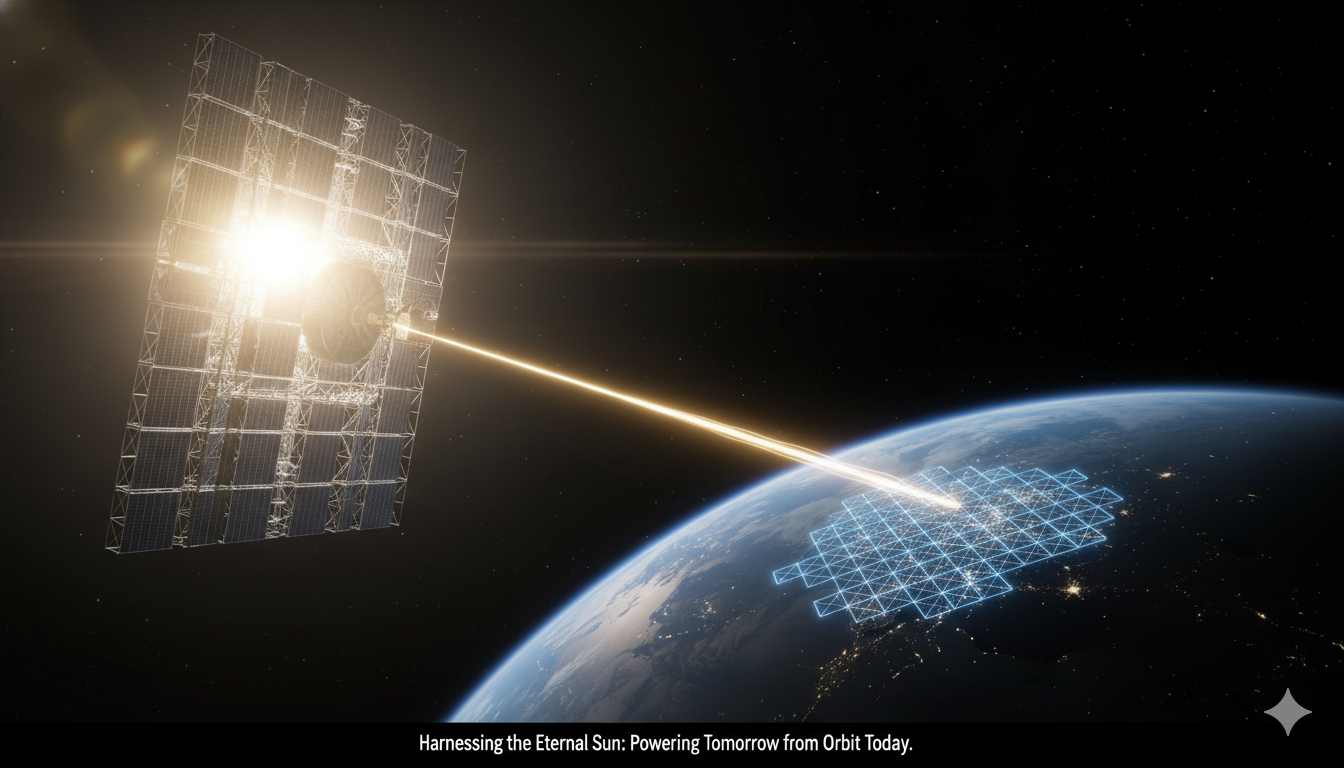
The quest for limitless, clean energy has found a new frontier: space. As the world grapples with climate change and the urgent need to decarbonize, a revolutionary technology is moving from science fiction to strategic reality. Space-Based Solar Power (SBSP) stands at the forefront of this revolution, offering the potential for unlimited, renewable electricity generation. This innovative concept harnesses solar energy directly from space, transmitting it wirelessly to Earth, through microwaves or lasers, and it is quickly becoming the new strategic race in the realm of renewable energy.
While the idea dates back to the 1960s when Dr. Peter Glaser first proposed it, only now—with advances in reusable launch systems, lightweight materials, robotics, and wireless transmission—is the concept becoming technically feasible and economically viable. The stakes are monumental: whoever masters SBSP will not only reshape the global energy sector but also command strategic dominance in the 21st century.
The Unbeatable Advantage: Why Space?
The fundamental appeal of space-based solar power (SBSP) lies in its ability to deliver uninterrupted, reliable energy. Unlike terrestrial solar arrays, which are hindered by nightfall, weather, and seasonal variations, a solar array in space enjoys a constant stream of intense sunlight. Free from the filtering effects of Earth’s atmosphere, it can operate around the clock, ensuring a level of reliability unmatched by any renewable source on the ground.
The potential energy yield is extraordinary. A satellite in geosynchronous orbit can receive 5 to 15 times more solar energy annually than the sunniest locations on Earth. Unlike ground-based solar systems, SBSP faces no efficiency reductions due to the day-night cycle, seasonal variations, or weather conditions. This makes SBSP up to six times more efficient than comparable Earth-based technologies.
With an operational uptime of about 99%, SBSP offers a near-constant energy supply that could revolutionize the global energy mix. On a practical scale, a single orbital array could deliver 250 megawatts of power, with the potential to scale to 5 gigawatts—sufficient to energize a major metropolitan region. To put this into perspective, New York City’s energy needs, which amount to around 20 gigawatts, could be met by a system comprised of just four 5-gigawatt SBSP arrays, illuminating the potential of SBSP to power entire cities.
Beyond urban centers, the applications of SBSP could transform how energy is delivered in critical and underserved environments. Remote communities, disaster-relief operations, and forward-deployed military bases could all benefit from a dependable energy source beamed directly from space. This level of flexibility would strengthen energy security while reducing the logistical and environmental challenges of transporting fuel.
In addition to providing constant renewable energy to the planet, a space solar power plant could, in theory, focus its beam outward and power spacecraft, obviating the need for solar cell wings and greatly increasing power levels and control accuracy. That power could also be used in space to meet the energy demands of future space mining and resource extraction operations. NASA is examining how space solar power could support robotic mining operations on the moon or asteroids–a stepping stone toward enabling long-term human space exploration and possible colonization of the solar system beyond Earth. The energy beams could also direct power to remote areas or even dissipate destructive weather systems like typhoons.
Looking further ahead, SBSP could play a pivotal role in humanity’s expansion into space. By providing power for spacecraft, orbital stations, and even off-world mining operations, it could act as a backbone for a sustainable space economy. As nations and industries push the boundaries of space exploration, SBSP offers not just a clean terrestrial energy solution, but also a foundational infrastructure for a truly spacefaring civilization.
Technology and Challenges
A solar panel in space, positioned above the scattering and absorbing effects of Earth’s atmosphere, can receive about one kilowatt of solar energy per square meter. Yet no solar panel is perfectly efficient. Even the best commercially available photovoltaic cells operate at roughly 30% efficiency, meaning a single square meter of panel yields only about 300 watts of usable power. Scaling this to a gigawatt—the output of a typical nuclear power plant—would require an enormous orbital array stretching several kilometers across and weighing around 10,000 metric tons. For context, the International Space Station has a mass of just 419 metric tons, underscoring the massive scale and daunting engineering challenge of space-based solar power (SBSP).
The primary technical obstacles begin with launch and assembly. Transporting thousands of tons of equipment into orbit would demand fleets of heavy-lift launch vehicles or the development of reusable, ultra-high-capacity systems. The costs associated with these launches, coupled with the difficulty of constructing and maintaining kilometer-scale structures in orbit, make SBSP one of the most resource-intensive energy technologies ever proposed. The complexity is magnified by the fact that such a structure would dwarf the ISS, which already represents one of humanity’s greatest engineering achievements.
Beyond assembly, the fundamental challenge is transmitting harvested energy back to Earth. While solar collection in space is relatively straightforward, safely delivering that power across 36,000 kilometers from geostationary orbit is far more difficult. Researchers are focused on two primary methods: microwave beaming and laser beaming. Microwave transmission is the leading candidate because microwaves pass through the atmosphere with minimal energy loss and are resilient against clouds and rain. The ground-based receivers—rectennas spanning several kilometers—would convert the incoming beam back into electricity while maintaining safe energy densities for people, animals, and aircraft.
Still, microwave systems bring their own challenges. These include synchronizing the output of billions of tiny antennas to form a tightly focused beam, preventing diffraction losses as the energy passes through water vapor, and designing lightweight orbital mirror structures to enable precision formation flying. Engineers must also develop ultra-high-voltage transmission systems with minimal resistive loss to ensure that the captured solar power is not wasted before reaching Earth.
Laser beaming, by contrast, offers advantages in precision and allows for smaller ground stations. However, lasers face severe atmospheric interference from rain, fog, and dust, drastically reducing efficiency. Conversion losses from sunlight to laser light also remain high, and the concentrated nature of laser beams limits their total power output. As a result, hundreds or thousands of laser-equipped satellites would be needed to match the output of a single microwave-based system. While lasers may be viable for niche applications requiring pinpoint energy delivery, microwave systems remain more practical for gigawatt-scale power transfer.
Beyond the transmission method itself, the engineering hurdles are immense. Building and assembling kilometer-scale solar arrays in orbit will demand new approaches to space construction and robotics. Maintaining pinpoint accuracy in beam targeting from geostationary orbit—36,000 kilometers above Earth—requires breakthroughs in guidance, navigation, and control systems. Finally, the use of ultra-lightweight yet durable materials is essential to keep launch costs feasible, making material science as critical as orbital engineering.
Ultimately, SBSP represents a trade-off between immense opportunity and nearly insurmountable engineering barriers. On one hand, it offers continuous, weather-independent solar power unconstrained by day-night cycles. On the other, it requires breakthroughs in materials science, robotics, orbital construction, and wireless power transmission. Meeting these challenges will demand decades of sustained research and investment. Yet if solved, SBSP could redefine global energy production and provide humanity with a virtually limitless clean power source
The Global SBSP Race: Who’s Leading?
As the world seeks to replace fossil fuels with clean alternatives, the strategic race for SBSP has intensified. Major players such as the United States, Japan, China, and Russia are investing heavily in SBSP research and development. These nations recognize the strategic significance of SBSP, from achieving energy independence to its potential use in space exploration and colonization.
China: The Aggressive Contender
China has elevated space-based solar power (SBSP) to the level of a national strategic priority, integrating it into its long-term space and energy plans. Its roadmap is the most ambitious in the world, with a 100-kilowatt experimental satellite targeted for 2025, a megawatt-scale geostationary demonstrator by 2035, and a full commercial gigawatt-class orbital power station by 2050. Such a timeline positions China to potentially dominate this transformative technology within the next three decades.
To achieve this, China is aggressively developing enabling technologies. The Tiangong space station is being used as a testbed for robotic in-orbit assembly—critical for constructing kilometer-scale solar arrays in geostationary orbit. On Earth, a 33-acre SBSP research facility in Chongqing has been built to test wireless power transmission methods, including long-distance microwave beaming. Together, these efforts illustrate a whole-of-nation push that combines government policy, research institutions, and state-backed industry in pursuit of technological leadership.
United States: A Public-Private Revival
The U.S. approach to SBSP has historically been marked by cycles of enthusiasm and retreat, but the landscape is shifting. The U.S. Naval Research Laboratory (NRL) has pioneered innovations like the “sandwich tile”—a modular unit that combines photovoltaics, electronics, and a transmission antenna. This design makes large-scale space assembly feasible, as thousands of tiles can be robotically pieced together to form vast solar power stations. Such modularity is essential to scaling SBSP without prohibitively complex launches.
Private industry is also beginning to play a decisive role. Aerospace giants like Northrop Grumman and new entrants are leveraging the sharp decline in launch costs driven by SpaceX’s Falcon 9 and Starship programs. These cheaper, heavier-lift launches make once-theoretical SBSP projects more financially plausible. The U.S. strategy is less about centralized government programs and more about harnessing its public-private ecosystem, with the Department of Defense serving as both a funder and potential first customer for space-to-Earth energy beaming.
Japan: The Quiet Pioneer
Japan has been a pioneer in wireless power transmission for decades, long before SBSP re-entered the global spotlight. The Japan Aerospace Exploration Agency (JAXA) demonstrated microwave power beaming across 55 meters on Earth, validating critical physics and engineering principles. Japan’s motivation is deeply tied to its energy security: after the Fukushima nuclear disaster in 2011, the nation sought alternatives to nuclear power and costly energy imports, with SBSP emerging as a potential long-term solution.
Japan’s roadmap is pragmatic yet ambitious. Its goal is to deploy a 1-gigawatt commercial SBSP system in the 2030s, enough to power hundreds of thousands of homes. To reach this milestone, JAXA is focusing on incremental demonstrations, improving wireless transmission efficiency, and developing international collaborations. While its programs receive less global media attention compared to China or the U.S., Japan’s long head start and proven technical expertise make it a quiet but formidable competitor in the SBSP race.
Europe: Seriously Entering the Fray
The European Space Agency (ESA) has recently taken decisive steps toward SBSP after years of study. Following encouraging cost-benefit analyses, ESA is lobbying its member states to fund a megawatt-scale space power demonstrator by 2030, with the longer-term goal of building a gigawatt-scale operational power station by 2040. This timeline reflects Europe’s broader strategy to diversify energy sources and reinforce energy independence in the face of geopolitical pressures.
Industry is also driving momentum. Airbus has already showcased a small-scale end-to-end SBSP system in a controlled hangar environment, proving feasibility from solar collection to wireless energy delivery. Meanwhile, the UK and India have commissioned feasibility studies of their own, signaling growing recognition that SBSP could reshape global energy markets. Europe’s entry represents more than just another competitor—it’s a coalition-based effort that could unlock multinational investment and shared infrastructure, giving it unique leverage in the race.
Other players such as the UK and India are conducting feasibility studies, positioning themselves to benefit from the technology once it matures. The global race underscores a shared understanding: the first nation to master SBSP could control not only energy flows but also a decisive strategic advantage.
The Dual-Use Dilemma: Power and Security
The transformative promise of Space-Based Solar Power (SBSP) also carries a shadow: its inherent dual-use nature. A system capable of transmitting vast amounts of energy to Earth could, in theory, be repurposed as a weapon. A misaligned or deliberately redirected multi-gigawatt microwave or laser beam could cause severe damage to infrastructure or even pose risks to human life. While SBSP is envisioned as a tool for delivering clean energy to cities, remote regions, or disaster zones, the possibility of its misuse cannot be ignored.
This dual-use dilemma elevates SBSP from a purely technical challenge to a matter of international security. Just as nuclear power required global treaties to separate civilian energy use from military applications, SBSP will demand robust oversight, transparency, and international agreements. Without such safeguards, the perception of SBSP as a potential space-based weapon could spark distrust, arms races, or even conflicts. Ensuring that SBSP remains a force for sustainable development rather than a tool of coercion will be one of the defining governance challenges of the coming decades.
The Path Forward
The path to realizing Space-Based Solar Power (SBSP) is still filled with formidable hurdles. The cost of launching and assembling thousands of tons of hardware into orbit remains one of the biggest challenges. While reusable rockets and commercial launch providers are driving costs down dramatically, the scale of materials needed for kilometer-wide arrays still pushes the limits of today’s capabilities. In parallel, major engineering challenges—such as improving wireless power transmission efficiency over thousands of kilometers and managing extreme thermal loads in orbit—demand breakthrough innovation.
Despite these barriers, the momentum is accelerating. Advances in robotics, in-orbit servicing, lightweight materials, and wireless energy transmission have moved SBSP from a futuristic vision to a near-term possibility. More importantly, SBSP represents the ultimate convergence of the space and energy sectors. It holds the promise of delivering a constant, abundant, and clean energy supply to Earth—something no terrestrial renewable source can match. In doing so, it could dramatically reduce reliance on fossil fuels, reshape global energy markets, and alleviate the geopolitical pressures tied to energy scarcity.
At its core, the race for SBSP is about more than technology—it is about energy security, climate stability, and leadership in space. The nation or consortium that masters SBSP first will not only command a revolutionary power source but also hold the “ultimate high ground” in space. Such dominance would extend beyond economics to defense, diplomacy, and global influence.
In this sense, SBSP is both a technological and geopolitical race to define humanity’s future. If successful, it could become the backbone of a new clean-energy era, enable sustained human activity in space, and serve as a cornerstone of the world’s transition to a more sustainable civilization. The question is no longer whether SBSP is possible, but who will be bold enough to make it a reality first.
References and Further Reading
- Chinese Academy of Space Technology (CAST). Space Solar Power Plant Project
- U.S. Naval Research Laboratory. Sandwich Module Prototype for Space Solar Power
- Japan Aerospace Exploration Agency (JAXA). Wireless Power Transmission Demonstration
- European Space Agency (ESA). SOLARIS Initiative
Lightweight space solar panels have the potential to generate 1 kW of power per kilogram, requiring 4,000 metric tons of panels to produce 4 gigawatts of power in space. The energy captured by these panels would be transmitted back to Earth through wireless antennas. However, the economic feasibility of space-based solar power (SBSP) faces significant technical challenges.
While these technological hurdles loom large, the pursuit of space-based solar power remains a compelling endeavor, driven by its potential to revolutionize our approach to sustainable energy generation.
The realization of SBSP as a viable and sustainable energy source is not without hurdles. These include the high initial costs of launching and maintaining solar arrays in space, as well as the development of efficient wireless power transmission systems.
Addressing these challenges will require collaboration between nations, private companies, and research institutions.
The Strategic Race for Clean Energy
Space-Based Solar Power holds the key to a cleaner, more sustainable future. By harnessing the virtually unlimited power of the sun from space, we can transform the way we generate electricity, reduce our environmental footprint, and meet the world’s growing energy demands.
Ralph Nansen, a prominent advocate from the US-based organization Solar High, emphasizes the urgency for the United States to take a leading role in developing Space-Based Solar Power (SBSP). He underscores that the first entity to harness SBSP on a large scale will attain a dominant position in the global economy, akin to England’s influence during the industrial revolution due to coal.
One noteworthy endeavor in this domain is the U.S. Naval Research Laboratory’s (NRL) innovative approach. They are constructing a groundbreaking “sandwich” module that combines photovoltaic panels to capture solar energy, an electronics system to convert it into radio frequency, and an antenna to efficiently transmit power to Earth. The NRL envisions assembling numerous such modules in space using robotics, a project already in progress within the NRL’s Space Robotics Group. The end goal is to create a highly potent satellite covering a kilometer in size, capable of delivering a substantial and consistent supply of remote power.
United States: Leading the Charge
The United States, alongside Japan, China, and Russia, has embarked on a substantial investment in Space Solar Power (SSP). NASA, in particular, is exploring SSP’s potential to support robotic mining operations on the moon and asteroids, laying the foundation for future human space exploration and potential colonization beyond Earth. The U.S. military is also interested in SSP for remote bases, disaster missions, and cost-saving in expeditionary missions. Private companies like Northrup Grumman and Lockheed Martin are collaborating with NASA to develop advanced solar arrays for extraterrestrial applications, emphasizing their commitment to this emerging technology.
China: A Rising Contender
China is aggressively pursuing SSP, recognizing its strategic significance. Researchers in China have narrowed the gap between themselves and leading countries in SSP research. They plan to launch small solar satellites as early as 2021, followed by larger plants capable of beaming energy back to Earth via lasers. China is actively using its newly-completed Tiangong space station to test key SSP technologies, including on-orbit assembly of modules. By 2050, China aims to have a full-sized, commercially viable space-based solar plant in operation, making it a strong contender in the SSP race.
China is at the forefront of pioneering space-based solar power (SBSP) technology, with ambitious plans to build the world’s first solar power station in space, heralding the prospect of virtually limitless and clean energy. The Chinese government, as reported in Science and Technology Daily, is actively exploring the potential of SBSP and is constructing a testing facility in Chongqing’s Bishan district to evaluate the feasibility of this innovative concept. This 33-acre test facility is dedicated to advancing space transmission technologies while studying the effects of beaming microwaves back to Earth on living organisms.
China is leveraging its newly completed Tiangong space station to test essential SBSP technologies. The Tiangong space station’s robotic arms, which are already operational on its exterior, will be employed for testing the on-orbit assembly of modules crucial for SBSP experiments, as highlighted by Yang Hong, the chief designer of the Tiangong space station.
In the realm of research and development, China has made significant strides in wireless energy transmission and has proposed various energy-collecting solutions. The China Aerospace Science and Technology Corporation aims to launch small solar satellites capable of harnessing energy in space, with plans to subsequently test larger facilities with advanced functions like beaming energy back to Earth via lasers. A receiving station, slated for construction in Xian, will further augment this ambitious endeavor.
Looking ahead, China envisions the deployment of a full-scale, commercially viable space-based solar power plant by 2050. This vision is underpinned by China’s commitment to conducting a “Space high voltage transfer and wireless power transmission experiment” in low Earth orbit by 2028, followed by a second phase experiment in geostationary orbit in 2035. The final phases of the project, anticipated for 2050, aim to achieve energy generation capacities of 10 MW and 2 gigawatts. These monumental goals necessitate substantial advancements in power transmission, orbital assembly capabilities, beam steering accuracy, and transmission architecture.
China’s dedication to SBSP innovation is underscored by its completion of the world’s first full-link and full-system ground test system for SBSP, realized at Xidian University in June 2022. Furthermore, funding for research into the construction of kilometer-scale objects in orbit has been secured, a development that promises to address the intricate challenge of assembling colossal arrays for solar power collection and transmission.
China Association for Science and Technology (CAST) has unveiled plans for a 100kW SBSP demonstration, scheduled for low Earth orbit by 2025, followed by the deployment of a fully operational SBSP system in geostationary orbit by 2050. This visionary project envisions a satellite weighing over 10,000 lbs., surpassing anything previously placed into orbit, including the International Space Station. As China advances toward the realization of SBSP, its pursuit of this groundbreaking technology promises to transform the landscape of energy generation and propel progress across diverse fields, including energy, electricity, materials, and aerospace, as articulated by Wang, an academician of the Chinese Academy of Sciences.
Japan: Microwaves from Space
Japan, a pioneer in SSP research, is focusing on wireless microwave transmission of solar power from space. JAXA has already demonstrated successful microwave transmission experiments, and while practical use is expected in the 2030s, Japan’s roadmap envisions a 1-gigawatt commercial system by that time. Japan’s interest in SSP is partly driven by its quest for safe and sustainable energy sources following the Fukushima disaster.
Japan, spurred by the Fukushima disaster and its commitment to safe, sustainable energy solutions, is at the forefront of research into space-based solar power (SBSP). The Japan Aerospace Exploration Agency (JAXA), a global leader in SBSP research, has laid out an ambitious technology roadmap that envisions a path to a 1-gigawatt commercial SBSP system by the 2030s, matching the output of a typical nuclear power plant.
JAXA has already demonstrated the feasibility of wireless microwave transmission of solar power in space. In a groundbreaking experiment conducted in March 2015, JAXA successfully beamed 1.8 kilowatts of electricity via microwave transmission over a distance of 55 meters to a precise target on a receiver. This transmitted microwave energy was efficiently converted into direct electrical current at the receiver’s end. While the ultimate goal is to establish microwave-transmitting solar satellites approximately 35,000 kilometers from Earth, which could generate up to one gigawatt of electricity with a ground-based receiver spanning roughly 3 kilometers (1.9 miles) in radius, it’s acknowledged that practical implementation may take several years, potentially into the 2030s. Importantly, the low-energy density of the transmitted microwaves ensures safety, minimizing the risk to wildlife and aircraft along their path, as confirmed by a JAXA spokesperson. Japan’s commitment to SBSP underscores its dedication to transforming the energy landscape and ensuring a sustainable, safe, and clean energy future.
Russia: Prototyping SSP
Roscosmos, the Russian Federal Space Agency, is developing a working prototype of a 100-kilowatt SSP system. While no launch date has been announced, Russia’s interest in SSP signifies its involvement in the global race for space-based solar power.
UK, Europe:
In November 2020, the UK government initiated research into space-based solar power (SBSP) systems, envisioning large solar power satellites that capture solar energy and convert it into high-frequency radio waves for safe transmission to ground-based receivers integrated with the electrical power grid. Led by Frazer-Nash Consultancy, the study explores the engineering and economic feasibility of this concept, examining its potential to provide affordable energy to consumers and the requisite technological advancements. Martin Soltau, Frazer-Nash’s space business manager, highlighted their efforts to evaluate leading international solar power satellite designs and outlined their plan to deploy a functional SBSP system by 2050. Recent developments in privately-led space ventures have significantly reduced the cost of rocket launches and the weight required for such an ambitious project, making space-based solar power more attainable than ever before.
In September 2022, engineers at European aerospace firm Airbus showcased a potential future in clean energy. They harnessed sunlight using solar panels, converted it into microwaves, and transmitted the energy across an aircraft hangar, where it was reconverted into electricity, illuminating a model city. While the demonstration delivered a modest 2 kilowatts over a distance of 36 meters, Europe is emerging as a hub for serious consideration of space solar power. The European Space Agency (ESA) commissioned two cost-benefit studies on space solar power, which indicated its potential competitiveness with ground-based renewables, even at a higher cost similar to nuclear power. ESA is taking the concept seriously, seeking funding from member states to assess technical challenges. If the results prove favorable, ESA intends to initiate a full-scale effort in 2025. With a budget ranging from €15 billion to €20 billion, ESA aims to deploy a megawatt-scale demonstration facility in orbit by 2030 and scale up to gigawatts, equivalent to a conventional power station, by 2040, paving the way for a sustainable energy future.
India: Emerging Interest
India has begun investing in a ‘solar mission’ and expressed interest in partnering with the United States on SSP. The UK, too, has commissioned research into SSP systems, considering engineering, economics, and affordability.
As countries worldwide recognize the need for sustainable energy sources and the strategic importance of SSP, a competitive global race is underway. Collaboration between nations and private enterprises is key to overcoming technical and economic challenges and realizing the potential of Space Solar Power as a revolutionary clean energy source.
Dual Use
Remote power has evident advantages for various sectors, particularly in scenarios where access to a traditional electric grid is challenging. One prominent beneficiary of this technology is the military, which can utilize remote power to energize bases in isolated locations, bolstering operational capabilities and reducing reliance on costly fuel sources.
Furthermore, remote power holds substantial promise for industries engaged in energy exploration, such as shale or Arctic expeditions. In these contexts, where conventional energy sources are scarce, remote power solutions can serve as a vital source of sustainable energy, facilitating critical operations far from civilization.
The potential benefits extend beyond military and energy sectors. The United States Military, recognizing the cost-saving potential, is actively exploring this concept. By harnessing solar power from space, they envision significant fuel cost savings and unprecedented flexibility in expeditionary missions. The ability to redirect solar power anywhere on the planet empowers them to adapt to diverse and dynamic operational requirements efficiently.
Additionally, remote power solutions, such as Solar Power Satellites (SPS), have immense utility in disaster relief missions. Portable rectennas can be rapidly deployed to capture microwave energy from space, converting it into essential electrical power. This agility in energy provision enhances disaster response capabilities, ensuring quick and efficient support in critical situations.
While the pursuit of an inexhaustible source of renewable energy is a noble endeavor in combating climate change, there are valid concerns regarding the potential militarization of lasers generated within a Space-Based Solar Power (SBSP) system. The fundamental difference in the nature of coherent radiation emitted by lasers compared to the microwave or radio wave approach raises apprehensions.
Indeed, if weaponized, a high-power laser from an SBSP platform could unleash devastating destruction upon a city within a matter of minutes or hours, as cautioned by experts like Schubert. The positioning of a satellite in geostationary orbit affords it an unparalleled vantage point, effectively granting a tactical advantage akin to the ultimate “high ground.” Given the inherent vulnerabilities of any system to hacking, the prospect of allowing a 5 gigawatt laser in geostationary orbit becomes a matter of significant global concern. As nations recognize the risks and complexities associated with such formidable laser technologies, a thoughtful and international approach is essential to ensure the responsible use of SBSP while addressing security challenges.
The Future of Clean Energy
As the world races toward a more sustainable future, the pursuit of Space-Based Solar Power has taken center stage. This revolutionary technology has the potential to provide clean, abundant energy to people around the world while reducing our reliance on fossil fuels and curbing the impact of climate change. The journey to harnessing SBSP’s full potential is challenging, but the benefits are monumental—a cleaner Earth and a boundless source of renewable energy for generations to come. The strategic race for SBSP is not just about energy; it’s about shaping the future of our planet and securing a brighter, cleaner tomorrow for generations to come.
References and Resources also include
http://en.people.cn/n3/2017/1102/c90000-9288036.html
http://blogs.discovermagazine.com/lovesick-cyborg/2017/09/30/4111/#.WkplrN-WY2w
https://www.greenmatch.co.uk/blog/2014/10/space-based-solar-power
https://edition.cnn.com/2019/03/03/asia/china-plans-solar-power-in-space-intl/
International Defense Security & Technology Your trusted Source for News, Research and Analysis