
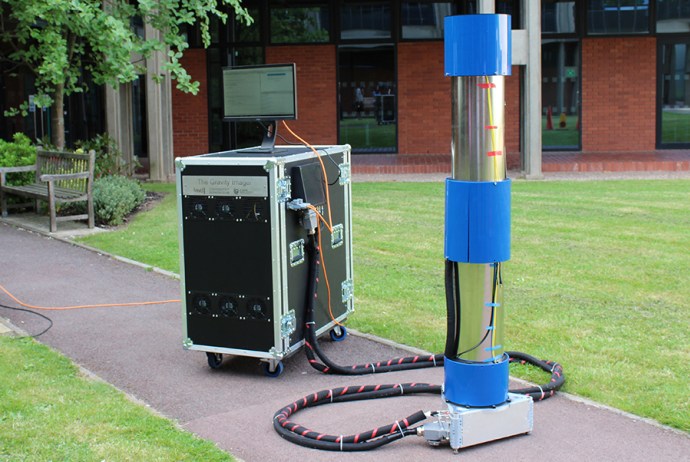

Quantum sensors are measuring device that takes advantage of quantum correlations, such as states in a quantum superposition or entanglement, for better sensitivity and resolution than can be obtained by classical systems. QP will boost the capabilities of all sorts of sensory devices, such as gravimeters, which are used to measure the strength of a gravitational field. Quantum effects disappear when exposed to any outside interference or noise, so any quantum system or device must be carefully shielded and cooled to very low temperatures. This has limited their use in many real-world applications.
Geophysical surveying is widely used for the location of subsurface features. Commonly used geophysical techniques such as ground-penetrating radar (GPR), electromagnetic (EM) conductivity, electrical resistivity and seismic methods have been successfully used to locate underground features in the near-surface.
Current technology is limited in terms of its resolution (thus size of features it can detect) and penetration depth. An alternative is to use “passive” technologies such as magnetic or gravity surveying which rely only on being able to measure the potential field generated by the target of interest and to distinguish it from the regional field and signals from other features above or below the ground.
Our mobile phones currently contain a gravity sensor which is accurate to 0.015 m/s2, good enough to tell you which way is up. New high sensitivity gravity measurement devices, such as gravity MEMS and quantum gravity sensors are being developed. The University of Glasgow’s Quantum enhanced imaging hub ‘QuantIC’ are investigating MEMS devices that can measure the acceleration due to gravity to 10-8 m/s2, good enough to detect a 10m3 cavity, such as a sinkhole, located 10m under the ground.
Quantum technology (QT) gravity sensors potentially offer a step-change in technology for locating features which lie outside of the currently detectable range in terms of size and depth, However, Quantum sensors are just becoming commercially available.
The Gravity Pioneer project, which has been awarded £6 million in research funding from UK Research and Innovation, was announced in Nov at the 2018 National Quantum Technologies Showcase in London. The Gravity Pioneer project will be led by leading environmental and engineering services company RSK and consist of 12 project partners from prominent organisations currently engaged in quantum technologies in the UK: Teledyne e2v, Fraunhofer UK, Altran, Geomatrix Earth Science, Magnetic Shields, UniKLasers, Silicon Microgravity, Optocap, QinetiQ, the University of Birmingham and the University of Southampton. The project aims to build and test a new gravity instrument that will have demonstrable benefits over existing technologies on the market.
Quantum gravimetry will bring a range of economic, social and environmental benefits in the coming years,” Graeme Malcolm, CEO and co-founder of M Squared said. “Applications can be envisaged in many sectors, from the detection of new oil and gas deposits, surveying unknown underground infrastructures such as pipes and cables, even monitoring the water table. If we can transfer the technology into accurate seismic mapping, it could be used to predict natural disasters ranging from avalanches and volcanic eruptions to tsunamis.”